Frequently purchased together
-
My Good Green Bokashi Plus 菌种混合物 - 1 公斤
常规价格 $16.78常规价格 -
My Good Green Bokashi Pro-Gro - 1.5 公斤
常规价格 $40.99常规价格 -
My Good Green Ferminator 植物清洗剂 - 500 毫升
常规价格 $41.88常规价格 -
我的好绿肥植物清洗剂 - 1升
常规价格 $66.88常规价格


Reviews are submitted by verified customers after purchase. This section shows a summary of product feedback rather than the full individual review list.

门店库存
Newmarket, Ontario (Head Office)
1175 Stellar Drive, Unit #5
Newmarket, ON L3Y 7B8
- Mon10:00am–6:00pm
- Tue10:00am–6:00pm
- Wed10:00am–6:00pm
- Thu10:00am–6:00pm
- Fri10:00am–6:00pm
- Sat10:00am–4:00pm
- SunClosed


Barrie, Ontario
106 Saunders Road, Unit #2A
Barrie, ON L4N 9A8
- Mon10:00am–6:00pm
- Tue10:00am–6:00pm
- Wed10:00am–6:00pm
- Thu10:00am–6:00pm
- Fri10:00am–6:00pm
- Sat10:00am–4:00pm
- SunClosed
Pickering, Ontario
719 Krosno Boulevard
Pickering, ON L1W 1G4
- MonClosed
- Tue10:00am–5:00pm
- Wed10:00am–6:00pm
- Thu10:00am–6:00pm
- Fri10:00am–6:00pm
- Sat11:00am–4:00pm
- SunClosed
Winnipeg, Manitoba
915 McLeod Avenue, Unit #4
Winnipeg, MB R2G 0Y4
- Mon10:00am–6:00pm
- Tue10:00am–6:00pm
- Wed10:00am–6:00pm
- Thu10:00am–6:00pm
- Fri10:00am–6:00pm
- Sat11:00am–3:00pm
- SunClosed
Province:
Order Within:
—
Estimated Delivery:
—
Free Shipping (Canada):
—
Free Shipping (Ontario):
—
数量
Qualifies for Free Shipping Promotion
Description
Description
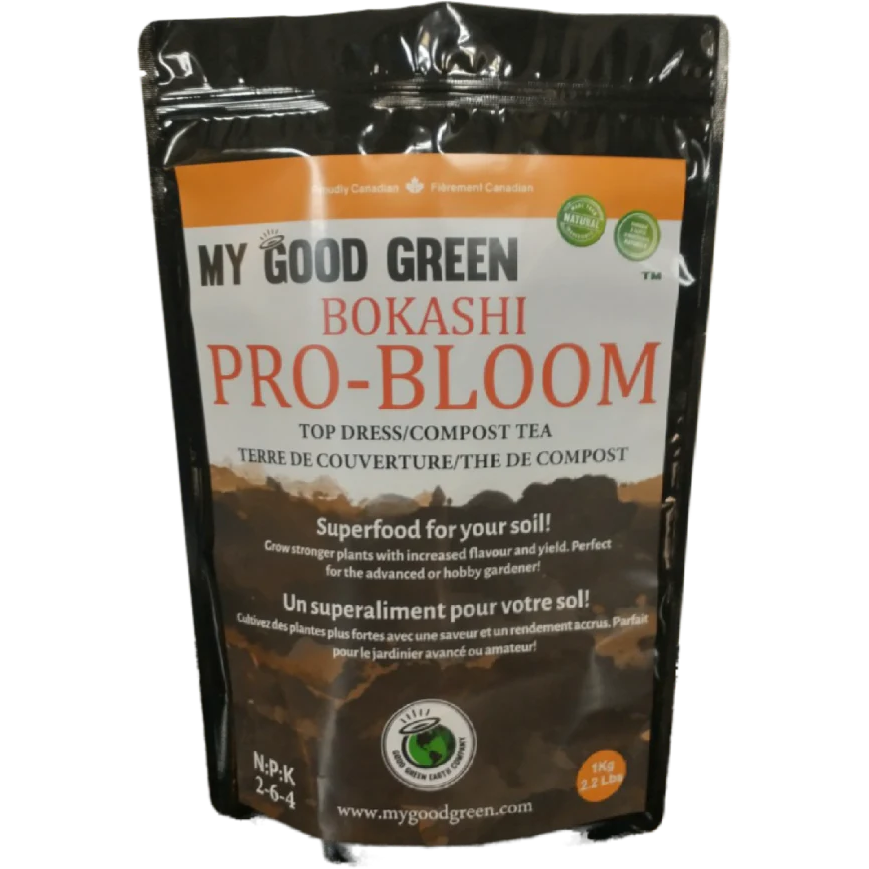
My Good Green Bokashi Pro-Bloom Top Dress & Compost Tea is a fermented top dress and compost tea made to support plant growth and harvest-ready performance with beneficial microbes and minerals. This organic fertilizer is designed for gardeners who want a living, microbe-rich amendment that helps keep nutrition available when plants are pushing toward a strong finish.
The defining feature is fermentation. Bokashi Pro-Bloom is positioned as a fermented top dress, which means it’s built around biologically active inputs rather than a simple mineral salt approach. That fermentation focus pairs with a “full of beneficial microbes” claim from the brand, making this a strong fit for growers who care about soil life as part of the growing process. It’s also described as a stand-alone organic fertilizer, giving it broad usefulness in gardens and containers where a single product is preferred.
In a compact, buyer-friendly facts layer, Bokashi Pro-Bloom carries an NPK of 2-6-4. The ingredient profile centers on a mineral blend that includes Volcanaphos rock dust, soft rock phosphate, and potash, supported by magnesium and calcium carbonate. The formula also includes organic inputs such as kelp and beet root molasses, bringing a mix of plant- and mineral-based components into one fermented amendment.
What this does for the plant is about keeping growth steady and reducing setbacks. My Good Green specifically describes it as correcting deficiencies and optimizing plant growth, which speaks to the product’s role as a supportive top dress when plants need nutrition to stay on track. The brand also frames it as “everything your plants need to harvest,” so it’s built to back the run-up to harvest rather than feeling like a single-purpose niche input. The result is a product aimed at stronger overall performance, with a balanced approach that supports both plant needs and the soil environment.
Bokashi Pro-Bloom is suitable for top dressing and compost tea, and it’s also presented as suitable for foliar application. That versatility matters for buyers who want one fermented amendment that can fit different styles of garden management without turning into a shelf full of one-off products.
My Good Green Bokashi Pro-Bloom Top Dress & Compost Tea is a good fit for gardeners looking for a fermented organic fertilizer with beneficial microbes, a mineral-rich profile, and a 2-6-4 NPK—especially for anyone who wants a soil-first approach that supports consistent growth and a confident finish.
Product benefits: Flowering Stage; Indoor; Outdoor; Coco Coir Safe; Soil; Soilless; Organic; Microbial Support; Balanced PK Formula; Trace Mineral Support; Foliar Ready; Multi-Media Ready; Plant-Available Nutrition; Organic Matter; Bloom Support.
Guaranteed analysis: Total Nitrogen (N): 2.0%; Water Soluble Nitrogen (N): 1.0%; Water Insoluble Nitrogen (N): 1.0%; Available Phosphoric Acid (P2O5): 6.0%; Soluble Potash (K2O): 4.0%; Calcium (Ca): 1.7%; Total Magnesium (Mg): 0.6%; Sodium (Na): 0.15%; Organic Matter: 86.6%.
Derived from: Wheat Bran; Carbonatite; Volcanophos Rock Dust; Sulfate of Potash; Hemp Seed Protein Powder; Blackstrap Molasses; Kelp Meal; Sea Salt; Pickling Salt.
The defining feature is fermentation. Bokashi Pro-Bloom is positioned as a fermented top dress, which means it’s built around biologically active inputs rather than a simple mineral salt approach. That fermentation focus pairs with a “full of beneficial microbes” claim from the brand, making this a strong fit for growers who care about soil life as part of the growing process. It’s also described as a stand-alone organic fertilizer, giving it broad usefulness in gardens and containers where a single product is preferred.
In a compact, buyer-friendly facts layer, Bokashi Pro-Bloom carries an NPK of 2-6-4. The ingredient profile centers on a mineral blend that includes Volcanaphos rock dust, soft rock phosphate, and potash, supported by magnesium and calcium carbonate. The formula also includes organic inputs such as kelp and beet root molasses, bringing a mix of plant- and mineral-based components into one fermented amendment.
What this does for the plant is about keeping growth steady and reducing setbacks. My Good Green specifically describes it as correcting deficiencies and optimizing plant growth, which speaks to the product’s role as a supportive top dress when plants need nutrition to stay on track. The brand also frames it as “everything your plants need to harvest,” so it’s built to back the run-up to harvest rather than feeling like a single-purpose niche input. The result is a product aimed at stronger overall performance, with a balanced approach that supports both plant needs and the soil environment.
Bokashi Pro-Bloom is suitable for top dressing and compost tea, and it’s also presented as suitable for foliar application. That versatility matters for buyers who want one fermented amendment that can fit different styles of garden management without turning into a shelf full of one-off products.
My Good Green Bokashi Pro-Bloom Top Dress & Compost Tea is a good fit for gardeners looking for a fermented organic fertilizer with beneficial microbes, a mineral-rich profile, and a 2-6-4 NPK—especially for anyone who wants a soil-first approach that supports consistent growth and a confident finish.
Product benefits: Flowering Stage; Indoor; Outdoor; Coco Coir Safe; Soil; Soilless; Organic; Microbial Support; Balanced PK Formula; Trace Mineral Support; Foliar Ready; Multi-Media Ready; Plant-Available Nutrition; Organic Matter; Bloom Support.
Guaranteed analysis: Total Nitrogen (N): 2.0%; Water Soluble Nitrogen (N): 1.0%; Water Insoluble Nitrogen (N): 1.0%; Available Phosphoric Acid (P2O5): 6.0%; Soluble Potash (K2O): 4.0%; Calcium (Ca): 1.7%; Total Magnesium (Mg): 0.6%; Sodium (Na): 0.15%; Organic Matter: 86.6%.
Derived from: Wheat Bran; Carbonatite; Volcanophos Rock Dust; Sulfate of Potash; Hemp Seed Protein Powder; Blackstrap Molasses; Kelp Meal; Sea Salt; Pickling Salt.
Guaranteed Minimum Analysis
Guaranteed Minimum Analysis
| Total Nitrogen (N) | 2.0% |
|---|---|
| Water Soluble Nitrogen (N) | 1.0% |
| Water Insoluble Nitrogen (N) | 1.0% |
| Available Phosphoric Acid (P2O5) | 6.0% |
| Soluble Potash (K2O) | 4.0% |
| Calcium (Ca) | 1.7% |
| Total Magnesium (Mg) | 0.6% |
| Sodium (Na) | 0.15% |
| Organic Matter | 86.6% |
Frequently Asked Questions
Frequently Asked Questions
What does available phosphoric acid (P₂O₅) do for plants, and how is it different from available phosphate?
Does blackstrap molasses actually feed plants or just soil microbes?
Why is calcium important for plant growth?
What makes carbonatite unique for plant growing compared to more common mineral amendments?
Why is organic matter important for plant growth?
Why is sodium (Na) important to manage in plant growing?
Why is soluble potash (K2O) important for plants?
Why is total magnesium (Mg) important for plant growth?
Why is total nitrogen (N) important for plant growth, and what makes it different from other nutrients?
Why is water insoluble nitrogen important for plant growth?
Why is water-soluble nitrogen important for plant growth, and what makes it unique compared to other nitrogen sources?
Can hemp seed protein powder replace regular nitrogen fertilizer for plants?
What does kelp meal do for plants?
Is pickling salt safe to use around plants?
Is sea salt good for plants?
What does sulfate of potash do for plants?
What makes volcanophos rock dust different from fast phosphorus fertilizers?
Is wheat bran good for plant soil?
Frequently purchased together
-
My Good Green Bokashi Plus 菌种混合物 - 1 公斤
常规价格 $16.78常规价格 -
My Good Green Bokashi Pro-Gro - 1.5 公斤
常规价格 $40.99常规价格 -
My Good Green Ferminator 植物清洗剂 - 500 毫升
常规价格 $41.88常规价格 -
我的好绿肥植物清洗剂 - 1升
常规价格 $66.88常规价格
Reviews are submitted by verified customers after purchase. This section shows a summary of product feedback rather than the full individual review list.