

Frequently purchased together
-
Gobelet doseur Hydrofarm - 250 ml
Prix habituel $3.05Prix habituel -
Gobelet doseur Hydrofarm - 500 ml
Prix habituel $4.99Prix habituel -
Gobelet doseur Hydrofarm - 1000 ml
Prix habituel $7.56Prix habituel -
Gobelet doseur Hydrofarm - 2000 ml
Prix habituel $9.94Prix habituel


Power Si Bloom - 5 litres
En rupture de stock à votre point de retrait ? Nous transférerons automatiquement le stock d’un autre entrepôt afin qu’il soit disponible à votre point de retrait. (Ontario seulement)
Newmarket, Ontario (Head Office)
1175 Stellar Drive, Unit #5
Newmarket, ON L3Y 7B8
- Mon10:00am–6:00pm
- Tue10:00am–6:00pm
- Wed10:00am–6:00pm
- Thu10:00am–6:00pm
- Fri10:00am–6:00pm
- Sat10:00am–4:00pm
- SunClosed


Barrie, Ontario
106 Saunders Road, Unit #2A
Barrie, ON L4N 9A8
- Mon10:00am–6:00pm
- Tue10:00am–6:00pm
- Wed10:00am–6:00pm
- Thu10:00am–6:00pm
- Fri10:00am–6:00pm
- Sat10:00am–4:00pm
- SunClosed
Pickering, Ontario
719 Krosno Boulevard
Pickering, ON L1W 1G4
- MonClosed
- Tue10:00am–5:00pm
- Wed10:00am–6:00pm
- Thu10:00am–6:00pm
- Fri10:00am–6:00pm
- Sat11:00am–4:00pm
- SunClosed
Winnipeg, Manitoba
915 McLeod Avenue, Unit #4
Winnipeg, MB R2G 0Y4
- Mon10:00am–6:00pm
- Tue10:00am–6:00pm
- Wed10:00am–6:00pm
- Thu10:00am–6:00pm
- Fri10:00am–6:00pm
- Sat11:00am–3:00pm
- SunClosed
Description
Description
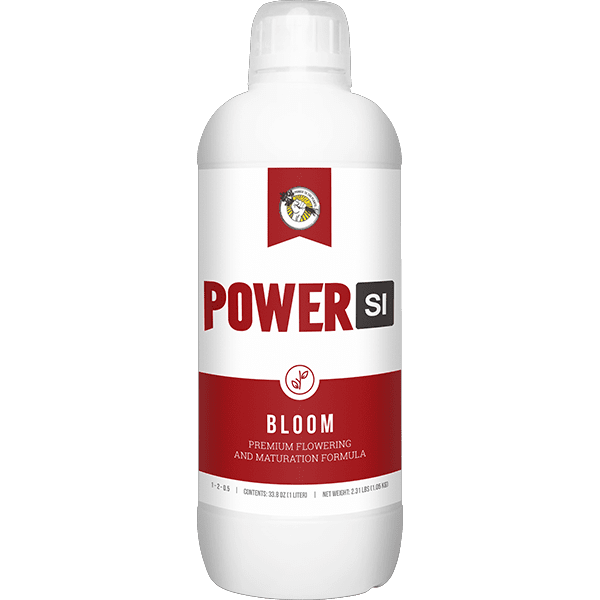
PowerSI Bloom de Power SI est un additif floral haut de gamme conçu pour favoriser le déclenchement de la floraison, la qualité de la récolte et une floraison plus harmonieuse. Formulé à base d'une matrice de silice exclusive et d'extraits végétaux, il est idéal pour les cultivateurs recherchant un stimulateur de floraison ciblé, simple et efficace.
PowerSI Bloom est élaboré en combinant une matrice de silice exclusive à un mélange exclusif d'extraits végétaux, grâce à un procédé de fermentation. Ce procédé vise à créer un effet d'entourage qui se manifeste rapidement au jardin, favorisant ainsi de meilleurs rendements et une récolte de qualité supérieure, sans complexifier votre programme de culture. Il en résulte un additif de floraison de qualité supérieure, conçu pour une efficacité optimale pendant la floraison, avec des bénéfices ciblés sur la répartition de l'énergie et la structure de la plante lors du développement des bourgeons et des fleurs.
Côté plante, PowerSI Bloom est reconnu pour favoriser une floraison plus précoce et multiplier les sites floraux, assurant ainsi un feuillage plus dense et productif. Il contribue également à une maturation plus homogène, essentielle pour une récolte uniforme. Outre ces avantages liés au déclenchement de la floraison, l'amélioration de la synthèse protéique et l'augmentation du taux de Brix font partie de son profil de performance axé sur la floraison, répondant ainsi aux attentes des cultivateurs qui privilégient la fonctionnalité de la plante et la qualité finale plutôt que des promesses superficielles.
Pour les consommateurs recherchant une information synthétique, PowerSI Bloom contient du silicium soluble (Si) issu du silicate de potassium et présente un profil NPK léger de 1-2-0,5. Sa formule est composée d'urée, d'acide phosphorique, de silicate de potassium et d'extrait d'algues (Ascophyllum nodosum), avec des sources de bore et de zinc également mentionnées dans l'analyse. Ces composants positionnent clairement le produit comme un engrais de floraison riche en silice, complété par d'autres éléments favorisant la floraison et la qualité finale.
PowerSI Bloom est idéal pour les cultivateurs recherchant un additif floral haut de gamme qui combine silicium soluble, fermentation et extraits végétaux pour une floraison plus précoce, une floraison plus abondante et une maturation plus homogène. Si votre objectif est un additif de floraison de qualité supérieure qui favorise la floraison, le bon fonctionnement des plantes et la qualité de la récolte, PowerSI Bloom est parfaitement adapté à cette étape.
How To Use
How To Use
How to Use Power Si Bloom - 5 litres
Step-by-step mixing and feeding instructions for Power Si Bloom - 5 litres.
Mixing & preparation
Fill your reservoir or watering container with clean, room-temperature water first. Shake the bottle of Power Si Bloom - 5 litres well before every use. Using the feeding schedule below, measure the recommended dose and add it directly to the water while stirring. Allow the solution to mix fully before adding any other fertilizers, additives, or supplements.
Always add nutrients to water — not the other way around. Mix thoroughly between products to ensure an even, stable nutrient solution.
Week-by-week feeding schedule
Vegetative stage — Power Si Bloom
- Week 1: do not use this product during this week of vegetative growth.
- Week 2: do not use this product during this week of vegetative growth.
- Week 3: do not use this product during this week of vegetative growth.
- Week 4: do not use this product during this week of vegetative growth.
Flowering stage — Power Si Bloom
- Week 1: mix 0.26 ml per litre of water or nutrient solution.
- Week 2: mix 0.26 ml per litre of water or nutrient solution.
- Week 3: mix 0.26 ml per litre of water or nutrient solution.
- Week 4: mix 0.26 ml per litre of water or nutrient solution.
- Week 5: mix 0.53 ml per litre of water or nutrient solution.
- Week 6: mix 0.53 ml per litre of water or nutrient solution.
- Week 7: mix 0.53 ml per litre of water or nutrient solution.
- Week 8: mix 0.53 ml per litre of water or nutrient solution.
Tips for best results
- Maintain pH and EC/ppm within the range recommended for your growing medium and crop.
- Use fresh nutrient solution whenever possible and avoid leaving mixed solution stagnant for long periods.
- Store nutrients in a cool, dark place away from direct sunlight and extreme temperatures.
- Keep bottles tightly sealed when not in use to reduce air exposure and preserve product quality.
- Use clean measuring tools and regularly rinse or clean your reservoir, lines, and irrigation equipment.
Common mistakes to avoid
- Do not mix different nutrients or additives together in concentrated form before adding them to water.
- Do not exceed the recommended dosage unless you are following a tested, crop-specific feeding plan.
- Do not skip pH or EC/ppm checks when growing in hydroponic or soilless systems.
- Do not allow the nutrient solution to freeze or overheat, as this can damage the formulation.
- Do not ignore the directions on the product label for your specific crop, growth stage, and system type.
Warnings & Safety
Warnings & Safety
Warning – Important Safety Information
This product may cause mild skin irritation and eye irritation. Avoid unnecessary contact with skin, eyes, and clothing. Use only as directed.
General safety precautions
Read and follow all instructions on the product label and any accompanying documentation before use. Keep out of reach of children and pets. Do not ingest. Avoid breathing vapours, mist, or dust that may be generated during handling or use.
Wear appropriate personal protective equipment (PPE), such as protective gloves, long sleeves, long pants and closed-toe footwear. When there is a risk of splashing or airborne particles, use safety glasses or other suitable eye and face protection.
First aid – skin contact
IF ON SKIN OR HAIR: Remove contaminated clothing immediately. Rinse skin with clean water for several minutes, then wash with mild soap and water. If irritation or redness develops and persists, seek medical attention. Wash contaminated clothing before reuse.
First aid – eye contact
IF IN EYES: Rinse cautiously with clean water for several minutes, keeping eyelids open. Remove contact lenses if present and easy to do. Continue rinsing. If irritation persists, obtain medical advice.
First aid – ingestion and inhalation
IF SWALLOWED: Rinse mouth thoroughly with water. Do not induce vomiting unless instructed by a medical professional. Seek medical attention if you feel unwell.
IF INHALED: Move the person to fresh air and keep them comfortable for breathing. If coughing, breathing difficulty, dizziness or other symptoms occur, seek medical assistance.
Storage and handling
Store this product in its original closed container, in a cool, dry and well-ventilated area. Protect from extreme temperatures and direct sunlight. Keep container tightly sealed when not in use.
Avoid release to drains, natural waterways or outdoor soil. Dispose of unused product and empty containers in accordance with local regulations and the directions on the label.
Important: If medical advice is needed, keep the product label or container available. Always follow the specific instructions and safety recommendations provided by the manufacturer. This safety notice is intended as general guidance and does not replace official label directions or documentation.
Guaranteed Minimum Analysis
Guaranteed Minimum Analysis
| Total Nitrogen (N) | 1.0% |
|---|---|
| Urea Nitrogen (N) | 0.8% |
| Available Phosphate (P2O5) | 2.0% |
| Soluble Potash (K2O) | 0.5% |
| Boron (B) | 0.007% |
| Zinc (Zn) | 0.3% |
| Soluble Silicon (Si) | 0.66% |
Frequently Asked Questions
Frequently Asked Questions
What does available phosphate (P₂O₅) do for plant growth?
What makes boric acid important for plants compared to other micronutrients?
Why is boron (B) essential for strong plant development, and what makes it different from other micronutrients?
Why is soluble potash (K2O) important for plants?
Why is soluble silicon important for plant growth?
Why is total nitrogen (N) important for plant growth, and what makes it different from other nutrients?
Why is urea nitrogen important for plant growth?
Why is zinc (Zn) important for plant growth?
Can phosphoric acid cause nutrient lockout?
Is potassium hydroxide just a potassium fertilizer?
Is potassium silicate mainly for potassium or for silicon?
Is seaweed a fertilizer or a plant booster?
What does sodium molybdate do for plants?
Why can urea burn plants even though it’s a common nitrogen fertilizer?
What does zinc sulfate do for plants?
Safety & Technical Documents
Safety & Technical Documents
Frequently purchased together
-
Gobelet doseur Hydrofarm - 250 ml
Prix habituel $3.05Prix habituel -
Gobelet doseur Hydrofarm - 500 ml
Prix habituel $4.99Prix habituel -
Gobelet doseur Hydrofarm - 1000 ml
Prix habituel $7.56Prix habituel -
Gobelet doseur Hydrofarm - 2000 ml
Prix habituel $9.94Prix habituel

Vegetative — Power Si Bloom
-
—
Flowering — Power Si Bloom
-
—