Passer aux informations produits
1 de 1
House & Garden US flag

Official Reseller

Provision Gardens is an official reseller of this brand.

Our inventory is sourced directly from the manufacturer and/or authorized distribution partners. We do not sell used items or unverified/old stock. This helps ensure product authenticity, freshness, and the high standard you expect.

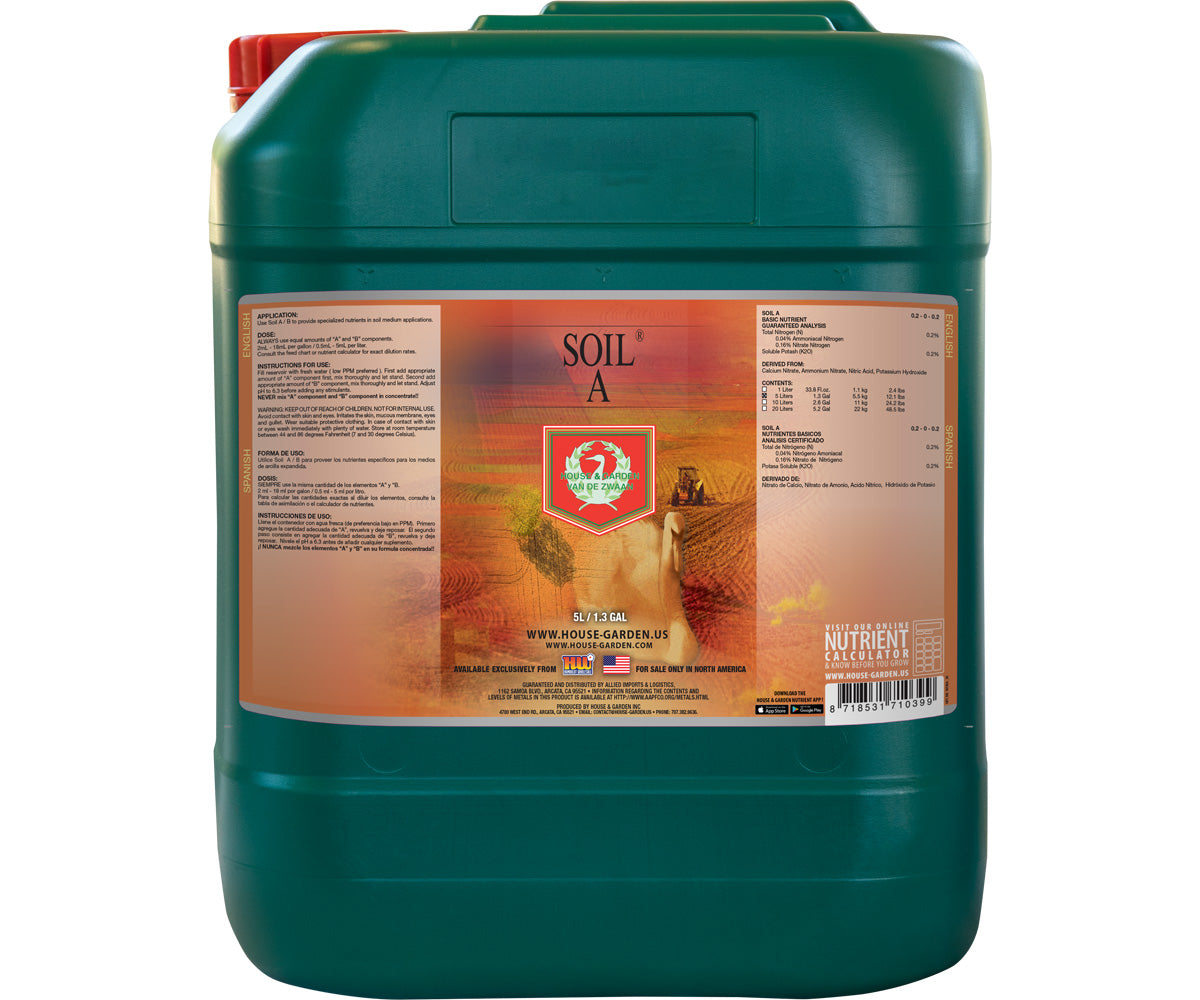
Terreau pour maison et jardin A - 5 litres

Terreau pour maison et jardin A - 5 litres

Prix habituel $46.80
Prix habituel Prix promotionnel $46.80
Frais d'expédition calculés à l'étape de paiement.
Disponibilité en magasin
Winnipeg, Manitoba
Disponible
Barrie, Ontario
Indisponible
Newmarket, Ontario
Indisponible
Pickering, Ontario
Indisponible

En rupture de stock à votre point de retrait ? Nous transférerons automatiquement le stock d’un autre entrepôt afin qu’il soit disponible à votre point de retrait. (Ontario seulement)

Province:
Choose your province
Order Within:
Estimated Delivery:
Free Shipping (Canada):
Free Shipping (Ontario):
Quantité
Éligible à la promotion de livraison gratuite

Description

L'engrais House & Garden Soil A & B est un engrais de base en deux parties pour les substrats de culture, conçu pour apporter les nutriments essentiels aux sols enrichis, de la croissance à la floraison. Cet engrais pour sol fournit aux plantes une base fiable de nutriments essentiels, permettant ainsi de développer une structure robuste dès le départ et de la maintenir jusqu'à la floraison.

L'engrais A et B est une base complète pour un sol enrichi, formulée pour optimiser l'utilisation des nutriments. Cette approche équilibrée favorise une croissance vigoureuse et des plantes plus résistantes, assurant ainsi la stabilité de votre jardin lors du passage de la croissance active à la floraison. Optimisé pour la croissance et la floraison, il constitue un choix pratique si vous recherchez un engrais de base efficace tout au long du cycle de vie, plutôt qu'une formule limitée à une étape spécifique.

L'un des atouts majeurs des terreaux A et B est leur forte teneur en magnésium. Ce dernier joue un rôle essentiel dans la vitalité des plantes, et cette concentration favorise leur vigueur et leur résistance tout au long de leur croissance. Outre sa richesse en magnésium, le terreau A et B contient tous les nutriments essentiels, offrant ainsi un profil nutritif de base complet et optimal pour les substrats de culture et les sols enrichis.

La formule garantit également des intrants purs et simples. Les terreaux A et B ne contiennent ni colorants, ni régulateurs de croissance synthétiques, ni métaux lourds détectables. En résumé, ses principaux ingrédients sont le nitrate de calcium, le nitrate d'ammonium, l'acide nitrique et l'hydroxyde de potassium ; l'objectif est de fournir les nutriments essentiels sous une forme adaptée à la culture en terre.

Le terreau House & Garden Soil A & B convient parfaitement aux cultivateurs utilisant des sols enrichis qui recherchent un engrais de base en deux parties optimisé pour la croissance et la floraison, favorisant la vigueur et la résilience des plantes et contribuant à des rendements plus importants.

How To Use

How to Use Terreau pour maison et jardin A - 5 litres

Step-by-step mixing and feeding instructions for Terreau pour maison et jardin A - 5 litres.

Mixing & preparation

Fill your reservoir or watering container with clean, room-temperature water first. Shake the bottle of Terreau pour maison et jardin A - 5 litres well before every use. Using the feeding schedule below, measure the recommended dose and add it directly to the water while stirring. Allow the solution to mix fully before adding any other fertilizers, additives, or supplements.

Always add nutrients to water — not the other way around. Mix thoroughly between products to ensure an even, stable nutrient solution.

Week-by-week feeding schedule

Vegetative stage — Soil A

  • Week 1: mix 2.0 ml per litre of water or nutrient solution.
  • Week 2: mix 2.5 ml per litre of water or nutrient solution.
  • Week 3: mix 2.5 ml per litre of water or nutrient solution.

Flowering stage — Soil A

  • Week 1: mix 3.0 ml per litre of water or nutrient solution.
  • Week 2: mix 3.5 ml per litre of water or nutrient solution.
  • Week 3: mix 4.0 ml per litre of water or nutrient solution.
  • Week 4: mix 5.0 ml per litre of water or nutrient solution.
  • Week 5: mix 4.5 ml per litre of water or nutrient solution.
  • Week 6: mix 3.0 ml per litre of water or nutrient solution.
  • Week 7: mix 3.0 ml per litre of water or nutrient solution.
  • Week 8: mix 3.0 ml per litre of water or nutrient solution.

Vegetative stage — Soil B

  • Week 1: mix 2.0 ml per litre of water or nutrient solution.
  • Week 2: mix 2.5 ml per litre of water or nutrient solution.
  • Week 3: mix 2.5 ml per litre of water or nutrient solution.

Flowering stage — Soil B

  • Week 1: mix 3.0 ml per litre of water or nutrient solution.
  • Week 2: mix 3.5 ml per litre of water or nutrient solution.
  • Week 3: mix 4.0 ml per litre of water or nutrient solution.
  • Week 4: mix 5.0 ml per litre of water or nutrient solution.
  • Week 5: mix 4.5 ml per litre of water or nutrient solution.
  • Week 6: mix 3.0 ml per litre of water or nutrient solution.
  • Week 7: mix 3.0 ml per litre of water or nutrient solution.
  • Week 8: mix 3.0 ml per litre of water or nutrient solution.

Vegetative stage — Roots Excelurator

  • Week 1: mix 0.3 ml per litre of water or nutrient solution.
  • Week 2: mix 0.3 ml per litre of water or nutrient solution.
  • Week 3: mix 0.3 ml per litre of water or nutrient solution.

Flowering stage — Roots Excelurator

  • Week 1: mix 0.3 ml per litre of water or nutrient solution.
  • Week 2: mix 0.3 ml per litre of water or nutrient solution.
  • Week 3: mix 3.0 ml per litre of water or nutrient solution.
  • Week 4: do not use this product during this week of flowering.
  • Week 5: do not use this product during this week of flowering.
  • Week 6: do not use this product during this week of flowering.
  • Week 7: do not use this product during this week of flowering.
  • Week 8: do not use this product during this week of flowering.

Vegetative stage — Multi Zen

  • Week 1: do not use this product during this week of vegetative growth.
  • Week 2: mix 1.0 ml per litre of water or nutrient solution.
  • Week 3: mix 1.0 ml per litre of water or nutrient solution.

Flowering stage — Multi Zen

  • Week 1: mix 1.0 ml per litre of water or nutrient solution.
  • Week 2: mix 1.0 ml per litre of water or nutrient solution.
  • Week 3: mix 1.0 ml per litre of water or nutrient solution.
  • Week 4: do not use this product during this week of flowering.
  • Week 5: do not use this product during this week of flowering.
  • Week 6: do not use this product during this week of flowering.
  • Week 7: do not use this product during this week of flowering.
  • Week 8: do not use this product during this week of flowering.

Vegetative stage — Bud-XL

  • Week 1: do not use this product during this week of vegetative growth.
  • Week 2: do not use this product during this week of vegetative growth.
  • Week 3: do not use this product during this week of vegetative growth.

Flowering stage — Bud-XL

  • Week 1: do not use this product during this week of flowering.
  • Week 2: do not use this product during this week of flowering.
  • Week 3: do not use this product during this week of flowering.
  • Week 4: mix 1.0 ml per litre of water or nutrient solution.
  • Week 5: mix 1.0 ml per litre of water or nutrient solution.
  • Week 6: mix 1.0 ml per litre of water or nutrient solution.
  • Week 7: mix 1.0 ml per litre of water or nutrient solution.
  • Week 8: mix 1.0 ml per litre of water or nutrient solution.

Vegetative stage — Top Booster

  • Week 1: do not use this product during this week of vegetative growth.
  • Week 2: do not use this product during this week of vegetative growth.
  • Week 3: do not use this product during this week of vegetative growth.

Flowering stage — Top Booster

  • Week 1: do not use this product during this week of flowering.
  • Week 2: do not use this product during this week of flowering.
  • Week 3: do not use this product during this week of flowering.
  • Week 4: do not use this product during this week of flowering.
  • Week 5: mix 1.5 ml per litre of water or nutrient solution.
  • Week 6: do not use this product during this week of flowering.
  • Week 7: do not use this product during this week of flowering.
  • Week 8: do not use this product during this week of flowering.

Vegetative stage — Top Shooter

  • Week 1: do not use this product during this week of vegetative growth.
  • Week 2: do not use this product during this week of vegetative growth.
  • Week 3: do not use this product during this week of vegetative growth.

Flowering stage — Top Shooter

  • Week 1: do not use this product during this week of flowering.
  • Week 2: do not use this product during this week of flowering.
  • Week 3: do not use this product during this week of flowering.
  • Week 4: do not use this product during this week of flowering.
  • Week 5: do not use this product during this week of flowering.
  • Week 6: mix 0.75 ml per litre of water or nutrient solution.
  • Week 7: mix 1.5 ml per litre of water or nutrient solution.
  • Week 8: mix 1.5 ml per litre of water or nutrient solution.

Tips for best results

  • Maintain pH and EC/ppm within the range recommended for your growing medium and crop.
  • Use fresh nutrient solution whenever possible and avoid leaving mixed solution stagnant for long periods.
  • Store nutrients in a cool, dark place away from direct sunlight and extreme temperatures.
  • Keep bottles tightly sealed when not in use to reduce air exposure and preserve product quality.
  • Use clean measuring tools and regularly rinse or clean your reservoir, lines, and irrigation equipment.

Common mistakes to avoid

  • Do not mix different nutrients or additives together in concentrated form before adding them to water.
  • Do not exceed the recommended dosage unless you are following a tested, crop-specific feeding plan.
  • Do not skip pH or EC/ppm checks when growing in hydroponic or soilless systems.
  • Do not allow the nutrient solution to freeze or overheat, as this can damage the formulation.
  • Do not ignore the directions on the product label for your specific crop, growth stage, and system type.

Warnings & Safety

Warning – Important Safety Information

This product may cause mild skin irritation and eye irritation. Avoid unnecessary contact with skin, eyes, and clothing. Use only as directed.

General safety precautions

Read and follow all instructions on the product label and any accompanying documentation before use. Keep out of reach of children and pets. Do not ingest. Avoid breathing vapours, mist, or dust that may be generated during handling or use.

Wear appropriate personal protective equipment (PPE), such as protective gloves, long sleeves, long pants and closed-toe footwear. When there is a risk of splashing or airborne particles, use safety glasses or other suitable eye and face protection.

First aid – skin contact

IF ON SKIN OR HAIR: Remove contaminated clothing immediately. Rinse skin with clean water for several minutes, then wash with mild soap and water. If irritation or redness develops and persists, seek medical attention. Wash contaminated clothing before reuse.

First aid – eye contact

IF IN EYES: Rinse cautiously with clean water for several minutes, keeping eyelids open. Remove contact lenses if present and easy to do. Continue rinsing. If irritation persists, obtain medical advice.

First aid – ingestion and inhalation

IF SWALLOWED: Rinse mouth thoroughly with water. Do not induce vomiting unless instructed by a medical professional. Seek medical attention if you feel unwell.

IF INHALED: Move the person to fresh air and keep them comfortable for breathing. If coughing, breathing difficulty, dizziness or other symptoms occur, seek medical assistance.

Storage and handling

Store this product in its original closed container, in a cool, dry and well-ventilated area. Protect from extreme temperatures and direct sunlight. Keep container tightly sealed when not in use.

Avoid release to drains, natural waterways or outdoor soil. Dispose of unused product and empty containers in accordance with local regulations and the directions on the label.

Important: If medical advice is needed, keep the product label or container available. Always follow the specific instructions and safety recommendations provided by the manufacturer. This safety notice is intended as general guidance and does not replace official label directions or documentation.

Guaranteed Minimum Analysis

Frequently Asked Questions

What Is ammoniacal nitrogen (N) and why do plants need It?

Ammoniacal Nitrogen (N) is a plant-available form of ammonium (NH₄⁺) that provides a steady, gentle source of nitrogen for healthy green growth. Unlike fast-release nitrogen types, ammoniacal nitrogen feeds plants slowly, helps stabilize root-zone pH, and works well in cooler temperatures. It is commonly used during early vegetative growth because it supports strong leaf development without burning young roots. If plants show pale leaves, slow growth, or weak stems, they may need more available ammoniacal nitrogen.

What makes ammonium nitrate different from other nitrogen ingredients for plant growth?

Ammonium nitrate is unique because it provides nitrogen in two plant-usable forms at once, which can give a fast green-up while still supporting steadier uptake depending on the root-zone conditions. That matters because it can correct true nitrogen shortages quickly, but it also needs careful balance since too much can push overly soft growth and trigger pH drift and nutrient imbalances.

Why do growers use calcium nitrate instead of other calcium sources?

Calcium nitrate is important because it supplies calcium in a fast, highly available form that supports strong new growth and healthy root tips, while also providing nitrate nitrogen for steady, usable growth energy. It’s unique because it delivers calcium together with nitrate nitrogen, making it especially effective during rapid growth phases when plants need both structure-building calcium and immediately available nitrogen at the same time.

What does nitrate nitrogen (N) do for plants?

Nitrate Nitrogen provides a stable, easy-to-absorb form of nitrogen that supports steady growth, strong foliage, and reliable plant development without sudden nutrient swings.

Why is soluble potash (K2O) important for plants?

Soluble potash (K2O) is important because it helps plants control water use, move sugars to new growth and fruit, and build stronger, higher-quality structure under stress. It’s unique from many other nutrients because it acts more like a regulator and transport helper than a direct “building material,” so the biggest benefits show up as steadier growth, stronger stems, and better finishing instead of just bigger leaves.

Why is total nitrogen (N) important for plant growth, and what makes it different from other nutrients?

Total Nitrogen is important because it directly drives leafy growth, chlorophyll production, and overall growth speed, which sets the pace for the entire plant. It’s unique because the “total” number can include different nitrogen forms that behave differently in the root zone, meaning the same total amount can produce very different results depending on the nitrogen type and plant stage.

Is nitric acid only for pH, or does it feed the plant too?

Nitric acid lowers pH, but it also adds nitrate nitrogen once diluted, so it can influence both nutrient availability and the plant’s growth balance. That makes it important for stable uptake, and unique compared to acids that adjust pH without contributing nitrate.

Is potassium hydroxide just a potassium fertilizer?

No, potassium hydroxide is mainly a strong pH-raising ingredient that changes how nutrients behave and how roots can access them, and its potassium addition is usually secondary. It’s important because stable pH prevents false deficiency symptoms and uptake stress, and it’s unique from other potassium sources because it’s used for acidity control rather than primarily for plant nutrition.

Afficher tous les détails
Tableau des apports nutritionnels

Vegetative — Week 1

  1. Soil A
  2. Soil B
  3. Roots Excelurator
  4. Multi Zen
  5. Bud-XL
  6. Top Booster
  7. Top Shooter

Flowering — Week 1

  1. Soil A
  2. Soil B
  3. Roots Excelurator
  4. Multi Zen
  5. Bud-XL
  6. Top Booster
  7. Top Shooter

Comparaison de produits