

Frequently purchased together
-
Grotek Monster Grow Pro - 130 grammes
Prix habituel $13.48Prix habituel -
Grotek Monster Bloom - 130 grammes
Prix habituel $14.14Prix habituel -
Grotek Vital - 500 ml
Prix habituel $34.56Prix habituel


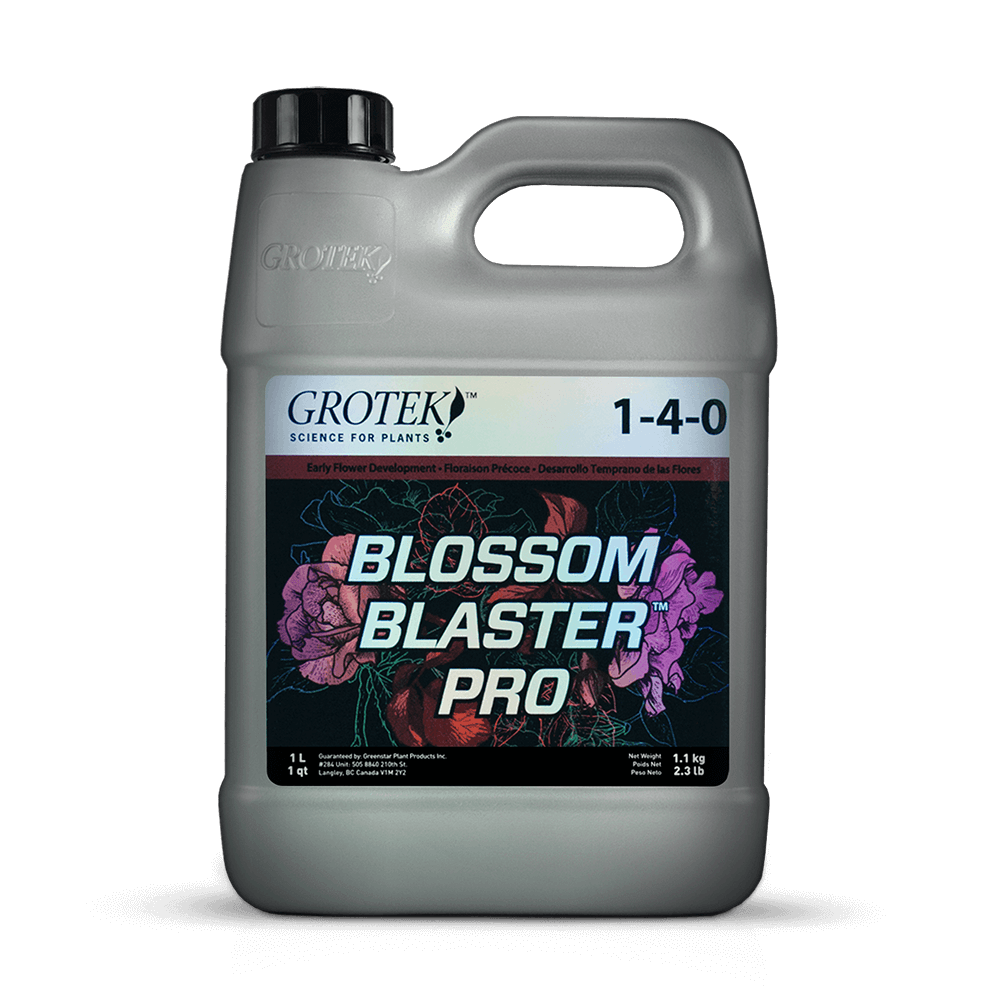
Grotek Blossom Blaster Pro - 4 litres
Newmarket, Ontario (Head Office)
1175 Stellar Drive, Unit #5
Newmarket, ON L3Y 7B8
- Mon10:00am–6:00pm
- Tue10:00am–6:00pm
- Wed10:00am–6:00pm
- Thu10:00am–6:00pm
- Fri10:00am–6:00pm
- Sat10:00am–4:00pm
- SunClosed


Barrie, Ontario
106 Saunders Road, Unit #2A
Barrie, ON L4N 9A8
- Mon10:00am–6:00pm
- Tue10:00am–6:00pm
- Wed10:00am–6:00pm
- Thu10:00am–6:00pm
- Fri10:00am–6:00pm
- Sat10:00am–4:00pm
- SunClosed
Pickering, Ontario
719 Krosno Boulevard
Pickering, ON L1W 1G4
- MonClosed
- Tue10:00am–5:00pm
- Wed10:00am–6:00pm
- Thu10:00am–6:00pm
- Fri10:00am–6:00pm
- Sat11:00am–4:00pm
- SunClosed
Winnipeg, Manitoba
915 McLeod Avenue, Unit #4
Winnipeg, MB R2G 0Y4
- Mon10:00am–6:00pm
- Tue10:00am–6:00pm
- Wed10:00am–6:00pm
- Thu10:00am–6:00pm
- Fri10:00am–6:00pm
- Sat11:00am–3:00pm
- SunClosed
Description
Description
Grotek Blossom Blaster Pro™ est un additif de floraison concentré pour le développement précoce des fleurs, soutenant la production de fleurs pendant la transition vers la floraison et contribuant à améliorer le potentiel de rendement.
Conçu pour stimuler efficacement les jeunes bourgeons floraux, cet engrais de floraison agit sur l'initiation florale et la période précédant ou suivant l'éclosion des bourgeons. Sa formule unique repose sur un complexe nutritif phosphoré qui cible le début de la formation des fleurs, moment où la constance des nutriments est primordiale. Si vous recherchez un stimulateur de floraison favorisant une floraison abondante sans complexifier votre programme, Blossom Blaster Pro™ se concentre sur la performance des premières fleurs et le développement de la plante jusqu'à la floraison.
Son profil NPK 1-4-0 est associé à une forme de phosphore optimisée pour l'absorption par les plantes, répondant ainsi aux besoins nutritionnels croissants liés au développement de la floraison. Au-delà de la simple stimulation de la floraison, cet engrais favorise l'amélioration du rendement et de la qualité de la récolte en renforçant les activités métaboliques clés associées à la floraison. Il en résulte une solution simple et ciblée pour les producteurs recherchant un complément nutritif spécifique pour le début de la floraison, jouant un rôle précis dans le cycle de floraison.
Blossom Blaster Pro™ est composé d'acide phosphorique et d'urée, enrichis en oligo-éléments (fer, zinc, bore et molybdène). Sa technologie de séquestration des oligo-éléments favorise l'absorption des minéraux essentiels par la plante, stimulant ainsi l'activité cellulaire et le développement global de la plante et de ses fleurs. Pour les cultivateurs soucieux de la qualité et de la performance, cette formule favorise la floraison tout en maintenant un environnement racinaire équilibré grâce à un apport optimal en nutriments essentiels.
Pour une intégration optimale, Blossom Blaster Pro™ convient aux systèmes de culture hydroponiques et hors-sol (tourbe/coco). Conçu pour la phase de floraison, son application est optimisée dès le débourrement et jusqu'à la nouaison. Ce produit est idéal pour les cultivateurs recherchant un additif hautement concentré pour le développement précoce de la floraison, favorisant une floraison abondante, une production florale accrue et une récolte de qualité, dans des installations hydroponiques ou hors-sol simplifiées.
How To Use
How To Use
How to Use Grotek Blossom Blaster Pro - 4 litres
Step-by-step mixing and feeding instructions for Grotek Blossom Blaster Pro - 4 litres.
Mixing & preparation
Fill your reservoir or watering container with clean, room-temperature water first. Shake the bottle of Grotek Blossom Blaster Pro - 4 litres well before every use. Using the feeding schedule below, measure the recommended dose and add it directly to the water while stirring. Allow the solution to mix fully before adding any other fertilizers, additives, or supplements.
Always add nutrients to water — not the other way around. Mix thoroughly between products to ensure an even, stable nutrient solution.
Week-by-week feeding schedule
Vegetative stage — Blossom Blaster Pro
- Week 1: do not use this product during this week of vegetative growth.
- Week 2: do not use this product during this week of vegetative growth.
- Week 3: do not use this product during this week of vegetative growth.
- Week 4: do not use this product during this week of vegetative growth.
Flowering stage — Blossom Blaster Pro
- Week 1: mix 1.0 ml per litre of water or nutrient solution.
- Week 2: mix 1.0 ml per litre of water or nutrient solution.
- Week 3: mix 1.0 ml per litre of water or nutrient solution.
- Week 4: do not use this product during this week of flowering.
- Week 5: do not use this product during this week of flowering.
- Week 6: do not use this product during this week of flowering.
- Week 7: do not use this product during this week of flowering.
- Week 8: do not use this product during this week of flowering.
Tips for best results
- Maintain pH and EC/ppm within the range recommended for your growing medium and crop.
- Use fresh nutrient solution whenever possible and avoid leaving mixed solution stagnant for long periods.
- Store nutrients in a cool, dark place away from direct sunlight and extreme temperatures.
- Keep bottles tightly sealed when not in use to reduce air exposure and preserve product quality.
- Use clean measuring tools and regularly rinse or clean your reservoir, lines, and irrigation equipment.
Common mistakes to avoid
- Do not mix different nutrients or additives together in concentrated form before adding them to water.
- Do not exceed the recommended dosage unless you are following a tested, crop-specific feeding plan.
- Do not skip pH or EC/ppm checks when growing in hydroponic or soilless systems.
- Do not allow the nutrient solution to freeze or overheat, as this can damage the formulation.
- Do not ignore the directions on the product label for your specific crop, growth stage, and system type.
Warnings & Safety
Warnings & Safety
Warning – Important Safety Information
This product may cause mild skin irritation and eye irritation. Avoid unnecessary contact with skin, eyes, and clothing. Use only as directed.
General safety precautions
Read and follow all instructions on the product label and any accompanying documentation before use. Keep out of reach of children and pets. Do not ingest. Avoid breathing vapours, mist, or dust that may be generated during handling or use.
Wear appropriate personal protective equipment (PPE), such as protective gloves, long sleeves, long pants and closed-toe footwear. When there is a risk of splashing or airborne particles, use safety glasses or other suitable eye and face protection.
First aid – skin contact
IF ON SKIN OR HAIR: Remove contaminated clothing immediately. Rinse skin with clean water for several minutes, then wash with mild soap and water. If irritation or redness develops and persists, seek medical attention. Wash contaminated clothing before reuse.
First aid – eye contact
IF IN EYES: Rinse cautiously with clean water for several minutes, keeping eyelids open. Remove contact lenses if present and easy to do. Continue rinsing. If irritation persists, obtain medical advice.
First aid – ingestion and inhalation
IF SWALLOWED: Rinse mouth thoroughly with water. Do not induce vomiting unless instructed by a medical professional. Seek medical attention if you feel unwell.
IF INHALED: Move the person to fresh air and keep them comfortable for breathing. If coughing, breathing difficulty, dizziness or other symptoms occur, seek medical assistance.
Storage and handling
Store this product in its original closed container, in a cool, dry and well-ventilated area. Protect from extreme temperatures and direct sunlight. Keep container tightly sealed when not in use.
Avoid release to drains, natural waterways or outdoor soil. Dispose of unused product and empty containers in accordance with local regulations and the directions on the label.
Important: If medical advice is needed, keep the product label or container available. Always follow the specific instructions and safety recommendations provided by the manufacturer. This safety notice is intended as general guidance and does not replace official label directions or documentation.
Guaranteed Minimum Analysis
Guaranteed Minimum Analysis
| Total Nitrogen (N) | 1.0% |
|---|---|
| Available Phosphoric Acid (P2O5) | 4.0% |
| Boron (B) | 0.02% |
| Molybdenum (Mo) | 0.01% |
| Zinc (Zn) | 0.2% |
| Total Iron (Fe) | 0.25% |
Derived From
Derived From
Frequently Asked Questions
Frequently Asked Questions
What does available phosphoric acid (P₂O₅) do for plants, and how is it different from available phosphate?
What makes boric acid important for plants compared to other micronutrients?
Why is boron (B) essential for strong plant development, and what makes it different from other micronutrients?
What does ferrous sulfate do for yellow new leaves on plants?
Why is molybdenum (Mo) important for plant growth?
Why is total iron (Fe) important for plant growth?
Why is total nitrogen (N) important for plant growth, and what makes it different from other nutrients?
Why is zinc (Zn) important for plant growth?
Can phosphoric acid cause nutrient lockout?
What does sodium molybdate do for plants?
Why can urea burn plants even though it’s a common nitrogen fertilizer?
Why doesn’t zinc oxide fix zinc deficiency quickly in plants?
Safety & Technical Documents
Safety & Technical Documents
Frequently purchased together
-
Grotek Monster Grow Pro - 130 grammes
Prix habituel $13.48Prix habituel -
Grotek Monster Bloom - 130 grammes
Prix habituel $14.14Prix habituel -
Grotek Vital - 500 ml
Prix habituel $34.56Prix habituel

Vegetative — Blossom Blaster Pro
-
—
Flowering — Blossom Blaster Pro
-
—