

Frequently purchased together
-
General Hydroponics CALiMAGic - 1 pinte
Prix habituel $31.99Prix habituel -
Nectar diamant General Hydroponics - 1 pinte
Prix habituel $30.99Prix habituel -
General Hydroponics Kool Bloom - 1 pinte
Prix habituel $39.99Prix habituel -
Démarrage rapide General Hydroponics - 275 ml
Prix habituel $72.99Prix habituel


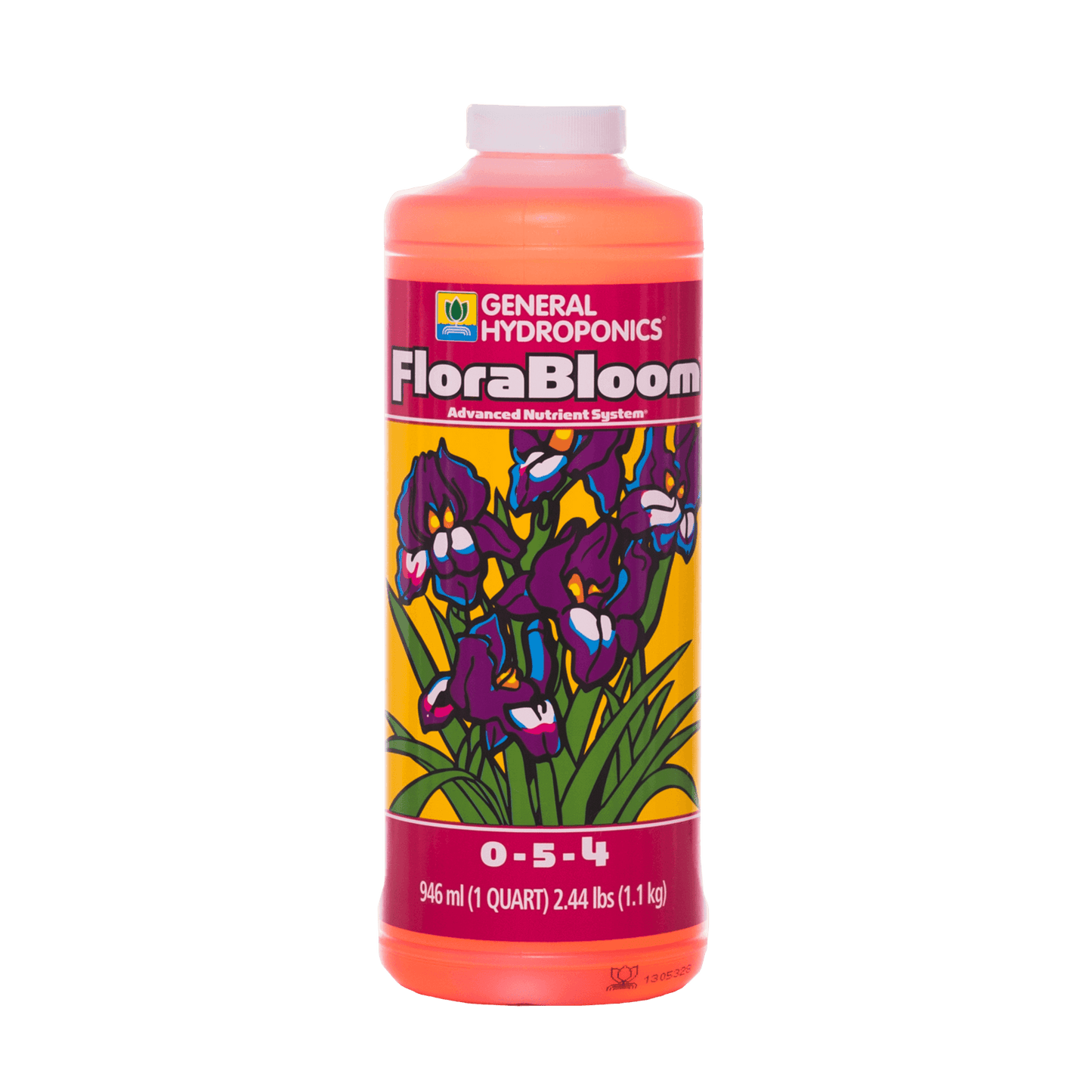
Flora Bloom de General Hydroponics - 1 pinte
Newmarket, Ontario (Head Office)
1175 Stellar Drive, Unit #5
Newmarket, ON L3Y 7B8
- Mon10:00am–6:00pm
- Tue10:00am–6:00pm
- Wed10:00am–6:00pm
- Thu10:00am–6:00pm
- Fri10:00am–6:00pm
- Sat10:00am–4:00pm
- SunClosed


Barrie, Ontario
106 Saunders Road, Unit #2A
Barrie, ON L4N 9A8
- Mon10:00am–5:00pm
- Tue10:00am–5:00pm
- Wed10:00am–5:00pm
- Thu10:00am–5:00pm
- Fri10:00am–5:00pm
- Sat10:00am–3:00pm
- SunClosed
Winnipeg, Manitoba
915 McLeod Avenue, Unit #4
Winnipeg, MB R2G 0Y4
- Mon10:00am–6:00pm
- Tue10:00am–6:00pm
- Wed10:00am–6:00pm
- Thu10:00am–6:00pm
- Fri10:00am–6:00pm
- Sat11:00am–3:00pm
- SunClosed
Sign in required
Back-in-stock notification
Select the store locations where you’d like to pick up this item, or choose Shipping to have it delivered.
Special order request
Select the store where you’d prefer to pick up your special order. To choose a different store, unselect your current choice first.
Manufacturer Recommended Products


Description
Description
Description
FloraSeries est conçu comme un système de nutrition hydroponique avancé et personnalisable, avec trois composants distincts qui vous permettent d'adapter des profils nutritionnels spécifiques aux différentes étapes de croissance et environnements. FloraMicro est la base du système nutritif FloraSeries, fournissant de l'azote, du potassium et du calcium ainsi que des micronutriments chélatés et des oligo-éléments pour une nutrition de base équilibrée. FloraGro se concentre sur la croissance structurelle et foliaire et est positionné pour soutenir la croissance végétative avec le développement de plus de branches et de feuilles. FloraBloom est conçu pour la phase de croissance reproductive, soutenant la floraison, la fructification et la production de graines et mettant l'accent sur des fleurs et des bourgeons plus gros.
Un résumé des faits : les trois composants ont des indices NPK de 5-0-1 (FloraMicro), 2-1-6 (FloraGro) et 0-5-4 (FloraBloom). Sur l'ensemble du système, FloraSeries met en évidence les rôles clés des nutriments en termes simples, y compris l'azote et le potassium pour l'élan de croissance, le calcium plus les micronutriments chélatés et les oligo-éléments pour une large couverture nutritionnelle, et le phosphore, le potassium, le magnésium et le sulfate pour soutenir le développement des fleurs et des fruits lorsque les plantes passent à la croissance reproductive.
Pour les acheteurs soucieux de la répétabilité, FloraSeries est positionné autour d'une qualité constante et d'une précision d'un lot à l'autre. General Hydroponics décrit des tests de laboratoire analytiques certifiés en interne ainsi que des tests tiers pour aider à maintenir chaque cycle dans des attentes strictes, afin que votre programme nutritionnel reste prévisible d'un cycle à l'autre. Le système est également décrit comme des nutriments liquides prémélangés précis, gardant le format simple à manipuler tout en offrant le contrôle pour lequel un système nutritif de base en trois parties est connu.
Si vous souhaitez un système nutritif de base hydroponique qui peut être ajusté à travers les différentes étapes sans vous enfermer dans une approche unique, FloraSeries est un excellent choix. Il convient parfaitement aux cultivateurs qui souhaitent un système de formule liquide en 3 parties construit autour de micronutriments chélatés et d'oligo-éléments, d'un soutien à la croissance structurelle et foliaire, et d'une performance fiable de floraison, de fructification et de production de graines lorsque les plantes passent à la phase de fructification et de floraison.
Avantages du produit : Stade végétatif ; Stade de floraison ; Intérieur ; Extérieur ; Arrosage régulier ; Systèmes d'arrosage ; Hydroponie ; Sans danger pour la fibre de coco ; Terre ; Sans terre ; Ratios personnalisés ; Soutien nutritif essentiel ; Soutien végétatif ; Soutien de floraison ; Résultats constants ; Compatible multi-substrats ; Utilisation multi-systèmes ; Développement racinaire.
Analyse garantie : Phosphate disponible (P2O5) : 5,0 % ; Potasse soluble (K2O) : 4,0 % ; Magnésium total (Mg) : 1,5 % ; Soufre (S) : 1,0 %.
Dérivé de : Carbonate de magnésium ; Phosphate de magnésium ; Sulfate de magnésium ; Acide phosphorique ; Carbonate de potassium ; Phosphate de potassium ; Sulfate de potassium.
How To Use
How To Use
How to Use Flora Bloom de General Hydroponics - 1 pinte
Step-by-step mixing and feeding instructions for Flora Bloom de General Hydroponics - 1 pinte.
Mixing & preparation
Fill your reservoir or watering container with clean, room-temperature water first. Shake the bottle of Flora Bloom de General Hydroponics - 1 pinte well before every use. Using the feeding schedule below, measure the recommended dose and add it directly to the water while stirring. Allow the solution to mix fully before adding any other fertilizers, additives, or supplements.
Always add nutrients to water — not the other way around. Mix thoroughly between products to ensure an even, stable nutrient solution.
Week-by-week feeding schedule
Vegetative stage — Bloom
- Week 1: mix 0.5 ml per litre of water or nutrient solution.
- Week 2: mix 0.61 ml per litre of water or nutrient solution.
- Week 3: mix 0.74 ml per litre of water or nutrient solution.
- Week 4: mix 1.0 ml per litre of water or nutrient solution.
Flowering stage — Bloom
- Week 1: mix 1.74 ml per litre of water or nutrient solution.
- Week 2: mix 1.74 ml per litre of water or nutrient solution.
- Week 3: mix 1.61 ml per litre of water or nutrient solution.
- Week 4: mix 1.61 ml per litre of water or nutrient solution.
- Week 5: mix 1.61 ml per litre of water or nutrient solution.
- Week 6: mix 0.74 ml per litre of water or nutrient solution.
- Week 7: mix 0.74 ml per litre of water or nutrient solution.
- Week 8: mix 0.61 ml per litre of water or nutrient solution.
- Week 9: do not use this product during this week of flowering.
Tips for best results
- Maintain pH and EC/ppm within the range recommended for your growing medium and crop.
- Use fresh nutrient solution whenever possible and avoid leaving mixed solution stagnant for long periods.
- Store nutrients in a cool, dark place away from direct sunlight and extreme temperatures.
- Keep bottles tightly sealed when not in use to reduce air exposure and preserve product quality.
- Use clean measuring tools and regularly rinse or clean your reservoir, lines, and irrigation equipment.
Common mistakes to avoid
- Do not mix different nutrients or additives together in concentrated form before adding them to water.
- Do not exceed the recommended dosage unless you are following a tested, crop-specific feeding plan.
- Do not skip pH or EC/ppm checks when growing in hydroponic or soilless systems.
- Do not allow the nutrient solution to freeze or overheat, as this can damage the formulation.
- Do not ignore the directions on the product label for your specific crop, growth stage, and system type.
Warnings & Safety
Warnings & Safety
Important – Safety Information
General Safety Precautions
First Aid – Skin Contact
First Aid – Eye Contact
First Aid – Ingestion
First aid – Inhalation
Storage And Handling
Important – Medical
Guaranteed Minimum Analysis
Guaranteed Minimum Analysis
| Available Phosphate (P2O5) | 5.0% |
|---|---|
| Soluble Potash (K2O) | 4.0% |
| Total Magnesium (Mg) | 1.5% |
| Sulfur (S) | 1.0% |
Frequently Asked Questions
Frequently Asked Questions
What does available phosphate (P₂O₅) do for plant growth?
Why is soluble potash (K2O) important for plants?
Why is total magnesium (Mg) important for plant growth?
Why is sulfur (S) important for plant growth?
Why is potassium carbonate important for plant growth, and what makes it unique compared to other potassium sources?
What does magnesium carbonate do for plants?
What does magnesium phosphate do for plants?
What does magnesium sulfate do for plants?
Can phosphoric acid cause nutrient lockout?
What does potassium phosphate do for plants?
Is potassium sulfate better than other potassium sources for sensitive plants?
Safety & Technical Documents
Safety & Technical Documents
Frequently purchased together
-
General Hydroponics CALiMAGic - 1 pinte
Prix habituel $31.99Prix habituel -
Nectar diamant General Hydroponics - 1 pinte
Prix habituel $30.99Prix habituel -
General Hydroponics Kool Bloom - 1 pinte
Prix habituel $39.99Prix habituel -
Démarrage rapide General Hydroponics - 275 ml
Prix habituel $72.99Prix habituel

Vegetative — Week 1
-
Micro—
-
Gro—
-
Bloom—
-
CALiMAGic—
-
Floralicious Plus—
-
Liquid Kool Bloom—
-
Rapid Start—
-
Ripen—
-
Armor Si—
-
FloraKleen—
Flowering — Week 1
-
Micro—
-
Gro—
-
Bloom—
-
CALiMAGic—
-
Floralicious Plus—
-
Liquid Kool Bloom—
-
Rapid Start—
-
Ripen—
-
Armor Si—
-
FloraKleen—