Frequently purchased together
-
 HOT ITEM
Gaia Green tout usage - 2 kg
Prix habituel $27.99Prix habituel -
 HOT ITEM
Gaia Green Power Bloom - 2 kg
Prix habituel $29.99Prix habituel -
Moulages de vers verts Gaia - 2 litres
Prix habituel $16.87Prix habituel -


Reviews are submitted by verified customers after purchase. This section shows a summary of product feedback rather than the full individual review list.

Terre Primale Verte Gaia - 40 litres
Prix habituel
$42.88
Prix habituel
Prix promotionnel
$42.88
Frais d'expédition calculés à l'étape de paiement.
Store Availability
Newmarket, Ontario (Head Office)
1175 Stellar Drive, Unit #5
Newmarket, ON L3Y 7B8
- Mon10:00am–6:00pm
- Tue10:00am–6:00pm
- Wed10:00am–6:00pm
- Thu10:00am–6:00pm
- Fri10:00am–6:00pm
- Sat10:00am–4:00pm
- SunClosed


Barrie, Ontario
106 Saunders Road, Unit #2A
Barrie, ON L4N 9A8
- Mon10:00am–5:00pm
- Tue10:00am–5:00pm
- Wed10:00am–5:00pm
- Thu10:00am–5:00pm
- Fri10:00am–5:00pm
- Sat10:00am–3:00pm
- SunClosed
Winnipeg, Manitoba
915 McLeod Avenue, Unit #4
Winnipeg, MB R2G 0Y4
- Mon10:00am–6:00pm
- Tue10:00am–6:00pm
- Wed10:00am–6:00pm
- Thu10:00am–6:00pm
- Fri10:00am–6:00pm
- Sat11:00am–3:00pm
- SunClosed
Quantité
In-Store Pickup Only
Sign in required
Back-in-stock notification
Select the store locations where you’d like to pick up this item, or choose Shipping to have it delivered.
Email notifications are turned off
Turn on email marketing to receive back-in-stock notifications.
Open account profile
Special order request
Select the store where you’d prefer to pick up your special order. To choose a different store, unselect your current choice first.
Description
Description
Description
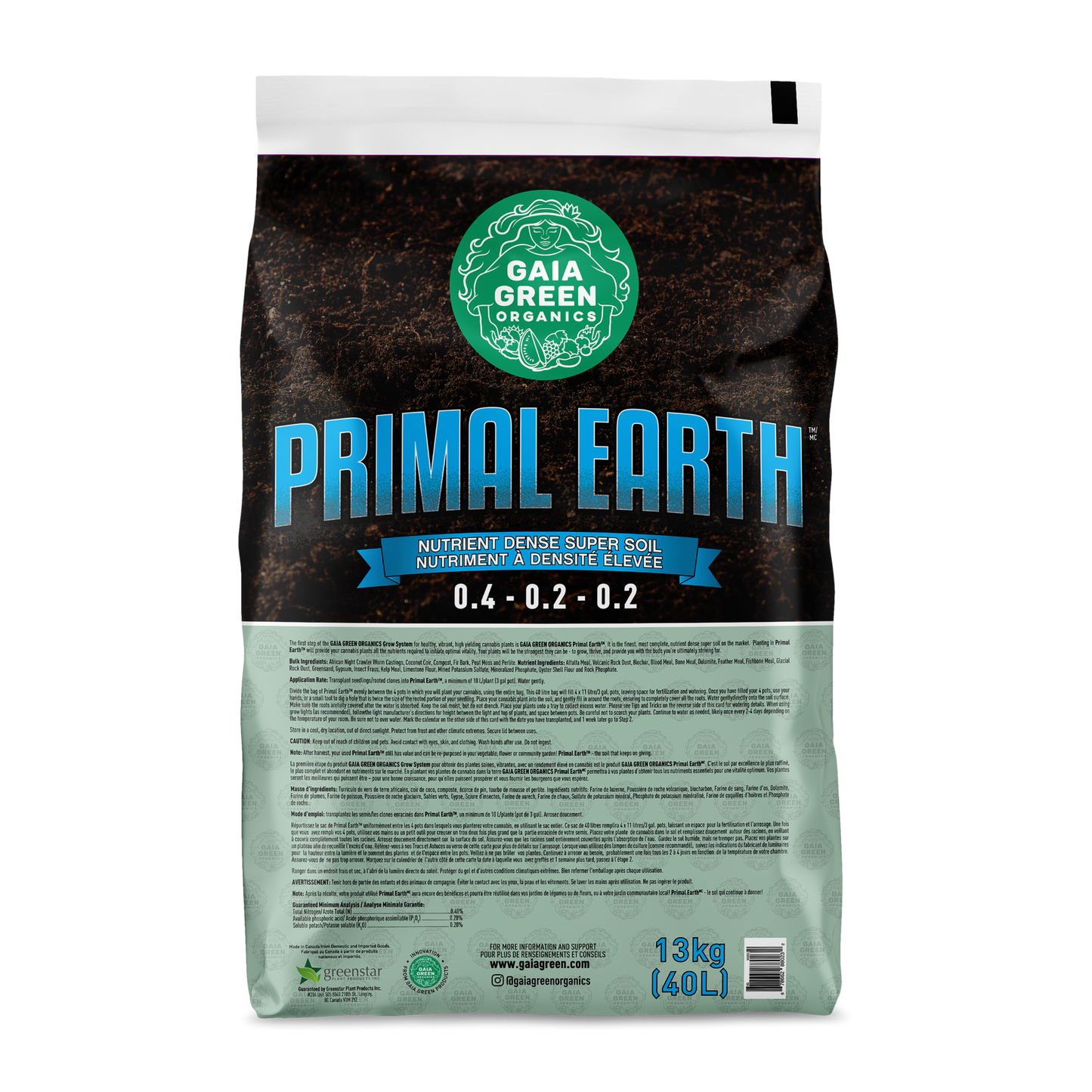
Gaia Green Primal Earth est un super-terreau biologique et un terreau en pot riche en nutriments pour soutenir des plantes biologiques saines, vibrantes et à haut rendement dès le début. Conçu comme un substrat de culture complet à base de terre, il est destiné à fournir aux plantes les nutriments nécessaires pour initier une vitalité optimale tout en gardant l'expérience simple et axée sur le sol.
Primal Earth est conçu pour les cultivateurs qui souhaitent une base de sol "tout-en-un" où le substrat lui-même apporte une nutrition significative. Au lieu de s'appuyer sur un seul amendement, ce super-terreau biologique riche en nutriments est formulé pour soutenir une croissance forte et constante et une vitalité globale des plantes de manière naturelle. L'objectif est simple : une zone racinaire vibrante et des performances constantes qui aident les plantes à pousser et à prospérer dans un environnement riche et biologiquement favorable.
Un aperçu compact des faits : Primal Earth présente un profil nutritif léger de 0,4-0,2-0,2, reflétant son rôle de sol chargé en nutriments plutôt qu'un engrais à forte concentration. Cet équilibre est associé à une large base d'ingrédients destinés à soutenir à la fois la nutrition et la qualité du sol au fil du temps, aidant le substrat à rester productif au lieu de se sentir "épuisé" tout de suite.
Le mélange commence par des ingrédients en vrac clés qui définissent la structure du mélange : déjections de vers de terre (African night crawler), fibre de coco, compost, écorce de sapin, tourbe de sphaigne et perlite. De là, il est enrichi d'une large gamme d'ingrédients nutritifs, y compris des farines végétales et animales et des apports minéraux. Ces apports comprennent la farine de luzerne, la farine de sang, la farine d'os, la farine de plumes, la farine d'arêtes de poisson, la farine d'algues, le frass d'insectes, le biochar, le complexe de carbone fossilisé et des amendements minéraux tels que la poussière de roche de basalte, la poussière de roche glaciaire, le sable vert, le gypse, la farine de calcaire, la farine de coquille d'huître, le phosphate minéralisé, le phosphate de roche et le sulfate de potassium extrait. Ensemble, ils forment un super-terreau biologique complet conçu autour d'une nutrition large et constante.
Primal Earth a également une valeur à long terme en tant que base de sol. Il est positionné comme un substrat qui peut être réutilisé après la récolte dans des potagers, des jardins floraux ou des jardins communautaires, ce qui est utile pour les cultivateurs qui aiment construire le sol et maintenir les apports au-delà d'un seul cycle.
C'est un bon choix pour les jardiniers qui veulent un terreau complet, riche en nutriments, un super-terreau biologique avec des déjections de vers, du compost et un profil d'amendements riches en minéraux, surtout lorsque l'objectif est d'obtenir des plantes biologiques saines et vibrantes et une base de sol qui mérite d'être retravaillée et réutilisée.
Avantages du produit : Super-Terreau Complet ; Nutrition Pré-Chargée ; Feuillage Luxuriant ; Soutien de la Croissance ; Nutrition Complète ; Alimentation Stable ; Libération Lente des Nutriments ; Matière Organique ; Intérieur ; Extérieur ; Stade de Floraison ; Stade Végétatif ; Sans Terre ; Biologique.
Analyse garantie : Azote Total (N) : 0,4 % ; Acide Phosphorique Disponible (P2O5) : 0,2 % ; Potasse Soluble (K2O) : 0,2 %.
Dérivé de : Déjections de vers de terre (African Night Crawler) ; Biochar ; Fibre de Coco ; Compost ; Écorce de Sapin ; Tourbe de Sphaigne ; Perlite ; Farine de Luzerne ; Azomite ; Poussière de roche de basalte ; Farine de sang ; Farine d'os ; Farine de plumes ; Farine d'arêtes de poisson ; Complexe de carbone fossilisé ; Poussière de roche glaciaire ; Sable vert ; Gypse ; Frass d'insectes ; Farine d'algues ; Farine de calcaire ; Sulfate de potassium extrait ; Phosphate minéralisé ; Farine de coquille d'huître ; Phosphate de roche.
Primal Earth est conçu pour les cultivateurs qui souhaitent une base de sol "tout-en-un" où le substrat lui-même apporte une nutrition significative. Au lieu de s'appuyer sur un seul amendement, ce super-terreau biologique riche en nutriments est formulé pour soutenir une croissance forte et constante et une vitalité globale des plantes de manière naturelle. L'objectif est simple : une zone racinaire vibrante et des performances constantes qui aident les plantes à pousser et à prospérer dans un environnement riche et biologiquement favorable.
Un aperçu compact des faits : Primal Earth présente un profil nutritif léger de 0,4-0,2-0,2, reflétant son rôle de sol chargé en nutriments plutôt qu'un engrais à forte concentration. Cet équilibre est associé à une large base d'ingrédients destinés à soutenir à la fois la nutrition et la qualité du sol au fil du temps, aidant le substrat à rester productif au lieu de se sentir "épuisé" tout de suite.
Le mélange commence par des ingrédients en vrac clés qui définissent la structure du mélange : déjections de vers de terre (African night crawler), fibre de coco, compost, écorce de sapin, tourbe de sphaigne et perlite. De là, il est enrichi d'une large gamme d'ingrédients nutritifs, y compris des farines végétales et animales et des apports minéraux. Ces apports comprennent la farine de luzerne, la farine de sang, la farine d'os, la farine de plumes, la farine d'arêtes de poisson, la farine d'algues, le frass d'insectes, le biochar, le complexe de carbone fossilisé et des amendements minéraux tels que la poussière de roche de basalte, la poussière de roche glaciaire, le sable vert, le gypse, la farine de calcaire, la farine de coquille d'huître, le phosphate minéralisé, le phosphate de roche et le sulfate de potassium extrait. Ensemble, ils forment un super-terreau biologique complet conçu autour d'une nutrition large et constante.
Primal Earth a également une valeur à long terme en tant que base de sol. Il est positionné comme un substrat qui peut être réutilisé après la récolte dans des potagers, des jardins floraux ou des jardins communautaires, ce qui est utile pour les cultivateurs qui aiment construire le sol et maintenir les apports au-delà d'un seul cycle.
C'est un bon choix pour les jardiniers qui veulent un terreau complet, riche en nutriments, un super-terreau biologique avec des déjections de vers, du compost et un profil d'amendements riches en minéraux, surtout lorsque l'objectif est d'obtenir des plantes biologiques saines et vibrantes et une base de sol qui mérite d'être retravaillée et réutilisée.
Avantages du produit : Super-Terreau Complet ; Nutrition Pré-Chargée ; Feuillage Luxuriant ; Soutien de la Croissance ; Nutrition Complète ; Alimentation Stable ; Libération Lente des Nutriments ; Matière Organique ; Intérieur ; Extérieur ; Stade de Floraison ; Stade Végétatif ; Sans Terre ; Biologique.
Analyse garantie : Azote Total (N) : 0,4 % ; Acide Phosphorique Disponible (P2O5) : 0,2 % ; Potasse Soluble (K2O) : 0,2 %.
Dérivé de : Déjections de vers de terre (African Night Crawler) ; Biochar ; Fibre de Coco ; Compost ; Écorce de Sapin ; Tourbe de Sphaigne ; Perlite ; Farine de Luzerne ; Azomite ; Poussière de roche de basalte ; Farine de sang ; Farine d'os ; Farine de plumes ; Farine d'arêtes de poisson ; Complexe de carbone fossilisé ; Poussière de roche glaciaire ; Sable vert ; Gypse ; Frass d'insectes ; Farine d'algues ; Farine de calcaire ; Sulfate de potassium extrait ; Phosphate minéralisé ; Farine de coquille d'huître ; Phosphate de roche.
Guaranteed Minimum Analysis
Guaranteed Minimum Analysis
Derived From
Derived From
Frequently Asked Questions
Frequently Asked Questions
Why is total nitrogen (N) important for plant growth, and what makes it different from other nutrients?
What does available phosphoric acid (P₂O₅) do for plants, and how is it different from available phosphate?
Why is soluble potash (K2O) important for plants?
Why are african night crawler worm castings important for plant growth?
What does biochar actually do in soil for plant growth?
Why is coconut coir important for plant growth?
What does compost actually do for plant growth?
What does fir bark do in potting soil?
Why is perlite important for plant growth, and what makes it different from other mix ingredients?
What makes alfalfa meal important for plant growth compared to other natural amendments?
Is azomite a fertilizer or a soil mineral supplement for plants?
What is basalt rock dust used for in gardening?
Is blood meal good for plants, and what makes it different from other nitrogen sources?
When should you use bone meal for plants, and why does it work differently than other amendments?
What does feather meal do for plants?
What does fishbone meal do for plant roots?
Is peat moss good for all potting mixes?
What does a fossilized carbon complex actually do in the root zone?
What does glacial rock dust actually do for plants?
Is greensand a fast way to fix a potassium deficiency in plants?
Does gypsum change soil pH?
What makes insect frass different from other organic soil amendments?
What does kelp meal do for plants?
What does limestone flour do for plants?
What does mined potassium sulfate do for fruiting plants?
What does mineralized phosphate do for plants?
What does oyster shell flour do for plants?
What makes natural rock phosphate different from other phosphorus sources for plant growth?
Frequently purchased together
-
HOT ITEM
Gaia Green tout usage - 2 kg
Prix habituel $27.99Prix habituel -
HOT ITEM
Gaia Green Power Bloom - 2 kg
Prix habituel $29.99Prix habituel -
Moulages de vers verts Gaia - 2 litres
Prix habituel $16.87Prix habituel -
Reviews are submitted by verified customers after purchase. This section shows a summary of product feedback rather than the full individual review list.