Frequently purchased together
-
 HOT ITEM
Farine de luzerne verte Gaia - 1 kg
Prix habituel $18.46Prix habituel -
-
Farine de plumes vertes Gaia - 1,5 kg
Prix habituel $18.43Prix habituel -
Phosphate minéralisé vert Gaia - 2 kg
Prix habituel $29.99Prix habituel


Reviews are submitted by verified customers after purchase. This section shows a summary of product feedback rather than the full individual review list.

Prix habituel
$106.37
Prix habituel
Prix promotionnel
$106.37
Frais d'expédition calculés à l'étape de paiement.
Store Availability
Newmarket, Ontario (Head Office)
1175 Stellar Drive, Unit #5
Newmarket, ON L3Y 7B8
- Mon10:00am–6:00pm
- Tue10:00am–6:00pm
- Wed10:00am–6:00pm
- Thu10:00am–6:00pm
- Fri10:00am–6:00pm
- Sat10:00am–4:00pm
- SunClosed


Barrie, Ontario
106 Saunders Road, Unit #2A
Barrie, ON L4N 9A8
- Mon10:00am–5:00pm
- Tue10:00am–5:00pm
- Wed10:00am–5:00pm
- Thu10:00am–5:00pm
- Fri10:00am–5:00pm
- Sat10:00am–3:00pm
- SunClosed
Winnipeg, Manitoba
915 McLeod Avenue, Unit #4
Winnipeg, MB R2G 0Y4
- Mon10:00am–6:00pm
- Tue10:00am–6:00pm
- Wed10:00am–6:00pm
- Thu10:00am–6:00pm
- Fri10:00am–6:00pm
- Sat11:00am–3:00pm
- SunClosed
Quantité
In-Store Pickup Only
Sign in required
Back-in-stock notification
Select the store locations where you’d like to pick up this item, or choose Shipping to have it delivered.
Email notifications are turned off
Turn on email marketing to receive back-in-stock notifications.
Open account profile
Special order request
Select the store where you’d prefer to pick up your special order. To choose a different store, unselect your current choice first.
Description
Description
Description
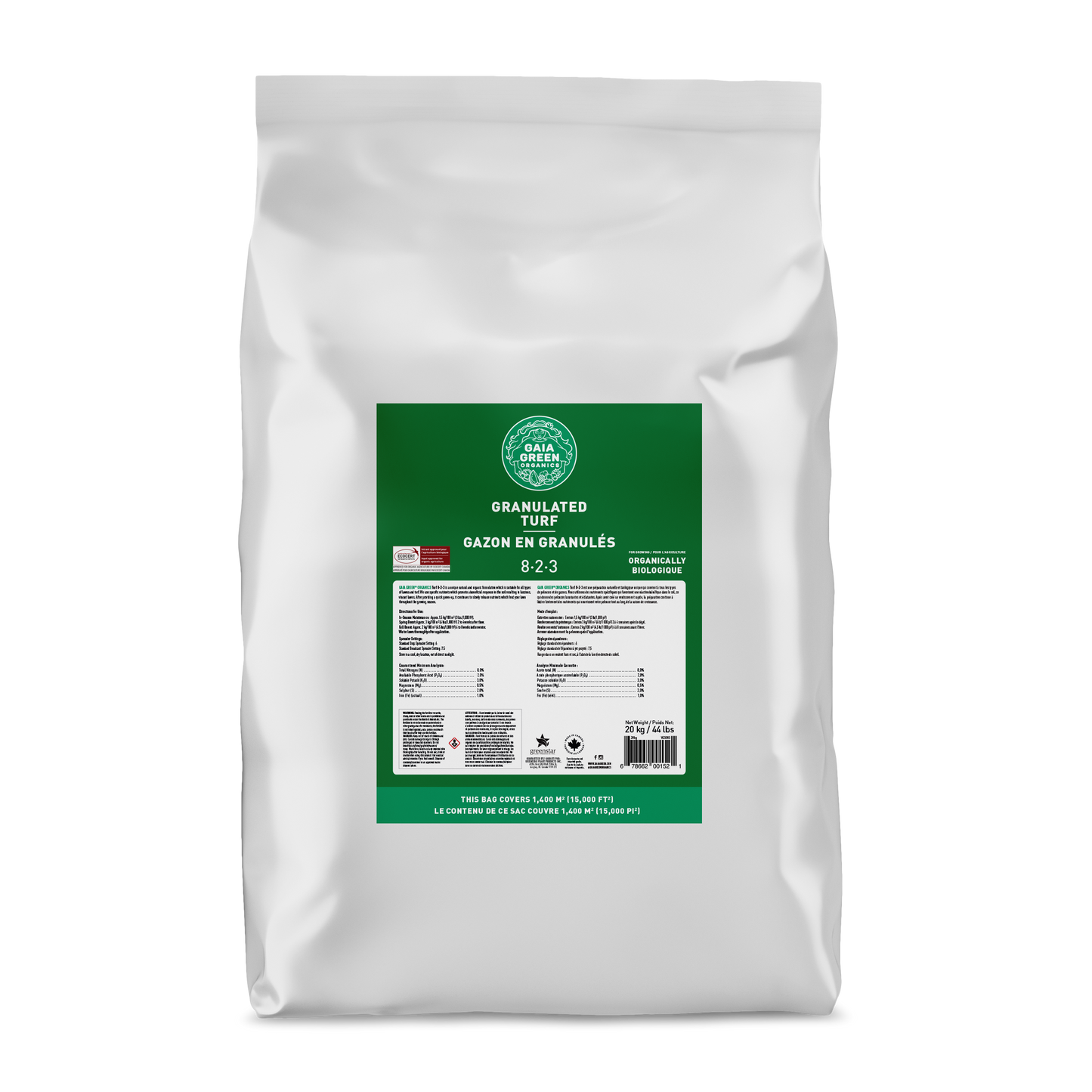
Le gazon granulé 8-2-3 de Gaia Green est un engrais granulé pour pelouses et gazons, conçu pour favoriser une pelouse plus verte et plus saine grâce à une nutrition axée sur le sol. C'est une formulation naturelle et biologique qui agit comme un engrais organique pour l'entretien courant des pelouses et des gazons sans transformer l'entretien du gazon en un programme compliqué.
Cet engrais pour gazon est conçu pour un reverdissement rapide, puis pour un profil de nutriments à libération lente qui soutient la performance de la pelouse tout au long de la saison de croissance. La formule longue durée combine des ingrédients avec des taux de libération de nutriments variables, ce qui aide à maintenir un apport nutritif plus constant au fil du temps. Si vous voulez un engrais granulé pour pelouse qui maintient votre gazon éclatant tout en soutenant le sol en dessous, ce produit garde l'objectif clair : un apport nutritif constant et de meilleures conditions de sol pour une croissance résiliente du gazon.
Gaia Green axe le gazon granulé sur l'amélioration de la qualité du sol pour soutenir une croissance et une abondance résilientes des plantes. Au lieu de s'appuyer sur un seul apport à action rapide, il est conçu pour promouvoir une réponse bénéfique dans le sol, aidant les pelouses à paraître luxuriantes et éclatantes au fur et à mesure que la saison avance. Cette approche axée sur le sol est importante pour le gazon car la densité, la couleur et la récupération sont étroitement liées à la façon dont la zone racinaire maintient sa structure, son oxygène et ses nutriments utilisables.
La couche factuelle est simple et axée sur l'acheteur. Cette formule a un NPK de 8-2-3, l'alignant avec une nutrition du gazon qui met l'accent sur une croissance verte riche en azote avec un soutien en phosphore et en potassium. Il est fabriqué avec des intrants naturels tels que la farine de plumes et la farine d'os, soutenus par des composants minéraux, y compris la poussière de roche glaciaire et les minéraux de sulfate, ainsi que le carbone fossilisé. La formulation comprend également du magnésium, du soufre et du fer dans son profil nutritionnel global, soutenant les besoins nutritionnels qui contribuent à un aspect de pelouse forte et verte.
Parce qu'il est granulé, cet engrais pour pelouse convient aux cultivateurs qui préfèrent un produit facile à manipuler pour l'entretien saisonnier des pelouses et l'entretien continu du gazon. Il est déclaré adapté à tous les types de pelouses et de gazons, ce qui en fait un choix pratique, que vous entreteniez une pelouse domestique, que vous amélioriez une pelouse qui a perdu sa couleur ou que vous souteniez un gazon qui a besoin d'une nutrition plus constante tout au long de la saison. Il est également reconnu par Écocert Canada pour une utilisation en agriculture biologique.
Le gazon granulé Gaia Green convient parfaitement à quiconque souhaite un engrais granulé naturel pour gazon avec un reverdissement rapide et un apport nutritif à libération lente, conçu pour améliorer la qualité du sol pour une croissance résiliente du gazon.
Avantages du produit : Stade végétatif ; Extérieur ; Sol ; Pelouse plus verte ; Gazon éclatant ; Application facile de granules ; Restaure la couleur verte ; Libération lente des nutriments ; Soutien de la structure du sol ; Zone racinaire forte ; Matière organique.
Analyse garantie : Azote total (N) : 8,0 % ; Phosphate disponible (P2O5) : 2,0 % ; Potasse soluble (K2O) : 3,0 % ; Magnésium total (Mg) : 0,5 % ; Soufre (S) : 2,0 % ; Fer total (Fe) : 1,0 %.
Dérivé de : Farine de plumes ; Farine d'os ; Poussière de roche glaciaire ; Sulfate de potassium ; Sulfate de magnésium ; Sulfate ferreux ; Carbone fossilisé.
Cet engrais pour gazon est conçu pour un reverdissement rapide, puis pour un profil de nutriments à libération lente qui soutient la performance de la pelouse tout au long de la saison de croissance. La formule longue durée combine des ingrédients avec des taux de libération de nutriments variables, ce qui aide à maintenir un apport nutritif plus constant au fil du temps. Si vous voulez un engrais granulé pour pelouse qui maintient votre gazon éclatant tout en soutenant le sol en dessous, ce produit garde l'objectif clair : un apport nutritif constant et de meilleures conditions de sol pour une croissance résiliente du gazon.
Gaia Green axe le gazon granulé sur l'amélioration de la qualité du sol pour soutenir une croissance et une abondance résilientes des plantes. Au lieu de s'appuyer sur un seul apport à action rapide, il est conçu pour promouvoir une réponse bénéfique dans le sol, aidant les pelouses à paraître luxuriantes et éclatantes au fur et à mesure que la saison avance. Cette approche axée sur le sol est importante pour le gazon car la densité, la couleur et la récupération sont étroitement liées à la façon dont la zone racinaire maintient sa structure, son oxygène et ses nutriments utilisables.
La couche factuelle est simple et axée sur l'acheteur. Cette formule a un NPK de 8-2-3, l'alignant avec une nutrition du gazon qui met l'accent sur une croissance verte riche en azote avec un soutien en phosphore et en potassium. Il est fabriqué avec des intrants naturels tels que la farine de plumes et la farine d'os, soutenus par des composants minéraux, y compris la poussière de roche glaciaire et les minéraux de sulfate, ainsi que le carbone fossilisé. La formulation comprend également du magnésium, du soufre et du fer dans son profil nutritionnel global, soutenant les besoins nutritionnels qui contribuent à un aspect de pelouse forte et verte.
Parce qu'il est granulé, cet engrais pour pelouse convient aux cultivateurs qui préfèrent un produit facile à manipuler pour l'entretien saisonnier des pelouses et l'entretien continu du gazon. Il est déclaré adapté à tous les types de pelouses et de gazons, ce qui en fait un choix pratique, que vous entreteniez une pelouse domestique, que vous amélioriez une pelouse qui a perdu sa couleur ou que vous souteniez un gazon qui a besoin d'une nutrition plus constante tout au long de la saison. Il est également reconnu par Écocert Canada pour une utilisation en agriculture biologique.
Le gazon granulé Gaia Green convient parfaitement à quiconque souhaite un engrais granulé naturel pour gazon avec un reverdissement rapide et un apport nutritif à libération lente, conçu pour améliorer la qualité du sol pour une croissance résiliente du gazon.
Avantages du produit : Stade végétatif ; Extérieur ; Sol ; Pelouse plus verte ; Gazon éclatant ; Application facile de granules ; Restaure la couleur verte ; Libération lente des nutriments ; Soutien de la structure du sol ; Zone racinaire forte ; Matière organique.
Analyse garantie : Azote total (N) : 8,0 % ; Phosphate disponible (P2O5) : 2,0 % ; Potasse soluble (K2O) : 3,0 % ; Magnésium total (Mg) : 0,5 % ; Soufre (S) : 2,0 % ; Fer total (Fe) : 1,0 %.
Dérivé de : Farine de plumes ; Farine d'os ; Poussière de roche glaciaire ; Sulfate de potassium ; Sulfate de magnésium ; Sulfate ferreux ; Carbone fossilisé.
Warnings & Safety
Warnings & Safety
Important – Safety Information
General Safety Precautions
First Aid – Skin Contact
First Aid – Eye Contact
First Aid – Ingestion
First aid – Inhalation
Storage And Handling
Important – Medical
Guaranteed Minimum Analysis
Guaranteed Minimum Analysis
| Total Nitrogen (N) | 8.0% |
|---|---|
| Available Phosphate (P2O5) | 2.0% |
| Soluble Potash (K2O) | 3.0% |
| Total Magnesium (Mg) | 0.5% |
| Sulfur (S) | 2.0% |
| Total Iron (Fe) | 1.0% |
Frequently Asked Questions
Frequently Asked Questions
Why is total nitrogen (N) important for plant growth, and what makes it different from other nutrients?
What does available phosphate (P₂O₅) do for plant growth?
Why is soluble potash (K2O) important for plants?
Why is total magnesium (Mg) important for plant growth?
Why is sulfur (S) important for plant growth?
Why is total iron (Fe) important for plant growth?
What does feather meal do for plants?
When should you use bone meal for plants, and why does it work differently than other amendments?
What does ferrous sulfate do for yellow new leaves on plants?
What does glacial rock dust actually do for plants?
Is potassium sulfate better than other potassium sources for sensitive plants?
What does magnesium sulfate do for plants?
What does fossilized carbon actually do for plant roots?
Frequently purchased together
-
HOT ITEM
Farine de luzerne verte Gaia - 1 kg
Prix habituel $18.46Prix habituel -
-
Farine de plumes vertes Gaia - 1,5 kg
Prix habituel $18.43Prix habituel -
Phosphate minéralisé vert Gaia - 2 kg
Prix habituel $29.99Prix habituel
Reviews are submitted by verified customers after purchase. This section shows a summary of product feedback rather than the full individual review list.