


Newmarket, Ontario (Head Office)
1175 Stellar Drive, Unit #5
Newmarket, ON L3Y 7B8
- Mon10:00am–6:00pm
- Tue10:00am–6:00pm
- Wed10:00am–6:00pm
- Thu10:00am–6:00pm
- Fri10:00am–6:00pm
- Sat10:00am–4:00pm
- SunClosed


Vous possédez un compte ?
Connectez-vous pour payer plus vite.
En rupture de stock à votre point de retrait ? Nous transférerons automatiquement le stock d’un autre entrepôt afin qu’il soit disponible à votre point de retrait. (Ontario seulement)
Impossible de charger la disponibilité du service de retrait
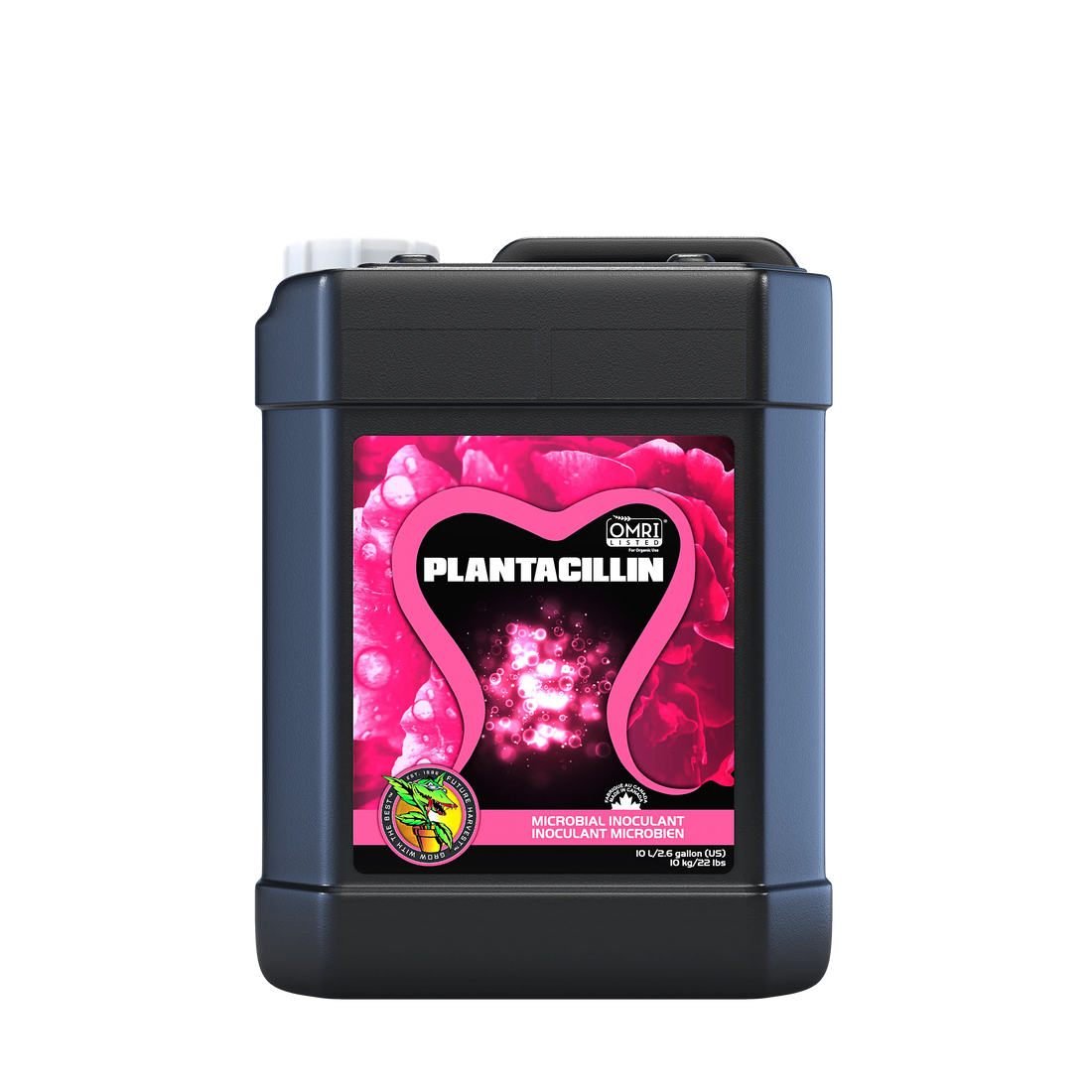
Future Harvest Plantacillin est un inoculant microbien liquide destiné au soutien de la zone racinaire. Il est conçu pour faciliter la décomposition de la matière organique et améliorer la biodisponibilité des nutriments, favorisant ainsi la croissance de plantes plus saines. Ce supplément de bactéries bénéfiques contribue à maintenir un environnement racinaire actif, permettant aux plantes d'exploiter pleinement les ressources déjà présentes dans leur milieu de culture.
Plantacillin repose sur un principe simple et pratique : une décomposition plus efficace de la matière organique et des racines mortes permet une meilleure assimilation des nutriments essentiels au niveau des racines. Future Harvest positionne Plantacillin comme un allié clé pour le développement d'un système racinaire robuste, en stimulant l'activité enzymatique qui favorise la décomposition des racines mortes. Il en résulte un inoculant microbien qui renforce les conditions racinaires et contribue à la stabilité des performances des plantes tout au long de leur croissance.
Les bénéfices visent clairement le bien-être global de la plante, et non de simples artifices. En améliorant la biodisponibilité des nutriments, Plantacillin favorise une meilleure santé générale et est associé à des rendements accrus. Dans les jardins, ce type de soutien racinaire est essentiel car la fonction racinaire détermine tout ce qui se trouve au-dessus, d'une croissance régulière à une meilleure résilience face aux variations climatiques.
La composition de Plantacillin est simple et vérifiable : 2-0-0. Ses principaux composants biologiques sont quatre espèces de bactéries bénéfiques, toutes issues du genre Bacillus, couramment utilisées dans les produits microbiens horticoles : Bacillus amyloliquefaciens, Bacillus megaterium, Bacillus licheniformis et Bacillus subtilis. Ce mélange de quatre espèces de bactéries bénéfiques est ce qui distingue Plantacillin et lui confère une identité claire : celle d’un additif microbien pour la zone racinaire, et non celle d’un supplément générique.
Plantacillin convient à tous les stades de croissance des plantes, ce qui en fait une option flexible pour un soutien microbien constant, contrairement aux produits à action limitée à un stade précis. Compatible avec différents systèmes de culture, il est efficace sur divers substrats, notamment l'hydroponie, les systèmes hors-sol et la fibre de coco. Plantacillin de Future Harvest est idéal pour les cultivateurs recherchant un inoculant microbien liquide favorisant un système racinaire robuste, la décomposition de la matière organique et l'amélioration de la biodisponibilité des nutriments, pour une santé optimale des plantes du début à la fin de leur croissance.
Step-by-step mixing and feeding instructions for Plantacilline Future Harvest - 10 litres.
Fill your reservoir or watering container with clean, room-temperature water first. Shake the bottle of Plantacilline Future Harvest - 10 litres well before every use. Using the feeding schedule below, measure the recommended dose and add it directly to the water while stirring. Allow the solution to mix fully before adding any other fertilizers, additives, or supplements.
Always add nutrients to water — not the other way around. Mix thoroughly between products to ensure an even, stable nutrient solution.
Vegetative stage — Plantacillin
Flowering stage — Plantacillin
Warning – Important Safety Information
This product may cause mild skin irritation and eye irritation. Avoid unnecessary contact with skin, eyes, and clothing. Use only as directed.
General safety precautions
Read and follow all instructions on the product label and any accompanying documentation before use. Keep out of reach of children and pets. Do not ingest. Avoid breathing vapours, mist, or dust that may be generated during handling or use.
Wear appropriate personal protective equipment (PPE), such as protective gloves, long sleeves, long pants and closed-toe footwear. When there is a risk of splashing or airborne particles, use safety glasses or other suitable eye and face protection.
First aid – skin contact
IF ON SKIN OR HAIR: Remove contaminated clothing immediately. Rinse skin with clean water for several minutes, then wash with mild soap and water. If irritation or redness develops and persists, seek medical attention. Wash contaminated clothing before reuse.
First aid – eye contact
IF IN EYES: Rinse cautiously with clean water for several minutes, keeping eyelids open. Remove contact lenses if present and easy to do. Continue rinsing. If irritation persists, obtain medical advice.
First aid – ingestion and inhalation
IF SWALLOWED: Rinse mouth thoroughly with water. Do not induce vomiting unless instructed by a medical professional. Seek medical attention if you feel unwell.
IF INHALED: Move the person to fresh air and keep them comfortable for breathing. If coughing, breathing difficulty, dizziness or other symptoms occur, seek medical assistance.
Storage and handling
Store this product in its original closed container, in a cool, dry and well-ventilated area. Protect from extreme temperatures and direct sunlight. Keep container tightly sealed when not in use.
Avoid release to drains, natural waterways or outdoor soil. Dispose of unused product and empty containers in accordance with local regulations and the directions on the label.
Important: If medical advice is needed, keep the product label or container available. Always follow the specific instructions and safety recommendations provided by the manufacturer. This safety notice is intended as general guidance and does not replace official label directions or documentation.
| Total Nitrogen (N) | 2.0% |
|---|---|
| Ammoniacal Nitrogen (N) | 0.6% |
| Nitrate Nitrogen (N) | 0.6% |
| Urea Nitrogen (N) | 0.8% |
1175 Stellar Drive, Unit #5
Newmarket, ON L3Y 7B8
106 Saunders Road, Unit #2A
Barrie, ON L4N 9A8
719 Krosno Boulevard
Pickering, ON L1W 1G4
915 McLeod Avenue, Unit #4
Winnipeg, MB R2G 0Y4