Frequently purchased together
-
-
-
-
Engrais pour plantes d'intérieur GardenPro 2-1-3 - 1 kg
Prix habituel $17.77Prix habituel


Reviews are submitted by verified customers after purchase. This section shows a summary of product feedback rather than the full individual review list.

GardenPro Tout Usage 20-20-20 + Micros Soluble dans l'Eau - 3,5 KG
Prix habituel
$50.31
Prix habituel
Prix promotionnel
$50.31
Frais d'expédition calculés à l'étape de paiement.
Store Availability
Newmarket, Ontario (Head Office)
1175 Stellar Drive, Unit #5
Newmarket, ON L3Y 7B8
- Mon10:00am–6:00pm
- Tue10:00am–6:00pm
- Wed10:00am–6:00pm
- Thu10:00am–6:00pm
- Fri10:00am–6:00pm
- Sat10:00am–4:00pm
- SunClosed


Barrie, Ontario
106 Saunders Road, Unit #2A
Barrie, ON L4N 9A8
- Mon10:00am–5:00pm
- Tue10:00am–5:00pm
- Wed10:00am–5:00pm
- Thu10:00am–5:00pm
- Fri10:00am–5:00pm
- Sat10:00am–3:00pm
- SunClosed
Winnipeg, Manitoba
915 McLeod Avenue, Unit #4
Winnipeg, MB R2G 0Y4
- Mon10:00am–6:00pm
- Tue10:00am–6:00pm
- Wed10:00am–6:00pm
- Thu10:00am–6:00pm
- Fri10:00am–6:00pm
- Sat11:00am–3:00pm
- SunClosed
Estimated Delivery Date
Order Within
—
Province
Est. Delivery
—
Quantité
Qualifies for Free Shipping Promotion
Sign in required
Back-in-stock notification
Select the store locations where you’d like to pick up this item, or choose Shipping to have it delivered.
Email notifications are turned off
Turn on email marketing to receive back-in-stock notifications.
Open account profile
Special order request
Select the store where you’d prefer to pick up your special order. To choose a different store, unselect your current choice first.
Description
Description
Description
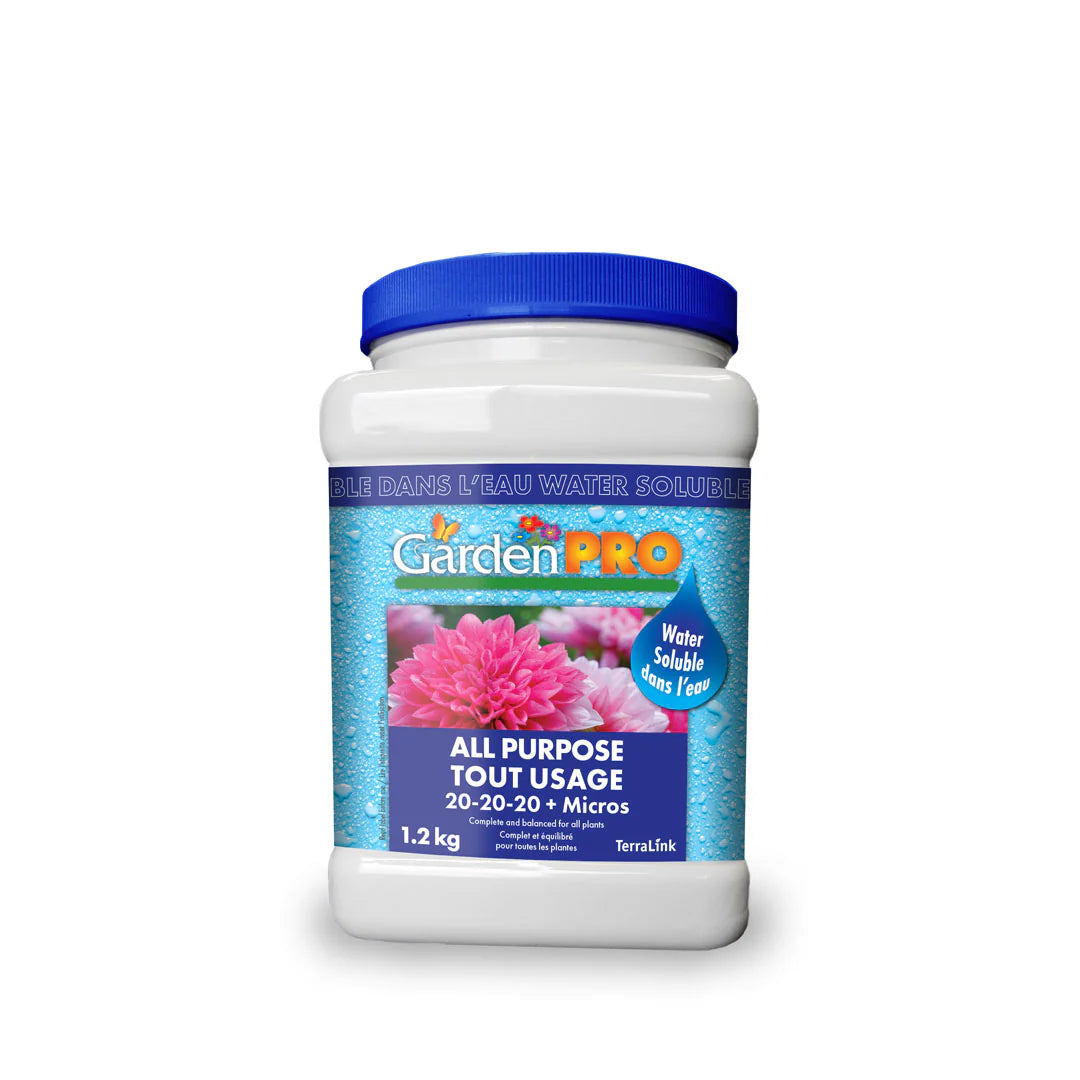
GardenPRO Universel 20-20-20 Soluble dans l'Eau est un engrais soluble dans l'eau tout usage pour une nutrition équilibrée des plantes d'intérieur et d'extérieur. Cet engrais complet et équilibré sert également de nutriment simple pour l'entretien général du jardin, offrant aux acheteurs une option simple triple 20 lorsqu'un engrais général répond aux besoins de la plante.
Le NPK 20-20-20 confère à la formule un profil nutritionnel équilibré, avec des valeurs égales pour les NPK indiqués. Le produit est un engrais pour toutes les plantes avec des micronutriments, gardant une portée large sans le lier à une famille de plantes. Son format d'engrais soluble dans l'eau aide les acheteurs à identifier rapidement le produit comme une nutrition végétale soluble pour un entretien simple des plantes.
Pour les acheteurs gérant l'entretien des plantes d'intérieur ou d'extérieur, le profil universel 20-20-20 soluble dans l'eau maintient le produit suffisamment large pour la nutrition des plantes pendant la saison de croissance générale tout en restant facile à identifier sur les étagères. Parce que la formule est conçue pour toutes les plantes, elle répond à de larges besoins des clients, comme la disponibilité d'un engrais général pour des collections intérieures mixtes ou des zones de jardin extérieures.
L'identité du produit est claire pour la prise de décision de l'acheteur : engrais tout usage, engrais soluble dans l'eau, nutriment végétal complet, NPK 20-20-20 et soutien en micronutriments dans un seul produit GardenPRO. Ce profil clair aide également les acheteurs à la recherche d'un engrais général avec une histoire nutritionnelle simple. Le nom du produit et le profil nutritionnel communiquent rapidement l'objectif principal, le rendant facile à comprendre comme une nutrition végétale large pour les clients jardiniers amateurs. Ces détails donnent au produit une identité de rayon simple pour les acheteurs qui scannent par marque, type d'engrais, équilibre nutritif et usage général des plantes.
La teneur en micronutriments confère au produit un autre ancrage nutritionnel vérifié, tandis que le positionnement d'engrais complet maintient l'objectif clair pour une nutrition végétale large. Il convient aux clients qui souhaitent un engrais complet et équilibré pour l'entretien courant du jardin, surtout lorsque l'objectif est une nutrition végétale large sur plus d'une catégorie de plantes.
Avantages du produit : Stade végétatif ; Stade de floraison ; Intérieur ; Extérieur ; Arrosage régulier ; Terre ; Hors-sol ; Nutrition complète ; Nutrition équilibrée ; Soutien en micronutriments ; Entièrement soluble dans l'eau ; Large utilisation pour les plantes ; Utilisation intérieure ; Utilisation extérieure ; Soutien à la croissance.
Analyse garantie : Azote total (N) : 20,0 % ; Acide phosphorique (P2O5) : 20,0 % ; Potasse soluble (K2O) : 20,0 % ; Bore (B) : 0,02 % ; Cuivre (Cu) : 0,05 % ; Fer total (Fe) : 0,1 % ; Manganèse total (Mn) : 0,05 % ; Molybdène (Mo) : 0,0005 % ; Zinc (Zn) : 0,05 % ; EDTA (Agent chélatant) : 1,0 %.
Le NPK 20-20-20 confère à la formule un profil nutritionnel équilibré, avec des valeurs égales pour les NPK indiqués. Le produit est un engrais pour toutes les plantes avec des micronutriments, gardant une portée large sans le lier à une famille de plantes. Son format d'engrais soluble dans l'eau aide les acheteurs à identifier rapidement le produit comme une nutrition végétale soluble pour un entretien simple des plantes.
Pour les acheteurs gérant l'entretien des plantes d'intérieur ou d'extérieur, le profil universel 20-20-20 soluble dans l'eau maintient le produit suffisamment large pour la nutrition des plantes pendant la saison de croissance générale tout en restant facile à identifier sur les étagères. Parce que la formule est conçue pour toutes les plantes, elle répond à de larges besoins des clients, comme la disponibilité d'un engrais général pour des collections intérieures mixtes ou des zones de jardin extérieures.
L'identité du produit est claire pour la prise de décision de l'acheteur : engrais tout usage, engrais soluble dans l'eau, nutriment végétal complet, NPK 20-20-20 et soutien en micronutriments dans un seul produit GardenPRO. Ce profil clair aide également les acheteurs à la recherche d'un engrais général avec une histoire nutritionnelle simple. Le nom du produit et le profil nutritionnel communiquent rapidement l'objectif principal, le rendant facile à comprendre comme une nutrition végétale large pour les clients jardiniers amateurs. Ces détails donnent au produit une identité de rayon simple pour les acheteurs qui scannent par marque, type d'engrais, équilibre nutritif et usage général des plantes.
La teneur en micronutriments confère au produit un autre ancrage nutritionnel vérifié, tandis que le positionnement d'engrais complet maintient l'objectif clair pour une nutrition végétale large. Il convient aux clients qui souhaitent un engrais complet et équilibré pour l'entretien courant du jardin, surtout lorsque l'objectif est une nutrition végétale large sur plus d'une catégorie de plantes.
Avantages du produit : Stade végétatif ; Stade de floraison ; Intérieur ; Extérieur ; Arrosage régulier ; Terre ; Hors-sol ; Nutrition complète ; Nutrition équilibrée ; Soutien en micronutriments ; Entièrement soluble dans l'eau ; Large utilisation pour les plantes ; Utilisation intérieure ; Utilisation extérieure ; Soutien à la croissance.
Analyse garantie : Azote total (N) : 20,0 % ; Acide phosphorique (P2O5) : 20,0 % ; Potasse soluble (K2O) : 20,0 % ; Bore (B) : 0,02 % ; Cuivre (Cu) : 0,05 % ; Fer total (Fe) : 0,1 % ; Manganèse total (Mn) : 0,05 % ; Molybdène (Mo) : 0,0005 % ; Zinc (Zn) : 0,05 % ; EDTA (Agent chélatant) : 1,0 %.
How To Use
How To Use
Indoor Plants
Outdoor Plants
Warnings & Safety
Warnings & Safety
Important – Safety Information
General Safety Precautions
First Aid – Skin Contact
First Aid – Eye Contact
First Aid – Ingestion
First aid – Inhalation
Storage And Handling
Important – Medical
Guaranteed Minimum Analysis
Guaranteed Minimum Analysis
| Total Nitrogen (N) | 20.0% |
|---|---|
| Phosphoric Acid (P2O5) | 20.0% |
| Soluble Potash (K2O) | 20.0% |
| Boron (B) | 0.02% |
| Copper (Cu) | 0.05% |
| Total Iron (Fe) | 0.1% |
| Total Manganese (Mn) | 0.05% |
| Molybdenum (Mo) | 0.0005% |
| Zinc (Zn) | 0.05% |
| EDTA (Chelating Agent) | 1.0% |
Frequently Asked Questions
Frequently Asked Questions
Why is total nitrogen (N) important for plant growth, and what makes it different from other nutrients?
Why is phosphoric acid (P2O5) important for plant growth?
Why is soluble potash (K2O) important for plants?
Why is boron (B) essential for strong plant development, and what makes it different from other micronutrients?
Why is copper (Cu) important for plant growth?
Why is total iron (Fe) important for plant growth?
Why is total manganese (Mn) important for plant growth?
Why is molybdenum (Mo) important for plant growth?
Why is zinc (Zn) important for plant growth?
Why is EDTA chelation important for plant nutrition, and what makes it unique?
Frequently purchased together
-
-
-
-
Engrais pour plantes d'intérieur GardenPro 2-1-3 - 1 kg
Prix habituel $17.77Prix habituel
Reviews are submitted by verified customers after purchase. This section shows a summary of product feedback rather than the full individual review list.