Newmarket, Ontario (Head Office)
1175 Stellar Drive, Unit #5
Newmarket, ON L3Y 7B8
- Mon10:00am–6:00pm
- Tue10:00am–6:00pm
- Wed10:00am–6:00pm
- Thu10:00am–6:00pm
- Fri10:00am–6:00pm
- Sat10:00am–4:00pm
- SunClosed
您选择的取货地点缺货?我们会自动从其他地点调货,确保您选择的取货地点有货。(仅限安大略省)
无法加载取货服务可用情况
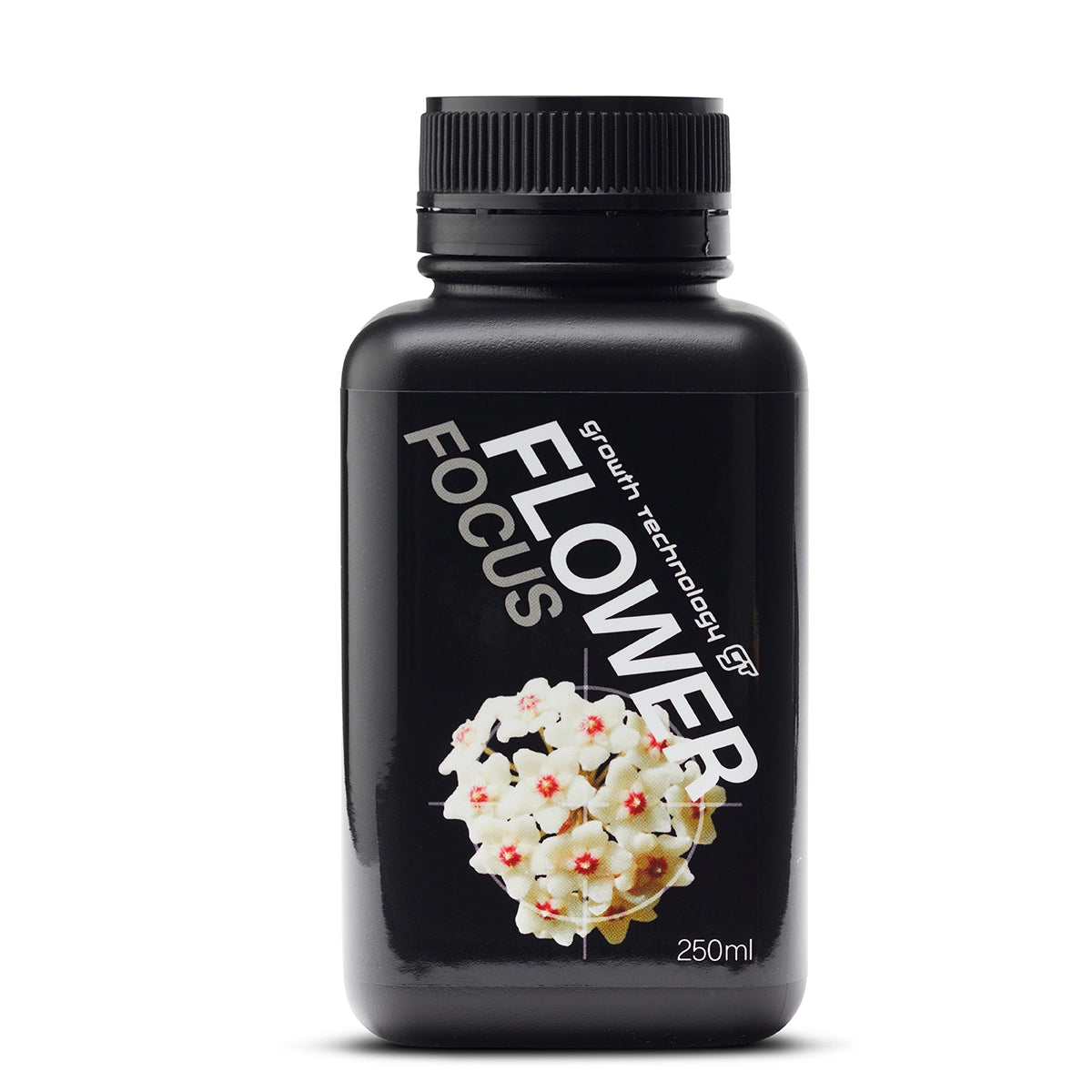
Growth Technology Flower Focus 是一款精准配制的开花植物营养液,旨在促进花朵繁盛、色彩艳丽,并延长花期。这款开花营养液适用于多种开花植物,为以提升花朵表现为首要目标的种植者提供了一种精准的施肥选择。
Flower Focus 是一款全面均衡的营养液,包含全部 12 种必需矿物质,能够为开花植物提供超越基本营养的全面支持。它具有极高的生物利用度,因此植物在生长旺盛期能够高效吸收营养。此外,该配方还具有 pH 缓冲功能,无需调节 pH 值即可在大多数自来水中稳定发挥作用。如果您希望使用单一的开花植物营养液获得稳定的效果,那么这些细节至关重要。
本配方采用优质原料,并添加螯合微量元素,以促进植物轻松吸收。简而言之,这意味着其矿物质配比旨在确保植物可靠吸收,从而帮助植物在生长旺盛的开花期保持最佳状态。矿物质营养包括硝态氮、磷、钾以及钙和镁,并辅以螯合形式的微量元素。
Flower Focus 还保证不含潜在有害且无效的氯化物、尿素和钠。对于许多种植者来说,这种更清洁的配方是其关键优势,尤其是在植物开花期较为敏感或需要长期施肥的情况下。它完全无味,因此非常适合室内使用,同时还能提供全面均衡的营养。
Flower Focus 适用于灵活的种植方式,无论是水培还是土壤栽培都适用。它涵盖植物的整个生命周期,包括营养生长、开花和成熟,因此非常适合同时种植处于不同生长阶段的开花植物。对于那些希望获得高生物利用度、pH 值缓冲的开花植物营养液,并希望其拥有完整均衡的矿物质成分,从而促进植物繁茂盛开、色彩艳丽的花朵的种植者来说,Flower Focus 是一个理想的选择。
Step-by-step mixing and feeding instructions for Growth Technology 花卉专用肥料 - 250 毫升.
Fill your reservoir or watering container with clean, room-temperature water first. Shake the bottle of Growth Technology 花卉专用肥料 - 250 毫升 well before every use. Using the feeding schedule below, measure the recommended dose and add it directly to the water while stirring. Allow the solution to mix fully before adding any other fertilizers, additives, or supplements.
Always add nutrients to water — not the other way around. Mix thoroughly between products to ensure an even, stable nutrient solution.
Vegetative stage — Soil
Flowering stage — Soil
Warning – Important Safety Information
This product may cause mild skin irritation and eye irritation. Avoid unnecessary contact with skin, eyes, and clothing. Use only as directed.
General safety precautions
Read and follow all instructions on the product label and any accompanying documentation before use. Keep out of reach of children and pets. Do not ingest. Avoid breathing vapours, mist, or dust that may be generated during handling or use.
Wear appropriate personal protective equipment (PPE), such as protective gloves, long sleeves, long pants and closed-toe footwear. When there is a risk of splashing or airborne particles, use safety glasses or other suitable eye and face protection.
First aid – skin contact
IF ON SKIN OR HAIR: Remove contaminated clothing immediately. Rinse skin with clean water for several minutes, then wash with mild soap and water. If irritation or redness develops and persists, seek medical attention. Wash contaminated clothing before reuse.
First aid – eye contact
IF IN EYES: Rinse cautiously with clean water for several minutes, keeping eyelids open. Remove contact lenses if present and easy to do. Continue rinsing. If irritation persists, obtain medical advice.
First aid – ingestion and inhalation
IF SWALLOWED: Rinse mouth thoroughly with water. Do not induce vomiting unless instructed by a medical professional. Seek medical attention if you feel unwell.
IF INHALED: Move the person to fresh air and keep them comfortable for breathing. If coughing, breathing difficulty, dizziness or other symptoms occur, seek medical assistance.
Storage and handling
Store this product in its original closed container, in a cool, dry and well-ventilated area. Protect from extreme temperatures and direct sunlight. Keep container tightly sealed when not in use.
Avoid release to drains, natural waterways or outdoor soil. Dispose of unused product and empty containers in accordance with local regulations and the directions on the label.
Important: If medical advice is needed, keep the product label or container available. Always follow the specific instructions and safety recommendations provided by the manufacturer. This safety notice is intended as general guidance and does not replace official label directions or documentation.
| Nitrate Nitrogen (N) | 1.8% |
|---|---|
| Available Phosphorus (P2O5) | 0.5% |
| Potassium (K) | 3.0% |
| Calcium (Ca) | 0.8% |
| Total Magnesium (Mg) | 0.4% |
| Sulfur (S) | 0.14% |
| Total Iron (Fe) | 0.04% |
| Total Manganese (Mn) | 0.012% |
| Boron (B) | 0.003% |
| Zinc (Zn) | 0.003% |
| Copper (Cu) | 0.002% |
| Molybdenum (Mo) | 0.001% |
Available phosphorus supports root growth, energy production, and strong flowering by providing a form of phosphorus that plants can absorb immediately.
Boron is essential because it stabilizes cell walls, supports root and shoot growth, and regulates sugar movement throughout the plant. What makes boron unique is its limited mobility and extremely narrow range between deficiency and excess, which causes new growth to show symptoms rapidly when levels fall out of balance.
Calcium is important because it builds and stabilizes plant cells as they form, acting as the structural support that keeps new growth strong and functional. Unlike other nutrients that drive color or speed of growth, calcium’s role is unique because it controls cell wall strength and membrane stability, making it essential for healthy roots, shoots, and long-term plant resilience rather than quick visual results.
Copper is important because it powers key enzymes that support energy use, tissue strength, and stress protection, and it’s unique from many other micronutrients because plants need it in tiny amounts but can be harmed quickly if copper becomes excessive.
Molybdenum is important because it helps plants convert nitrogen into usable building blocks for chlorophyll and growth, and it’s unique from many nutrients because it mainly supports enzyme-driven “nutrient use” rather than directly building plant tissue.
Nitrate Nitrogen provides a stable, easy-to-absorb form of nitrogen that supports steady growth, strong foliage, and reliable plant development without sudden nutrient swings.
Potassium is important because it controls key plant systems like water regulation, sugar transport, and nutrient movement, which supports stronger stems and better flowering or fruit quality. It’s unique because it doesn’t mainly build plant tissue like other major nutrients—it helps the plant use and manage what it already has, so small imbalances can affect the whole plant.
Sulfur is important because plants need it to build key amino acids and proteins that drive real growth, strong structure, and efficient use of nitrogen, making it uniquely different from “look-alike” nutrients that may change leaf color without supporting the plant’s core building process.
Total iron (Fe) matters because iron supports chlorophyll development and plant energy systems, keeping new growth green and vigorous; it’s unique from many other nutrients because iron deficiency usually shows up first in young leaves even when older leaves stay green, since iron doesn’t easily move within the plant.
Total magnesium is important because magnesium powers chlorophyll and energy use, helping plants stay green, turn light into growth, and use other nutrients efficiently—and it’s unique because its problems often come from nutrient balance and uptake competition, not just a simple shortage.
Total manganese matters because it supports photosynthesis and enzyme activity that keep new growth green and vigorous, and it’s unique because “total” manganese measures what’s present but not necessarily what the plant can absorb—so pH and root conditions decide whether manganese helps or harms.
Zinc is important because it powers key enzymes and helps regulate growth hormones, which directly controls healthy new leaves, normal internode spacing, and strong growth tips; it’s unique compared to many other micronutrients because zinc problems often show up as distorted, undersized new growth and stunting, not just simple leaf yellowing.

1175 Stellar Drive, Unit #5
Newmarket, ON L3Y 7B8
106 Saunders Road, Unit #2A
Barrie, ON L4N 9A8
719 Krosno Boulevard
Pickering, ON L1W 1G4
915 McLeod Avenue, Unit #4
Winnipeg, MB R2G 0Y4