Skip to product information
1 of 1
Jack’s Nutrients US flag

Official Reseller

Provision Gardens is an official reseller of this brand.

Our inventory is sourced directly from the manufacturer and/or authorized distribution partners. We do not sell used items or unverified/old stock. This helps ensure product authenticity, freshness, and the high standard you expect.

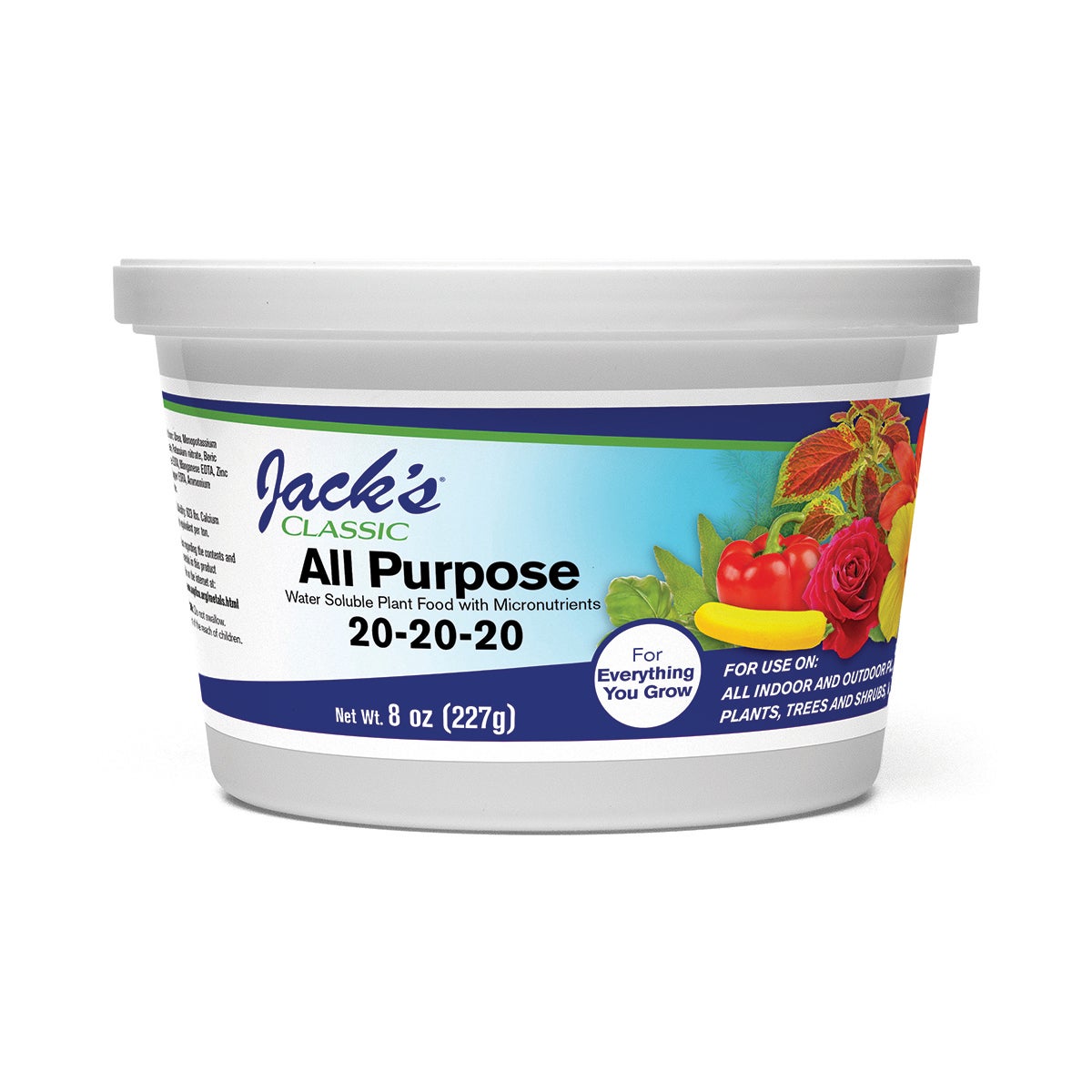
Jack's Classic All Purpose 20-20-20 - 4 lbs

Jack's Classic All Purpose 20-20-20 - 4 lbs

Regular price $55.45
Regular price Sale price $55.45
Shipping calculated at checkout.

OTHER AVAILABLE SIZES / MODELS:

Store Availability
Barrie, Ontario
Available
Newmarket, Ontario
Available
Pickering, Ontario
Unavailable
Winnipeg, Manitoba
Unavailable

Out of stock at your chosen pickup location? We'll automatically transfer inventory from another location so it's ready at your selected pickup location. (Ontario Only)

Quantity
Qualifies for Free Shipping Promotion

Description

Jack's Classic All Purpose 20-20-20 is a Jack’s Classic general purpose fertilizer for broad, everyday plant nutrition, designed to support fast green-up and steady growth across many plant types. This all-purpose plant fertilizer delivers a balanced 20-20-20 nutrient profile for growers who want one reliable option for general maintenance and consistent results.

All Purpose 20-20-20 is considered the industry standard of general purpose fertilizers by professional growers, which makes it a familiar choice in both hobby and professional settings. It’s built around the core nutrients plants rely on for vigorous, even development, and it’s known for fast green-up when plants need a quick return to a healthier-looking, more vibrant color.

Growth support is also reflected in its rapid leaf expansion, helping plants push fresh foliage and maintain a fuller canopy. Indoors, it is especially effective on foliage plants, where keeping leaves green is often the main goal. That makes it a practical fit for plant collections focused on leaf quality, appearance, and ongoing maintenance rather than a narrow, single-stage focus.

Jack's Classic All Purpose 20-20-20 is suited to indoor and outdoor plants, giving it wide versatility for everyday growing. It’s positioned for a broad range of plant categories, including bedding and container plants, trees and shrubs, vegetables, fruits and turf. This flexibility is helpful when you’re caring for multiple plant types and want a consistent nutrition approach that still supports green growth and active leaf development.

This product is a good fit for growers who want an industry-standard general purpose fertilizer for indoor and outdoor plants, especially when fast green-up, rapid leaf expansion, and keeping leaves green are the priorities.

How To Use

How to Use Jack's Classic All Purpose 20-20-20 - 4 lbs

Step-by-step mixing and feeding instructions for Jack's Classic All Purpose 20-20-20 - 4 lbs.

Mixing & preparation

Fill your reservoir or watering container with clean, room-temperature water first. Shake the bottle of Jack's Classic All Purpose 20-20-20 - 4 lbs well before every use. Using the feeding schedule below, measure the recommended dose and add it directly to the water while stirring. Allow the solution to mix fully before adding any other fertilizers, additives, or supplements.

Always add nutrients to water — not the other way around. Mix thoroughly between products to ensure an even, stable nutrient solution.

Week-by-week feeding schedule

Vegetative stage — All Purpose

  • Week 1: mix 0.066 tsp per litre of water or nutrient solution.
  • Week 2: mix 0.066 tsp per litre of water or nutrient solution.
  • Week 3: mix 0.066 tsp per litre of water or nutrient solution.
  • Week 4: mix 0.066 tsp per litre of water or nutrient solution.

Flowering stage — All Purpose

  • Week 1: mix 0.066 tsp per litre of water or nutrient solution.
  • Week 2: mix 0.066 tsp per litre of water or nutrient solution.
  • Week 3: mix 0.066 tsp per litre of water or nutrient solution.
  • Week 4: mix 0.066 tsp per litre of water or nutrient solution.

Tips for best results

  • Maintain pH and EC/ppm within the range recommended for your growing medium and crop.
  • Use fresh nutrient solution whenever possible and avoid leaving mixed solution stagnant for long periods.
  • Store nutrients in a cool, dark place away from direct sunlight and extreme temperatures.
  • Keep bottles tightly sealed when not in use to reduce air exposure and preserve product quality.
  • Use clean measuring tools and regularly rinse or clean your reservoir, lines, and irrigation equipment.

Common mistakes to avoid

  • Do not mix different nutrients or additives together in concentrated form before adding them to water.
  • Do not exceed the recommended dosage unless you are following a tested, crop-specific feeding plan.
  • Do not skip pH or EC/ppm checks when growing in hydroponic or soilless systems.
  • Do not allow the nutrient solution to freeze or overheat, as this can damage the formulation.
  • Do not ignore the directions on the product label for your specific crop, growth stage, and system type.

Warnings & Safety

Warning – Important Safety Information

This product may cause mild skin irritation and eye irritation. Avoid unnecessary contact with skin, eyes, and clothing. Use only as directed.

General safety precautions

Read and follow all instructions on the product label and any accompanying documentation before use. Keep out of reach of children and pets. Do not ingest. Avoid breathing vapours, mist, or dust that may be generated during handling or use.

Wear appropriate personal protective equipment (PPE), such as protective gloves, long sleeves, long pants and closed-toe footwear. When there is a risk of splashing or airborne particles, use safety glasses or other suitable eye and face protection.

First aid – skin contact

IF ON SKIN OR HAIR: Remove contaminated clothing immediately. Rinse skin with clean water for several minutes, then wash with mild soap and water. If irritation or redness develops and persists, seek medical attention. Wash contaminated clothing before reuse.

First aid – eye contact

IF IN EYES: Rinse cautiously with clean water for several minutes, keeping eyelids open. Remove contact lenses if present and easy to do. Continue rinsing. If irritation persists, obtain medical advice.

First aid – ingestion and inhalation

IF SWALLOWED: Rinse mouth thoroughly with water. Do not induce vomiting unless instructed by a medical professional. Seek medical attention if you feel unwell.

IF INHALED: Move the person to fresh air and keep them comfortable for breathing. If coughing, breathing difficulty, dizziness or other symptoms occur, seek medical assistance.

Storage and handling

Store this product in its original closed container, in a cool, dry and well-ventilated area. Protect from extreme temperatures and direct sunlight. Keep container tightly sealed when not in use.

Avoid release to drains, natural waterways or outdoor soil. Dispose of unused product and empty containers in accordance with local regulations and the directions on the label.

Important: If medical advice is needed, keep the product label or container available. Always follow the specific instructions and safety recommendations provided by the manufacturer. This safety notice is intended as general guidance and does not replace official label directions or documentation.

Frequently Asked Questions

Why does ammonium molybdate matter if plants only need tiny amounts of molybdenum?

Even in tiny amounts, molybdenum is crucial because it helps plants convert absorbed nitrogen, especially nitrate, into forms they can actually use to build new growth. That makes ammonium molybdate unique from many other micronutrient sources: it supports nitrogen-use efficiency, so a shortage can make plants look nitrogen-deficient even when feeding is adequate, leading to slow growth, pale leaves, and weak vigor unless the bottleneck is fixed.

What does available phosphate (P₂O₅) do for plant growth?

Available Phosphate (P₂O₅) supports root development, energy transfer, and early structural growth by providing a form of phosphorus that plants can absorb and use quickly.

What makes boric acid important for plants compared to other micronutrients?

Boric acid supplies boron, which plants need in extremely small amounts to build healthy new growth and support flowering and fruit development, but the safe range is very narrow. It’s unique because deficiency shows up first in the newest tissues while excess often burns older leaf edges, so accurate diagnosis and tiny, careful corrections matter more than with most nutrients.

Why is boron (B) essential for strong plant development, and what makes it different from other micronutrients?

Boron is essential because it stabilizes cell walls, supports root and shoot growth, and regulates sugar movement throughout the plant. What makes boron unique is its limited mobility and extremely narrow range between deficiency and excess, which causes new growth to show symptoms rapidly when levels fall out of balance.

Why is chelated copper (Cu) important for plant growth, and what makes it unique from other micronutrients?

Chelated copper is important because it supports key enzyme systems that drive energy flow, strong tissue formation, and healthy new growth, while chelation keeps copper available and stable in the root zone. It’s unique because plants need it in extremely small amounts and it can become unavailable or toxic more easily than many other micronutrients, so chelated forms help deliver precise, predictable copper without big swings.

Why is chelated iron important for plants, and what makes it different from other iron sources?

Chelated iron is important because it keeps iron usable for plants even when growing conditions would normally lock iron out, helping prevent the classic yellow-new-leaf symptom caused by low chlorophyll production. It is unique from other iron sources because the chelation protects iron from becoming insoluble, making it a more reliable way to correct iron-related chlorosis when regular iron can fail.

Why is chelated manganese (Mn) important for plant growth?

Chelated manganese is important because it keeps manganese available for photosynthesis and enzyme activity even when pH or water chemistry would normally lock it out, and it’s unique from similar micronutrients because it strongly supports the plant’s energy-processing systems that drive healthy, resilient new growth.

Why is chelated zinc (Zn) important for plants?

Chelated zinc is important because it keeps zinc available for uptake even when pH or root-zone conditions would normally lock zinc out, helping plants form normal-sized, healthy new growth—something that makes zinc uniquely different from many other nutrients that mainly affect older leaves or simple leaf color changes.

Why is copper EDTA used in plant nutrition instead of plain copper?

Copper EDTA helps keep copper dissolved and available to roots longer, so plants can absorb it more consistently when copper would otherwise tie up in the growing medium. It’s important because copper supports enzyme activity and healthy new growth, and it’s unique because the chelate improves predictability while allowing very small, controlled copper dosing.

Why is molybdenum (Mo) important for plant growth?

Molybdenum is important because it helps plants convert nitrogen into usable building blocks for chlorophyll and growth, and it’s unique from many nutrients because it mainly supports enzyme-driven “nutrient use” rather than directly building plant tissue.

What does nitrate nitrogen (N) do for plants?

Nitrate Nitrogen provides a stable, easy-to-absorb form of nitrogen that supports steady growth, strong foliage, and reliable plant development without sudden nutrient swings.

Why is soluble potash (K2O) important for plants?

Soluble potash (K2O) is important because it helps plants control water use, move sugars to new growth and fruit, and build stronger, higher-quality structure under stress. It’s unique from many other nutrients because it acts more like a regulator and transport helper than a direct “building material,” so the biggest benefits show up as steadier growth, stronger stems, and better finishing instead of just bigger leaves.

Why is total nitrogen (N) important for plant growth, and what makes it different from other nutrients?

Total Nitrogen is important because it directly drives leafy growth, chlorophyll production, and overall growth speed, which sets the pace for the entire plant. It’s unique because the “total” number can include different nitrogen forms that behave differently in the root zone, meaning the same total amount can produce very different results depending on the nitrogen type and plant stage.

Why is urea nitrogen important for plant growth?

Urea nitrogen is important because it can supply a high-impact source of nitrogen that supports chlorophyll production and fast leafy growth, but it’s unique from other nitrogen forms because it usually must convert in the growing environment before roots can use it consistently, making correct application and conditions critical for avoiding loss, burn, or sudden imbalance.

Why is water soluble magnesium important for plant growth?

Water soluble magnesium is important because it quickly restores the plant’s ability to make chlorophyll and produce energy, which helps stop interveinal yellowing on older leaves and improves overall nutrient use; it’s unique because it becomes available immediately in water, making it faster and more predictable than slower magnesium sources.

What makes iron EDTA effective for fixing pale new leaves?

Iron EDTA keeps iron dissolved and available long enough for roots to absorb it, which is why it can quickly improve new growth color when iron is tied up in the root zone. It’s unique because the EDTA chelate balances stability and accessibility, making iron more reliably usable in mildly acidic to near-neutral conditions compared to many non-chelated iron forms.

What makes manganese EDTA different from other manganese sources?

Manganese EDTA is unique because the EDTA chelate keeps manganese stable and more available during delivery, helping plants absorb it more reliably when manganese would otherwise lock up. This matters because manganese drives key enzyme functions tied to photosynthesis and healthy new growth, so consistent availability can prevent pale, chlorotic young leaves and stalled vigor.

What does monopotassium phosphate do for flowering plants?

Monopotassium phosphate provides fast phosphorus and potassium that support energy use, nutrient flow, and bloom development without adding nitrogen, so it helps flowering progress cleanly without pushing extra leafy growth. It’s unique because it delivers a focused PK boost in a highly soluble form, which can correct stage-related demand quickly, but it must be used carefully to avoid potassium-heavy imbalances that can block calcium and magnesium uptake.

Is potassium nitrate better for quick deficiency correction than other potassium sources?

Potassium nitrate is often better for quick correction when the plant needs both potassium and fast nitrate nitrogen, because it dissolves cleanly and is taken up quickly, unlike potassium sources that don’t supply nitrogen. It’s unique because it can restore leaf color and growth momentum while also improving water regulation, but it can backfire if nitrogen is already high or if salt levels are already stressing the roots.

Why can urea burn plants even though it’s a common nitrogen fertilizer?

Urea can burn plants because it must convert in the root zone, and that conversion can create a concentrated, temporarily harsh micro-zone that stresses roots, especially if urea is piled, left on the surface, or not watered in. That conversion step is what makes urea unique compared with nitrogen forms that are already plant-available, so correct placement and moisture are critical.

What makes zinc EDTA better for preventing zinc lockout?

Zinc EDTA is important because it keeps zinc available in the root zone when pH or water chemistry would normally tie zinc up, helping new growth develop normally before deficiency symptoms get worse. It’s unique from other zinc forms because the EDTA chelate shields zinc in solution, making delivery more consistent when conditions are not ideal.

View full details
Nutrient Feed Chart

Vegetative — All Purpose

Flowering — All Purpose

Product Comparison