

Frequently purchased together
-
House & Garden Top Booster - 500 ML
Regular price $26.10Regular price -
House & Garden Top Shooter - 250 ML
Regular price $39.99Regular price -
House & Garden Algen Extract - 250 ML
Regular price $32.40Regular price -


Reviews are submitted by verified customers after purchase. This section shows a summary of product feedback rather than the full individual review list.

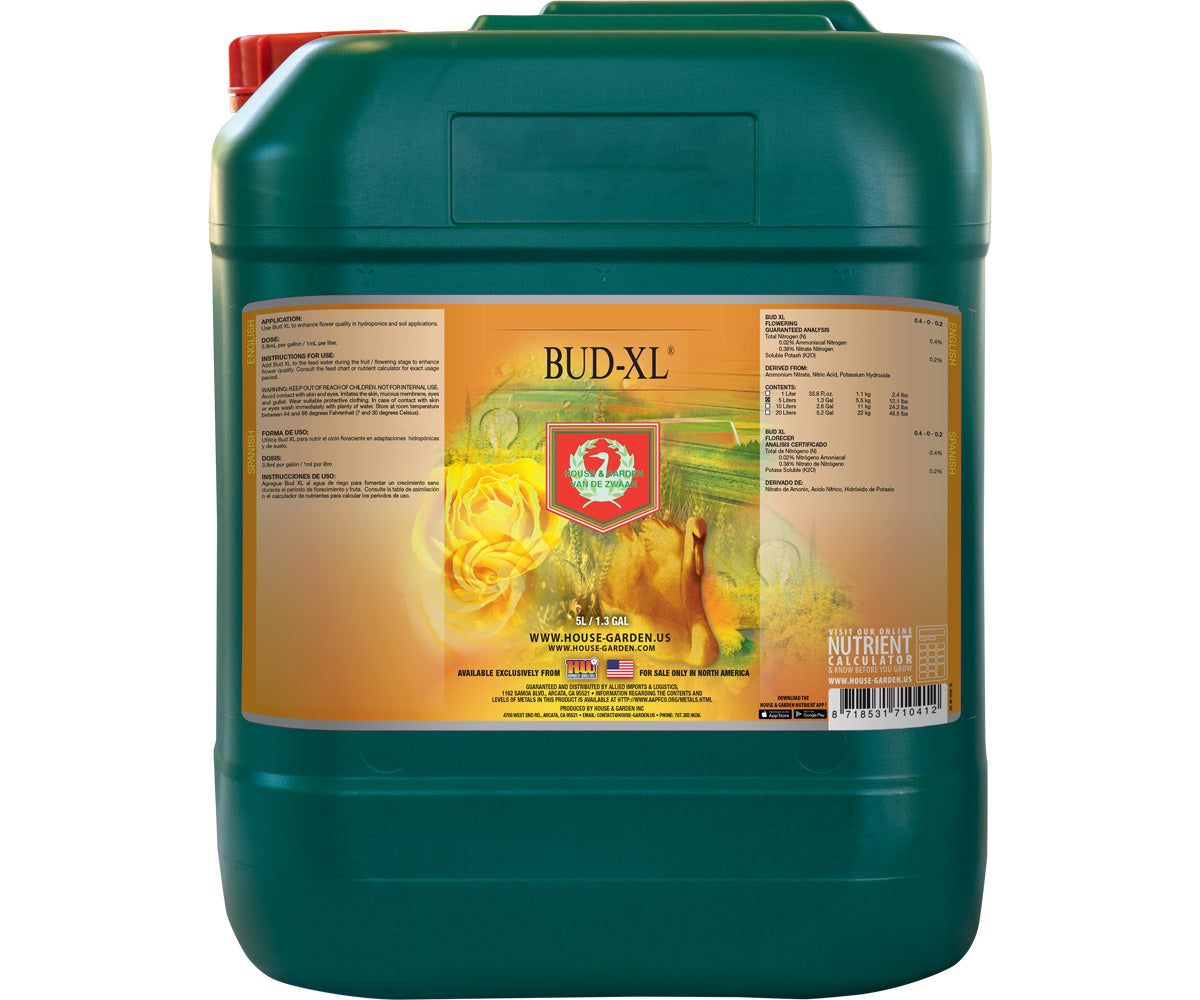
House & Garden Bud XL - 5 Litre
Regular price
$261.00
Regular price
Sale price
$261.00
Shipping calculated at checkout.
Store Availability
Newmarket, Ontario (Head Office)
1175 Stellar Drive, Unit #5
Newmarket, ON L3Y 7B8
- Mon10:00am–6:00pm
- Tue10:00am–6:00pm
- Wed10:00am–6:00pm
- Thu10:00am–6:00pm
- Fri10:00am–6:00pm
- Sat10:00am–4:00pm
- SunClosed


Barrie, Ontario
106 Saunders Road, Unit #2A
Barrie, ON L4N 9A8
- Mon10:00am–5:00pm
- Tue10:00am–5:00pm
- Wed10:00am–5:00pm
- Thu10:00am–5:00pm
- Fri10:00am–5:00pm
- Sat10:00am–3:00pm
- SunClosed
Winnipeg, Manitoba
915 McLeod Avenue, Unit #4
Winnipeg, MB R2G 0Y4
- Mon10:00am–6:00pm
- Tue10:00am–6:00pm
- Wed10:00am–6:00pm
- Thu10:00am–6:00pm
- Fri10:00am–6:00pm
- Sat11:00am–3:00pm
- SunClosed
Estimated Delivery Date
Order Within
—
Province
Est. Delivery
—
Quantity
Not Eligible for Free Shipping
Sign in required
Back-in-stock notification
Select the store locations where you’d like to pick up this item, or choose Shipping to have it delivered.
Email notifications are turned off
Turn on email marketing to receive back-in-stock notifications.
Open account profile
Special order request
Select the store where you’d prefer to pick up your special order. To choose a different store, unselect your current choice first.
Description
Description
Description
House & Garden Bud-XL is a proprietary flowering additive blend that supports the transfer of natural plant sugars to flowering sites for stronger mid-to-late bloom performance. It’s a bloom-stage nutrient additive built for growers who want more focused energy delivery where flowers and fruits are forming.
Bud-XL is designed to provide key soluble nutrients that support sugar transport required for flowering. By helping move natural plant sugars from the leaves to the flowering sites, it reinforces the plant’s own energy flow during the fruit/flowering stage. This targeted sugar transfer supports growth and vigor when plants are shifting from building structure to building flower mass.
The performance focus is clear and practical. Bud-XL is positioned to enhance flower size and density, helping flowers develop with more substance through the finishing stretch of bloom. It’s also described for improving aroma and flavor, a benefit many growers look for when quality matters as much as production. Alongside those quality traits, Bud-XL is intended to help drive high yields of high-quality flowers and fruits by supporting the sugar transport needed for strong flowering development.
Nutritionally, Bud-XL is described as an essential blend of water-soluble nitrogen and soluble potassium, supplying essential macronutrients that support key enzymatic processes tied to sugar movement and flower building. The listed inputs are ammonium nitrate, nitric acid, and potassium hydroxide, presented as the foundational sources behind its soluble nutrient profile.
Bud-XL supports mid-to-late flowering stages and is positioned for mid-flower through harvest timing, making it a straightforward finishing additive when your goal is to keep plants pushing through bloom without losing momentum. It works in all growing media, with compatible systems specifically noted as hydroponics and soil, so it fits neatly into a wide range of grow styles without changing the overall direction of your base program.
For growers who care about clean formulations, Bud-XL is stated to contain no dyes, no synthetic PGRs, and no detectable heavy metals. Those differentiators pair well with its core purpose: a flowering additive that helps transfer sugars to flowers, supports flower size and density, and improves aroma and flavor during the bloom window.
House & Garden Bud-XL is a good fit for growers focused on mid-to-late flowering results who want a sugar-transport-driven bloom additive for hydroponics, soil, or other media, with a clean-input profile and a clear finishing-stage role.
Bud-XL is designed to provide key soluble nutrients that support sugar transport required for flowering. By helping move natural plant sugars from the leaves to the flowering sites, it reinforces the plant’s own energy flow during the fruit/flowering stage. This targeted sugar transfer supports growth and vigor when plants are shifting from building structure to building flower mass.
The performance focus is clear and practical. Bud-XL is positioned to enhance flower size and density, helping flowers develop with more substance through the finishing stretch of bloom. It’s also described for improving aroma and flavor, a benefit many growers look for when quality matters as much as production. Alongside those quality traits, Bud-XL is intended to help drive high yields of high-quality flowers and fruits by supporting the sugar transport needed for strong flowering development.
Nutritionally, Bud-XL is described as an essential blend of water-soluble nitrogen and soluble potassium, supplying essential macronutrients that support key enzymatic processes tied to sugar movement and flower building. The listed inputs are ammonium nitrate, nitric acid, and potassium hydroxide, presented as the foundational sources behind its soluble nutrient profile.
Bud-XL supports mid-to-late flowering stages and is positioned for mid-flower through harvest timing, making it a straightforward finishing additive when your goal is to keep plants pushing through bloom without losing momentum. It works in all growing media, with compatible systems specifically noted as hydroponics and soil, so it fits neatly into a wide range of grow styles without changing the overall direction of your base program.
For growers who care about clean formulations, Bud-XL is stated to contain no dyes, no synthetic PGRs, and no detectable heavy metals. Those differentiators pair well with its core purpose: a flowering additive that helps transfer sugars to flowers, supports flower size and density, and improves aroma and flavor during the bloom window.
House & Garden Bud-XL is a good fit for growers focused on mid-to-late flowering results who want a sugar-transport-driven bloom additive for hydroponics, soil, or other media, with a clean-input profile and a clear finishing-stage role.
Product benefits
Flowering Stage; Indoor; Outdoor; Regular Watering; Watering Systems; Hydroponics; Coco Coir Safe; Soil; Soilless; Flower Energy; Bloom Support; Flower Weight Support; Denser Flowers; Aroma Boost; Better Flavor; Bigger Yields; Strong Bloom Finish.
Guaranteed analysis
Total Nitrogen (N): 0.4%; Ammoniacal Nitrogen (N): 0.02%; Nitrate Nitrogen (N): 0.38%; Soluble Potash (K2O): 0.2%.
Derived from
Ammonium Nitrate; Nitric Acid; Potassium Hydroxide.
Warnings & Safety
Warnings & Safety
Important – Safety Information
General Safety Precautions
First Aid – Skin Contact
First Aid – Eye Contact
First Aid – Ingestion
First aid – Inhalation
Storage And Handling
Important – Medical
Guaranteed Minimum Analysis
Guaranteed Minimum Analysis
| Total Nitrogen (N) | 0.4% |
|---|---|
| Ammoniacal Nitrogen (N) | 0.02% |
| Nitrate Nitrogen (N) | 0.38% |
| Soluble Potash (K2O) | 0.2% |
Derived From
Derived From
Frequently Asked Questions
Frequently Asked Questions
Why is total nitrogen (N) important for plant growth, and what makes it different from other nutrients?
What Is ammoniacal nitrogen (N) and why do plants need It?
What does nitrate nitrogen (N) do for plants?
Why is soluble potash (K2O) important for plants?
What makes ammonium nitrate different from other nitrogen ingredients for plant growth?
Is nitric acid only for pH, or does it feed the plant too?
Is potassium hydroxide just a potassium fertilizer?
Frequently purchased together
-
House & Garden Top Booster - 500 ML
Regular price $26.10Regular price -
House & Garden Top Shooter - 250 ML
Regular price $39.99Regular price -
House & Garden Algen Extract - 250 ML
Regular price $32.40Regular price -
Reviews are submitted by verified customers after purchase. This section shows a summary of product feedback rather than the full individual review list.

Nutrient Feed Chart
Vegetative — Bud XL
-
—
Flowering — Bud XL
-
—