

Frequently purchased together
-
House & Garden Algen Extract - 250 ML
Regular price $34.98Regular price -
House & Garden Drip Clean - 250 ML
Regular price $26.88Regular price -
House & Garden Shooting Powder - 1 Satchet
Regular price $16.92Regular price


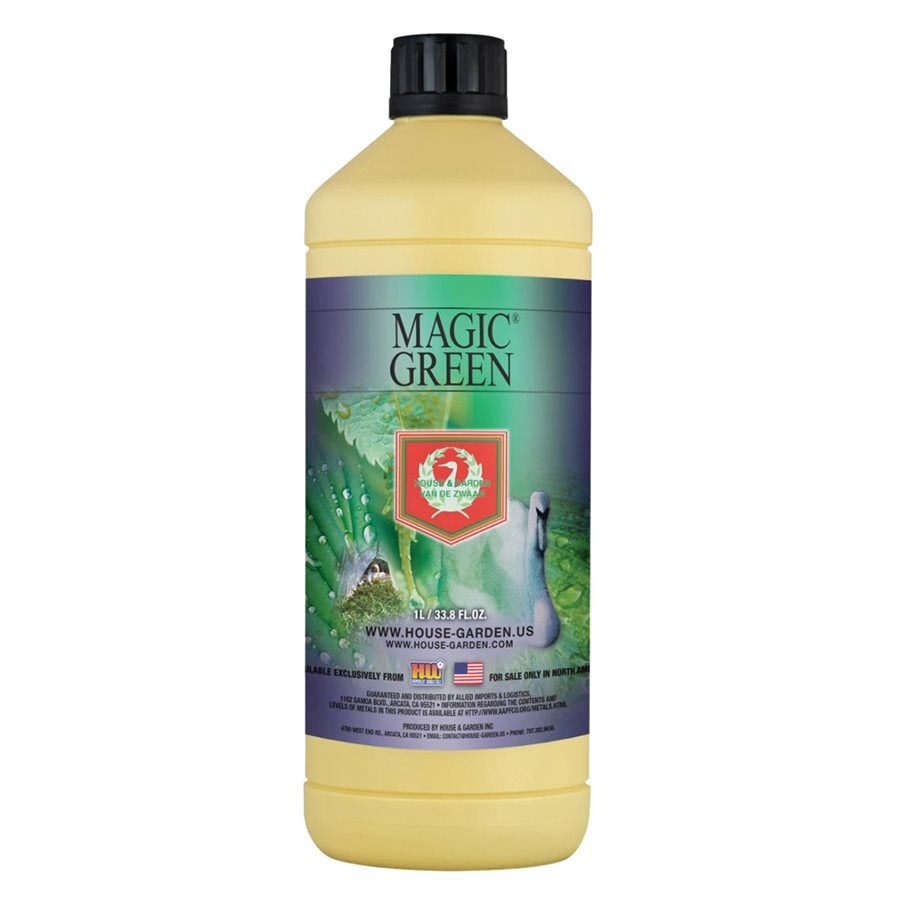
House & Garden Magic Green - 1 Litre
Newmarket, Ontario (Head Office)
1175 Stellar Drive, Unit #5
Newmarket, ON L3Y 7B8
- Mon10:00am–6:00pm
- Tue10:00am–6:00pm
- Wed10:00am–6:00pm
- Thu10:00am–6:00pm
- Fri10:00am–6:00pm
- Sat10:00am–4:00pm
- SunClosed


Barrie, Ontario
106 Saunders Road, Unit #2A
Barrie, ON L4N 9A8
- Mon10:00am–5:00pm
- Tue10:00am–5:00pm
- Wed10:00am–5:00pm
- Thu10:00am–5:00pm
- Fri10:00am–5:00pm
- Sat10:00am–3:00pm
- SunClosed
Winnipeg, Manitoba
915 McLeod Avenue, Unit #4
Winnipeg, MB R2G 0Y4
- Mon10:00am–6:00pm
- Tue10:00am–6:00pm
- Wed10:00am–6:00pm
- Thu10:00am–6:00pm
- Fri10:00am–6:00pm
- Sat11:00am–3:00pm
- SunClosed
Sign in required
Back-in-stock notification
Select the store locations where you’d like to pick up this item, or choose Shipping to have it delivered.
Special order request
Select the store where you’d prefer to pick up your special order. To choose a different store, unselect your current choice first.
Description
Description
Description
Magic Green is built around fast foliar nutrient delivery, helping plants respond quickly when leaves show signs of stress or yellowing. It’s positioned to green up yellowing leaves with noticeable improvement that can appear overnight, while also supporting foliage through its role as a leaf strengthener. That combination makes it useful when you want quicker visible recovery in the canopy without changing the base nutrition you already rely on.
Beyond rapid greening, Magic Green is intended to strengthen and support foliage across the full life cycle. It’s described as boosting plant vigor at any stage, with a practical focus on maintaining healthier-looking leaves and steadier growth momentum. When leaf discoloration is linked to macronutrient deficiencies, Magic Green is positioned to help alleviate that discoloration by supplying those macronutrients directly to the foliage.
Magic Green has an NPK of 0.3-0.1-0.4, presented as a compact nutrient profile for foliar canopy support. Its listed inputs are ammonium nitrate, nitric acid, potassium oxide, and phosphoric acid, keeping the formula centered on soluble nutrient sources rather than a long list of extras. It contains no dyes, no synthetic PGRs, and no detectable heavy metals, which matters for growers who prefer a clean-input foliar nutrient option.
It’s suitable for hydroponics, coco, and soil, and it works in all growing media. House & Garden positions it for vegetative growth and early bloom, making it a straightforward choice when plants need a quick foliage-focused nutrient boost during active development.
House & Garden Magic Green is a good fit for growers who want a foliar spray that supports fast foliar nutrient delivery, greens up yellowing leaves, and strengthens foliage, while keeping the nutrient program simple across common media and systems.
How to use
- Week 1: do not use this product during this week of vegetative growth.
- Week 2: do not use this product during this week of vegetative growth.
- Week 3: mix 5.0 ml per litre of water or nutrient solution.
Flowering stage - Magic Green:
- Week 1: do not use this product during this week of flowering.
- Week 2: mix 5.0 ml per litre of water or nutrient solution.
- Week 3: do not use this product during this week of flowering.
- Week 4: do not use this product during this week of flowering.
- Week 5: do not use this product during this week of flowering.
- Week 6: do not use this product during this week of flowering.
- Week 7: do not use this product during this week of flowering.
- Week 8: do not use this product during this week of flowering.
Product benefits
Guaranteed analysis
Derived from
How To Use
How To Use
How to Use House & Garden Magic Green - 1 Litre
Step-by-step mixing and feeding instructions for House & Garden Magic Green - 1 Litre.
Mixing & preparation
Fill your reservoir or watering container with clean, room-temperature water first. Shake the bottle of House & Garden Magic Green - 1 Litre well before every use. Using the feeding schedule below, measure the recommended dose and add it directly to the water while stirring. Allow the solution to mix fully before adding any other fertilizers, additives, or supplements.
Always add nutrients to water — not the other way around. Mix thoroughly between products to ensure an even, stable nutrient solution.
Week-by-week feeding schedule
Vegetative stage — Magic Green
- Week 1: do not use this product during this week of vegetative growth.
- Week 2: do not use this product during this week of vegetative growth.
- Week 3: mix 5.0 ml per litre of water or nutrient solution.
Flowering stage — Magic Green
- Week 1: do not use this product during this week of flowering.
- Week 2: mix 5.0 ml per litre of water or nutrient solution.
- Week 3: do not use this product during this week of flowering.
- Week 4: do not use this product during this week of flowering.
- Week 5: do not use this product during this week of flowering.
- Week 6: do not use this product during this week of flowering.
- Week 7: do not use this product during this week of flowering.
- Week 8: do not use this product during this week of flowering.
Tips for best results
- Maintain pH and EC/ppm within the range recommended for your growing medium and crop.
- Use fresh nutrient solution whenever possible and avoid leaving mixed solution stagnant for long periods.
- Store nutrients in a cool, dark place away from direct sunlight and extreme temperatures.
- Keep bottles tightly sealed when not in use to reduce air exposure and preserve product quality.
- Use clean measuring tools and regularly rinse or clean your reservoir, lines, and irrigation equipment.
Common mistakes to avoid
- Do not mix different nutrients or additives together in concentrated form before adding them to water.
- Do not exceed the recommended dosage unless you are following a tested, crop-specific feeding plan.
- Do not skip pH or EC/ppm checks when growing in hydroponic or soilless systems.
- Do not allow the nutrient solution to freeze or overheat, as this can damage the formulation.
- Do not ignore the directions on the product label for your specific crop, growth stage, and system type.
Warnings & Safety
Warnings & Safety
Important – Safety Information
General Safety Precautions
First Aid – Skin Contact
First Aid – Eye Contact
First Aid – Ingestion
First aid – Inhalation
Storage And Handling
Important – Medical
Guaranteed Minimum Analysis
Guaranteed Minimum Analysis
| Total Nitrogen (N) | 0.3% |
|---|---|
| Ammoniacal Nitrogen (N) | 0.15% |
| Nitrate Nitrogen (N) | 0.15% |
| Available Phosphate (P2O5) | 0.1% |
| Soluble Potash (K2O) | 0.4% |
Derived From
Derived From
Frequently Asked Questions
Frequently Asked Questions
Why is total nitrogen (N) important for plant growth, and what makes it different from other nutrients?
What Is ammoniacal nitrogen (N) and why do plants need It?
What does nitrate nitrogen (N) do for plants?
What does available phosphate (P₂O₅) do for plant growth?
Why is soluble potash (K2O) important for plants?
What makes ammonium nitrate different from other nitrogen ingredients for plant growth?
Is nitric acid only for pH, or does it feed the plant too?
Why is potassium oxide (K2O) important for plant growth, and what makes it different from other nutrients?
Can phosphoric acid cause nutrient lockout?
Frequently purchased together
-
House & Garden Algen Extract - 250 ML
Regular price $34.98Regular price -
House & Garden Drip Clean - 250 ML
Regular price $26.88Regular price -
House & Garden Shooting Powder - 1 Satchet
Regular price $16.92Regular price
Vegetative — Magic Green
-
—
Flowering — Magic Green
-
—