

Frequently purchased together
-
Provision Measuring Syringe - 10 ML
Regular price $1.31Regular price -
Provision Measuring Syringe - 60 ML
Regular price $2.99Regular price -
Hydrofarm Measuring Cup - 500 ML
Regular price $4.99Regular price -
Bluelab pH Pen
Regular price $169.99Regular price


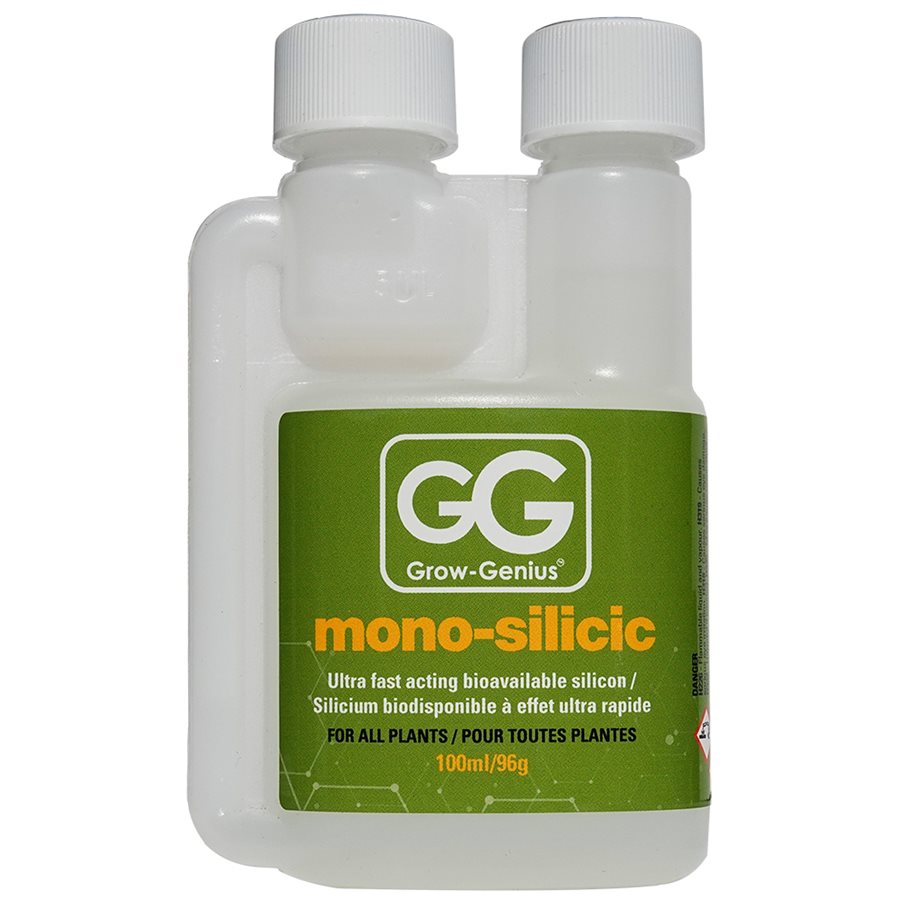
Grow Genius Mono Silicic Acid - 100 ML
Newmarket, Ontario (Head Office)
1175 Stellar Drive, Unit #5
Newmarket, ON L3Y 7B8
- Mon10:00am–6:00pm
- Tue10:00am–6:00pm
- Wed10:00am–6:00pm
- Thu10:00am–6:00pm
- Fri10:00am–6:00pm
- Sat10:00am–4:00pm
- SunClosed


Barrie, Ontario
106 Saunders Road, Unit #2A
Barrie, ON L4N 9A8
- Mon10:00am–5:00pm
- Tue10:00am–5:00pm
- Wed10:00am–5:00pm
- Thu10:00am–5:00pm
- Fri10:00am–5:00pm
- Sat10:00am–3:00pm
- SunClosed
Winnipeg, Manitoba
915 McLeod Avenue, Unit #4
Winnipeg, MB R2G 0Y4
- Mon10:00am–6:00pm
- Tue10:00am–6:00pm
- Wed10:00am–6:00pm
- Thu10:00am–6:00pm
- Fri10:00am–6:00pm
- Sat11:00am–3:00pm
- SunClosed
Sign in required
Back-in-stock notification
Select the store locations where you’d like to pick up this item, or choose Shipping to have it delivered.
Special order request
Select the store where you’d prefer to pick up your special order. To choose a different store, unselect your current choice first.
Description
Description
Description
Built around mono-silicic acid, this product delivers silicon in a form plants can use directly. Mono-silicic acid is also known as orthosilicic acid (silicic acid), and it’s the form associated with fast silicon uptake and visible structural support. Grow Genius describes it as a pH neutral source of plant-available silicon, which keeps the focus on clean support for plant strength without forcing your overall program to revolve around it.
Silicon’s role here is straightforward: reinforce the plant so it can keep growing with less slowdown from common pressure points. Grow Genius highlights bigger, healthier plants and stronger natural defences, with increased resistance to fungal pathogens such as powdery mildew, botrytis, and black spot. When those issues are a recurring concern, plant-available silicon can be a practical way to support sturdier tissues and help plants hold quality through the cycle.
Grow Genius Mono Silicic Acid is also positioned for increased resistance to biting and piercing pests, specifically thrips, mites, and aphids. Alongside pest and pathogen pressure, it’s described for increased resistance to heat stress and water stress, plus high winds and damage from pruning. That makes it a useful option for growers who want plants that stay composed when temperatures swing, moisture becomes inconsistent, or physical stress shows up during routine handling.
For root-zone conditions, Grow Genius notes support related to toxicity from heavy metals and other undesirable elements in soil. That focus on resilience is paired with broad versatility: it’s described as being for all plants in all settings, and it’s suited to root-zone and foliar application. The result is a silicon additive that can fit into a wide range of garden styles, from early propagation through late-stage growth, when plant strength and stress resistance matter most.
This is a good fit for growers who want a pH neutral, plant-available silicon nutrient built around mono-silicic acid to support stronger plants, stress resistance, and more reliable protection against common fungal pathogens and biting and piercing pests.
How to use
- Week 1: mix 0.03 ml per litre of water or nutrient solution.
- Week 2: mix 0.03 ml per litre of water or nutrient solution.
- Week 3: mix 0.03 ml per litre of water or nutrient solution.
- Week 4: mix 0.03 ml per litre of water or nutrient solution.
Flowering stage - Mono Silicic Acid:
- Week 1: mix 0.03 ml per litre of water or nutrient solution.
- Week 2: mix 0.03 ml per litre of water or nutrient solution.
- Week 3: mix 0.03 ml per litre of water or nutrient solution.
- Week 4: mix 0.03 ml per litre of water or nutrient solution.
- Week 5: mix 0.03 ml per litre of water or nutrient solution.
- Week 6: mix 0.03 ml per litre of water or nutrient solution.
- Week 7: mix 0.03 ml per litre of water or nutrient solution.
- Week 8: do not use this product during this week of flowering.
Product benefits
Guaranteed analysis
Derived from
How To Use
How To Use
How to Use Grow Genius Mono Silicic Acid - 100 ML
Step-by-step mixing and feeding instructions for Grow Genius Mono Silicic Acid - 100 ML.
Mixing & preparation
Fill your reservoir or watering container with clean, room-temperature water first. Shake the bottle of Grow Genius Mono Silicic Acid - 100 ML well before every use. Using the feeding schedule below, measure the recommended dose and add it directly to the water while stirring. Allow the solution to mix fully before adding any other fertilizers, additives, or supplements.
Always add nutrients to water — not the other way around. Mix thoroughly between products to ensure an even, stable nutrient solution.
Week-by-week feeding schedule
Vegetative stage — Mono Silicic Acid
- Week 1: mix 0.03 ml per litre of water or nutrient solution.
- Week 2: mix 0.03 ml per litre of water or nutrient solution.
- Week 3: mix 0.03 ml per litre of water or nutrient solution.
- Week 4: mix 0.03 ml per litre of water or nutrient solution.
Flowering stage — Mono Silicic Acid
- Week 1: mix 0.03 ml per litre of water or nutrient solution.
- Week 2: mix 0.03 ml per litre of water or nutrient solution.
- Week 3: mix 0.03 ml per litre of water or nutrient solution.
- Week 4: mix 0.03 ml per litre of water or nutrient solution.
- Week 5: mix 0.03 ml per litre of water or nutrient solution.
- Week 6: mix 0.03 ml per litre of water or nutrient solution.
- Week 7: mix 0.03 ml per litre of water or nutrient solution.
- Week 8: do not use this product during this week of flowering.
Tips for best results
- Maintain pH and EC/ppm within the range recommended for your growing medium and crop.
- Use fresh nutrient solution whenever possible and avoid leaving mixed solution stagnant for long periods.
- Store nutrients in a cool, dark place away from direct sunlight and extreme temperatures.
- Keep bottles tightly sealed when not in use to reduce air exposure and preserve product quality.
- Use clean measuring tools and regularly rinse or clean your reservoir, lines, and irrigation equipment.
Common mistakes to avoid
- Do not mix different nutrients or additives together in concentrated form before adding them to water.
- Do not exceed the recommended dosage unless you are following a tested, crop-specific feeding plan.
- Do not skip pH or EC/ppm checks when growing in hydroponic or soilless systems.
- Do not allow the nutrient solution to freeze or overheat, as this can damage the formulation.
- Do not ignore the directions on the product label for your specific crop, growth stage, and system type.
Warnings & Safety
Warnings & Safety
Important – Safety Information
General Safety Precautions
First Aid – Skin Contact
First Aid – Eye Contact
First Aid – Ingestion
First aid – Inhalation
Storage And Handling
Important – Medical
Guaranteed Minimum Analysis
Guaranteed Minimum Analysis
| Silicon Dioxide (SiO2) | 19.0% |
|---|---|
| Alcohol Ethoxylates | 15.0% |
Frequently Asked Questions
Frequently Asked Questions
Why is silicon dioxide important for plant growth, and what makes it different from other nutrients?
What do alcohol ethoxylates do in plant growth?
Why is alcohols C11–C15 secondary ethoxylated important in plant sprays?
What does ethylpolysilicate do for plants?
What makes tetraethyl silicate different from other silicon ingredients used for plant support?
What does polyether do for plants if it isn’t a nutrient?
Safety & Technical Documents
Safety & Technical Documents
Frequently purchased together
-
Provision Measuring Syringe - 10 ML
Regular price $1.31Regular price -
Provision Measuring Syringe - 60 ML
Regular price $2.99Regular price -
Hydrofarm Measuring Cup - 500 ML
Regular price $4.99Regular price -
Bluelab pH Pen
Regular price $169.99Regular price

Vegetative — Mono Silicic Acid
-
—
Flowering — Mono Silicic Acid
-
—