Frequently purchased together
-
-
GardenPro Superbloom 10-40-25 + Micros Water Soluble - 1.2 KG
Regular price $23.80Regular price -
GardenPro Rose Food 8-14-12 + Micros - 1.8 KG
Regular price $15.70Regular price -


Reviews are submitted by verified customers after purchase. This section shows a summary of product feedback rather than the full individual review list.

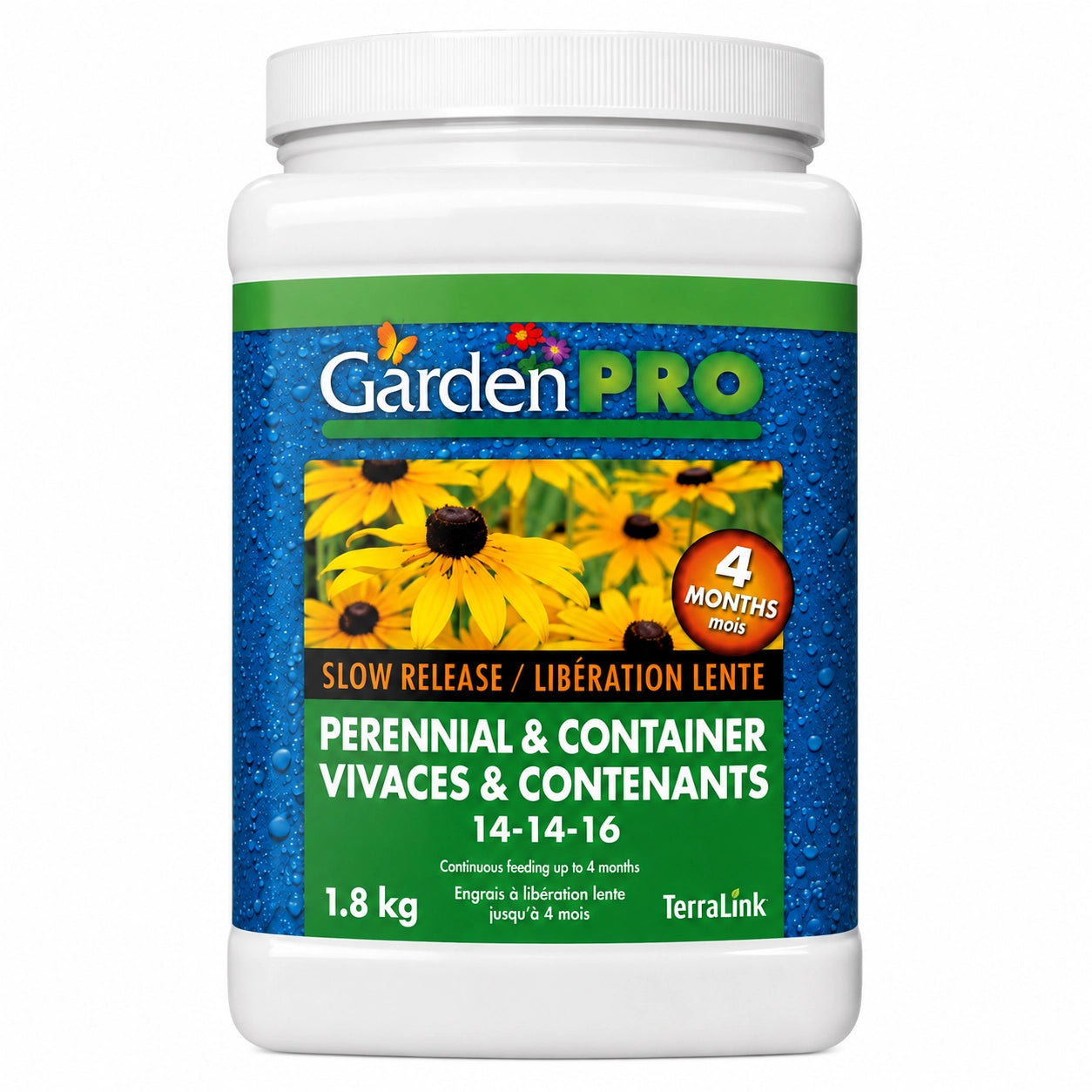
GardenPro Perennial & Container 14-14-16 Slow Release - 1.8 KG
Store Availability
Newmarket, Ontario (Head Office)
1175 Stellar Drive, Unit #5
Newmarket, ON L3Y 7B8
- Mon10:00am–6:00pm
- Tue10:00am–6:00pm
- Wed10:00am–6:00pm
- Thu10:00am–6:00pm
- Fri10:00am–6:00pm
- Sat10:00am–4:00pm
- SunClosed


Barrie, Ontario
106 Saunders Road, Unit #2A
Barrie, ON L4N 9A8
- Mon10:00am–5:00pm
- Tue10:00am–5:00pm
- Wed10:00am–5:00pm
- Thu10:00am–5:00pm
- Fri10:00am–5:00pm
- Sat10:00am–3:00pm
- SunClosed
Winnipeg, Manitoba
915 McLeod Avenue, Unit #4
Winnipeg, MB R2G 0Y4
- Mon10:00am–6:00pm
- Tue10:00am–6:00pm
- Wed10:00am–6:00pm
- Thu10:00am–6:00pm
- Fri10:00am–6:00pm
- Sat11:00am–3:00pm
- SunClosed
Estimated Delivery Date
Order Within
—
Province
Est. Delivery
—
Quantity
Qualifies for Free Shipping Promotion
Sign in required
Back-in-stock notification
Select the store locations where you’d like to pick up this item, or choose Shipping to have it delivered.
Email notifications are turned off
Turn on email marketing to receive back-in-stock notifications.
Open account profile
Special order request
Select the store where you’d prefer to pick up your special order. To choose a different store, unselect your current choice first.
Description
Description
Description
GardenPRO Perennial & Container 14-14-16 Slow Release is a controlled release fertilizer for perennials and container plants, designed to provide season-long nutrition in gardens, planters, and baskets.
This slow release formula is positioned as a proven 3–4 month option, giving you a predictable window of steady nutrient availability through the main part of the growing season. If you maintain mixed perennial borders and container displays at the same time, this product keeps your fertilizer choice simple: one perennial and container fertilizer that matches both planting styles without switching products.
The balanced 14-14-16 NPK is stated right in the product name and supports general, all-around plant nutrition rather than pushing a single outcome. That makes it a practical fit when your goal is consistent growth and dependable performance across a range of perennial types and container arrangements. It’s also a straightforward choice for gardeners who want a slow release fertilizer that’s easy to shop by category: controlled release fertilizer, perennial fertilizer, and container plant fertilizer.
GardenPRO Perennial & Container 14-14-16 Slow Release is also clearly aligned with spring timing for garden maintenance. For many gardens, spring is when perennial beds and seasonal container plantings get refreshed, and a 3–4 month controlled release window fits neatly into that early-season planning. Because it’s intended for both landscape and container settings, it’s well suited to patios and entry planters alongside in-ground perennial beds, helping you keep nutrition consistent across the spaces you actually look at every day.
GardenPRO Perennial & Container 14-14-16 Slow Release is a good fit for gardeners who want a controlled release, slow release fertilizer for all perennials and container plants, especially when you prefer a proven 3–4 month season-long nutrition approach with a simple, balanced 14-14-16 profile.
This slow release formula is positioned as a proven 3–4 month option, giving you a predictable window of steady nutrient availability through the main part of the growing season. If you maintain mixed perennial borders and container displays at the same time, this product keeps your fertilizer choice simple: one perennial and container fertilizer that matches both planting styles without switching products.
The balanced 14-14-16 NPK is stated right in the product name and supports general, all-around plant nutrition rather than pushing a single outcome. That makes it a practical fit when your goal is consistent growth and dependable performance across a range of perennial types and container arrangements. It’s also a straightforward choice for gardeners who want a slow release fertilizer that’s easy to shop by category: controlled release fertilizer, perennial fertilizer, and container plant fertilizer.
GardenPRO Perennial & Container 14-14-16 Slow Release is also clearly aligned with spring timing for garden maintenance. For many gardens, spring is when perennial beds and seasonal container plantings get refreshed, and a 3–4 month controlled release window fits neatly into that early-season planning. Because it’s intended for both landscape and container settings, it’s well suited to patios and entry planters alongside in-ground perennial beds, helping you keep nutrition consistent across the spaces you actually look at every day.
GardenPRO Perennial & Container 14-14-16 Slow Release is a good fit for gardeners who want a controlled release, slow release fertilizer for all perennials and container plants, especially when you prefer a proven 3–4 month season-long nutrition approach with a simple, balanced 14-14-16 profile.
How to use
Landscape Beds:
Use in spring to deliver season-long nutrition in garden and landscape areas.
When to apply: Spring.
Rate: Incorporate 0.5 kg (1.1 lb) per 10 m² (100 sq. ft.) into the soil.
Finish: Water after applying to help activate the slow-release feeding.
Landscape Beds:
Great for potted perennials and mixed planters.
50 cm (20 in.) container: Topdress with 150 g (about 1 cup).
How: Sprinkle evenly over the soil surface, mix lightly into the top layer, and water well.
Landscape Beds:
Hanging Baskets.
30 cm (12 in.) basket: Topdress with 30 g (2 tbsp).
How: Spread evenly, lightly work into the surface, and water well.
Coverage:
Covers approximately 36 m² (360 sq. ft.) or feeds about 60 baskets sized 30 cm (12 in.).
Use in spring to deliver season-long nutrition in garden and landscape areas.
When to apply: Spring.
Rate: Incorporate 0.5 kg (1.1 lb) per 10 m² (100 sq. ft.) into the soil.
Finish: Water after applying to help activate the slow-release feeding.
Landscape Beds:
Great for potted perennials and mixed planters.
50 cm (20 in.) container: Topdress with 150 g (about 1 cup).
How: Sprinkle evenly over the soil surface, mix lightly into the top layer, and water well.
Landscape Beds:
Hanging Baskets.
30 cm (12 in.) basket: Topdress with 30 g (2 tbsp).
How: Spread evenly, lightly work into the surface, and water well.
Coverage:
Covers approximately 36 m² (360 sq. ft.) or feeds about 60 baskets sized 30 cm (12 in.).
Product benefits
Vegetative Stage; Flowering Stage; Indoor; Outdoor; Regular Watering; Soil; Soilless; Slow Nutrient Release; Steady Feeding; Balanced Nutrition; Container Ready; Garden Bed Ready; Consistent Performance; Outdoor Use; Targeted Support.
Guaranteed analysis
Total Nitrogen (N): 14.0%; Ammoniacal Nitrogen (N): 7.5%; Nitrate Nitrogen (N): 6.5%; Available Phosphoric Acid (P2O5): 14.0%; Soluble Potash (K2O): 16.0%.
Derived from
Active Ingredients derived from exempt materials.
How To Use
How To Use
Landscape Beds
Landscape Beds
Landscape Beds
Coverage
Warnings & Safety
Warnings & Safety
Important – Safety Information
General Safety Precautions
First Aid – Skin Contact
First Aid – Eye Contact
First Aid – Ingestion
First aid – Inhalation
Storage And Handling
Important – Medical
Guaranteed Minimum Analysis
Guaranteed Minimum Analysis
| Total Nitrogen (N) | 14.0% |
|---|---|
| Ammoniacal Nitrogen (N) | 7.5% |
| Nitrate Nitrogen (N) | 6.5% |
| Available Phosphoric Acid (P2O5) | 14.0% |
| Soluble Potash (K2O) | 16.0% |
Derived From
Derived From
| Active Ingredients derived from exempt materials |
Frequently Asked Questions
Frequently Asked Questions
Why is total nitrogen (N) important for plant growth, and what makes it different from other nutrients?
What Is ammoniacal nitrogen (N) and why do plants need It?
What does nitrate nitrogen (N) do for plants?
What does available phosphoric acid (P₂O₅) do for plants, and how is it different from available phosphate?
Why is soluble potash (K2O) important for plants?
Frequently purchased together
-
-
GardenPro Superbloom 10-40-25 + Micros Water Soluble - 1.2 KG
Regular price $23.80Regular price -
GardenPro Rose Food 8-14-12 + Micros - 1.8 KG
Regular price $15.70Regular price -
Reviews are submitted by verified customers after purchase. This section shows a summary of product feedback rather than the full individual review list.