Frequently purchased together
-
 HOT ITEM
Gaia Green Alfalfa Meal - 1 KG
Regular price $18.46Regular price -
-
Gaia Green Feather Meal - 1.5 KG
Regular price $18.43Regular price -
Gaia Green Mineralized Phosphate - 2 KG
Regular price $29.99Regular price


Reviews are submitted by verified customers after purchase. This section shows a summary of product feedback rather than the full individual review list.

Store Availability
Newmarket, Ontario (Head Office)
1175 Stellar Drive, Unit #5
Newmarket, ON L3Y 7B8
- Mon10:00am–6:00pm
- Tue10:00am–6:00pm
- Wed10:00am–6:00pm
- Thu10:00am–6:00pm
- Fri10:00am–6:00pm
- Sat10:00am–4:00pm
- SunClosed


Barrie, Ontario
106 Saunders Road, Unit #2A
Barrie, ON L4N 9A8
- Mon10:00am–5:00pm
- Tue10:00am–5:00pm
- Wed10:00am–5:00pm
- Thu10:00am–5:00pm
- Fri10:00am–5:00pm
- Sat10:00am–3:00pm
- SunClosed
Winnipeg, Manitoba
915 McLeod Avenue, Unit #4
Winnipeg, MB R2G 0Y4
- Mon10:00am–6:00pm
- Tue10:00am–6:00pm
- Wed10:00am–6:00pm
- Thu10:00am–6:00pm
- Fri10:00am–6:00pm
- Sat11:00am–3:00pm
- SunClosed
Estimated Delivery Date
Order Within
—
Province
Est. Delivery
—
Quantity
Qualifies for Free Shipping Promotion
Sign in required
Back-in-stock notification
Select the store locations where you’d like to pick up this item, or choose Shipping to have it delivered.
Email notifications are turned off
Turn on email marketing to receive back-in-stock notifications.
Open account profile
Special order request
Select the store where you’d prefer to pick up your special order. To choose a different store, unselect your current choice first.
Description
Description
Description
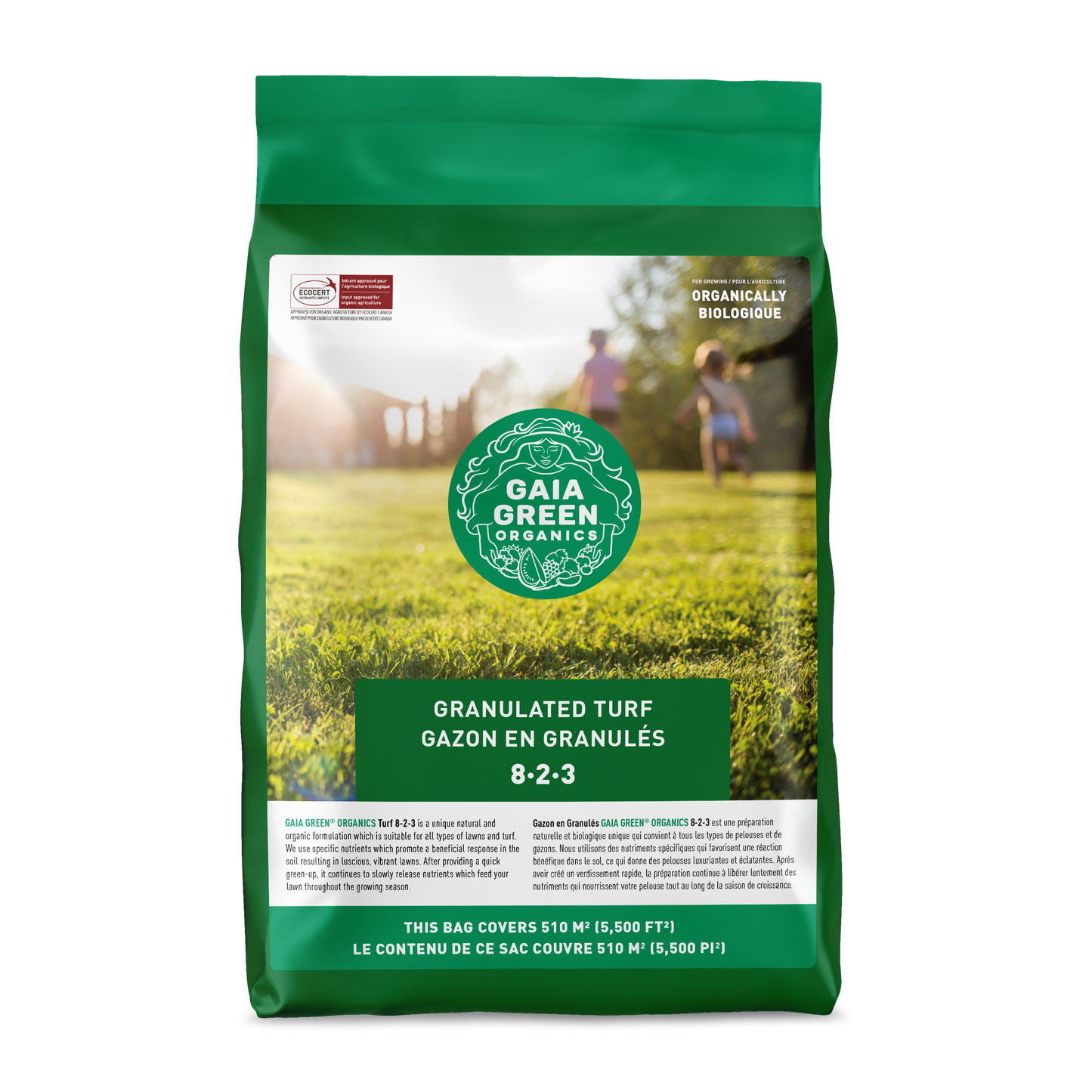
Gaia Green Granulated Turf 8-2-3 is a granulated turf fertilizer for lawns and turf, made to support a greener, healthier lawn with soil-focused nutrition. It’s a natural and organic formulation that works as an organic lawn fertilizer for routine lawn and turf maintenance without turning turf care into a complicated program.
This turf fertilizer is built to deliver a quick green-up, then continue with a slow release nutrient profile that supports lawn performance throughout the growing season. The long-lasting formula combines ingredients with variable nutrient release rates, which helps keep nutrient support more consistent over time. If you want a granulated lawn fertilizer that keeps your turf looking vibrant while supporting the ground beneath it, this product keeps the goal clear: steady nutrient support and better soil conditions for resilient turf growth.
Gaia Green frames Granulated Turf around improving soil quality to support resilient plant growth and abundance. Instead of relying on a single fast-acting input, it’s designed to promote a beneficial response in the soil, helping lawns look lush and vibrant as the season progresses. That soil-first approach matters for turf because density, color, and recovery are closely tied to how well the root zone holds structure, oxygen, and usable nutrients.
The facts layer is straightforward and buyer-focused. This formula carries an NPK of 8-2-3, aligning it with turf nutrition that emphasizes nitrogen-forward green growth with supportive phosphorus and potassium. It’s made with natural inputs such as feather meal and bone meal, backed by mineral components including glacial rock dust and sulphate minerals, plus fossilized carbon. The formulation also includes magnesium, sulphur, and iron as part of its overall nutrient profile, supporting the nutrient needs that contribute to a strong, green lawn look.
Because it’s granulated, this lawn fertilizer fits growers who prefer a product that’s easy to handle for seasonal lawn care and ongoing turf maintenance. It’s stated to be suitable for all types of lawns and turf, making it a practical match whether you’re maintaining a home lawn, improving a lawn that’s lost color, or supporting turf that needs more consistent season-long nutrition. It’s also recognized by Ecocert Canada for use in organic agriculture.
Gaia Green Granulated Turf is a good fit for anyone who wants a natural, granulated turf fertilizer with a quick green-up and slow release nutrient support, built around improving soil quality for resilient turf growth.
This turf fertilizer is built to deliver a quick green-up, then continue with a slow release nutrient profile that supports lawn performance throughout the growing season. The long-lasting formula combines ingredients with variable nutrient release rates, which helps keep nutrient support more consistent over time. If you want a granulated lawn fertilizer that keeps your turf looking vibrant while supporting the ground beneath it, this product keeps the goal clear: steady nutrient support and better soil conditions for resilient turf growth.
Gaia Green frames Granulated Turf around improving soil quality to support resilient plant growth and abundance. Instead of relying on a single fast-acting input, it’s designed to promote a beneficial response in the soil, helping lawns look lush and vibrant as the season progresses. That soil-first approach matters for turf because density, color, and recovery are closely tied to how well the root zone holds structure, oxygen, and usable nutrients.
The facts layer is straightforward and buyer-focused. This formula carries an NPK of 8-2-3, aligning it with turf nutrition that emphasizes nitrogen-forward green growth with supportive phosphorus and potassium. It’s made with natural inputs such as feather meal and bone meal, backed by mineral components including glacial rock dust and sulphate minerals, plus fossilized carbon. The formulation also includes magnesium, sulphur, and iron as part of its overall nutrient profile, supporting the nutrient needs that contribute to a strong, green lawn look.
Because it’s granulated, this lawn fertilizer fits growers who prefer a product that’s easy to handle for seasonal lawn care and ongoing turf maintenance. It’s stated to be suitable for all types of lawns and turf, making it a practical match whether you’re maintaining a home lawn, improving a lawn that’s lost color, or supporting turf that needs more consistent season-long nutrition. It’s also recognized by Ecocert Canada for use in organic agriculture.
Gaia Green Granulated Turf is a good fit for anyone who wants a natural, granulated turf fertilizer with a quick green-up and slow release nutrient support, built around improving soil quality for resilient turf growth.
Product benefits
Vegetative Stage; Outdoor; Soil; Greener Lawn; Vibrant Turf; Easy Granule Application; Restores Green Color; Slow Nutrient Release; Soil Structure Support; Strong Root Zone; Organic Matter.
Guaranteed analysis
Total Nitrogen (N): 8.0%; Available Phosphate (P2O5): 2.0%; Soluble Potash (K2O): 3.0%; Total Magnesium (Mg): 0.5%; Sulfur (S): 2.0%; Total Iron (Fe): 1.0%.
Derived from
Feather Meal; Bone Meal; Glacial Rock Dust; Potassium Sulphate; Magnesium Sulphate; Ferrous Sulphate; Fossilized Carbon.
Warnings & Safety
Warnings & Safety
Important – Safety Information
General Safety Precautions
First Aid – Skin Contact
First Aid – Eye Contact
First Aid – Ingestion
First aid – Inhalation
Storage And Handling
Important – Medical
Guaranteed Minimum Analysis
Guaranteed Minimum Analysis
| Total Nitrogen (N) | 8.0% |
|---|---|
| Available Phosphate (P2O5) | 2.0% |
| Soluble Potash (K2O) | 3.0% |
| Total Magnesium (Mg) | 0.5% |
| Sulfur (S) | 2.0% |
| Total Iron (Fe) | 1.0% |
Frequently Asked Questions
Frequently Asked Questions
Why is total nitrogen (N) important for plant growth, and what makes it different from other nutrients?
What does available phosphate (P₂O₅) do for plant growth?
Why is soluble potash (K2O) important for plants?
Why is total magnesium (Mg) important for plant growth?
Why is sulfur (S) important for plant growth?
Why is total iron (Fe) important for plant growth?
What does feather meal do for plants?
When should you use bone meal for plants, and why does it work differently than other amendments?
What does ferrous sulfate do for yellow new leaves on plants?
What does glacial rock dust actually do for plants?
Is potassium sulfate better than other potassium sources for sensitive plants?
What does magnesium sulfate do for plants?
What does fossilized carbon actually do for plant roots?
Frequently purchased together
-
HOT ITEM
Gaia Green Alfalfa Meal - 1 KG
Regular price $18.46Regular price -
-
Gaia Green Feather Meal - 1.5 KG
Regular price $18.43Regular price -
Gaia Green Mineralized Phosphate - 2 KG
Regular price $29.99Regular price
Reviews are submitted by verified customers after purchase. This section shows a summary of product feedback rather than the full individual review list.