Frequently purchased together
-
 HOT ITEM
Gaia Green All Purpose - 2 KG
Regular price $27.99Regular price -
Gaia Green Bone Meal - 2 KG
Regular price $23.99Regular price -
Gaia Green Feather Meal - 1.5 KG
Regular price $18.43Regular price -


Reviews are submitted by verified customers after purchase. This section shows a summary of product feedback rather than the full individual review list.

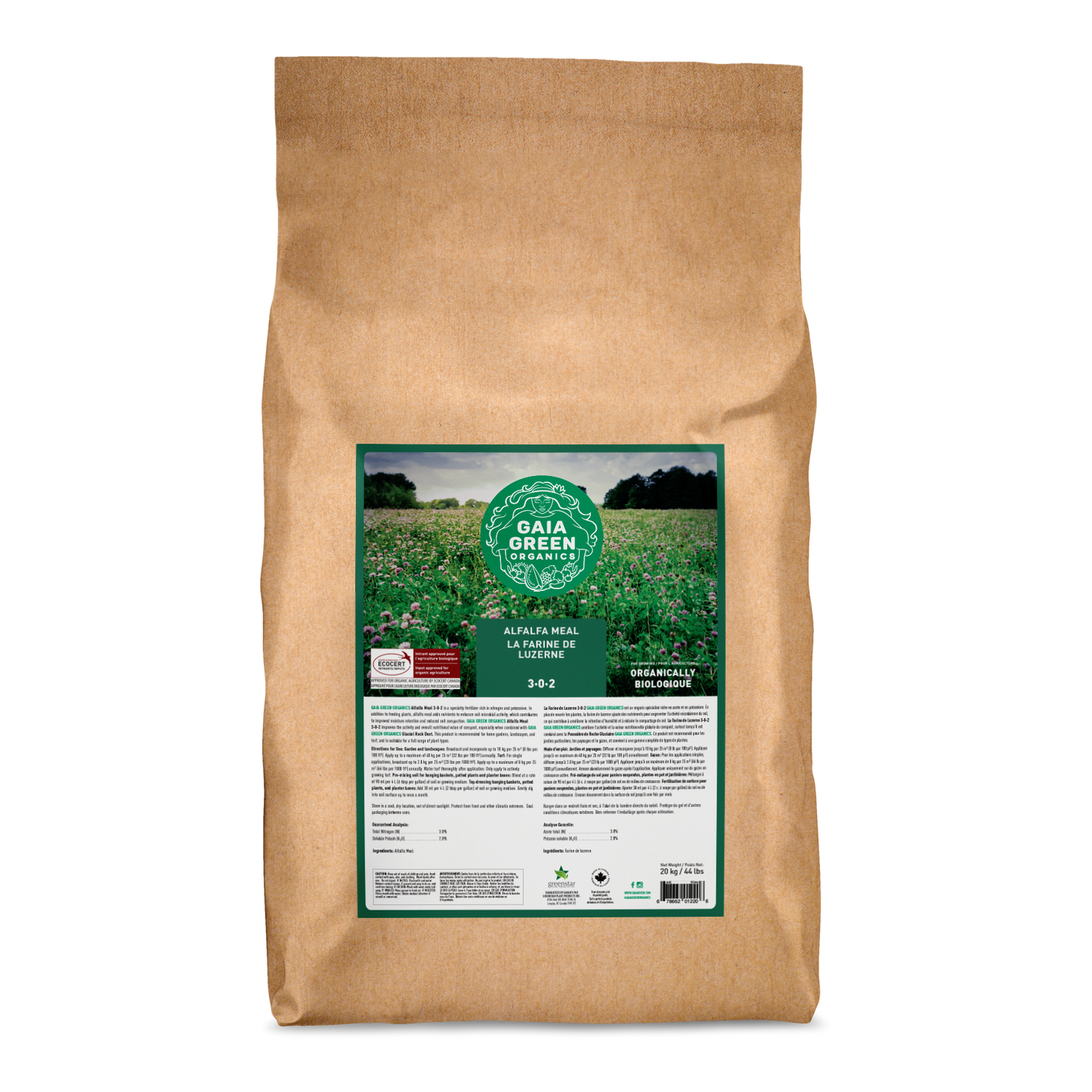
Gaia Green Alfalfa Meal - 20 KG
Regular price
$65.12
Regular price
Sale price
$65.12
Shipping calculated at checkout.
Store Availability
Newmarket, Ontario (Head Office)
1175 Stellar Drive, Unit #5
Newmarket, ON L3Y 7B8
- Mon10:00am–6:00pm
- Tue10:00am–6:00pm
- Wed10:00am–6:00pm
- Thu10:00am–6:00pm
- Fri10:00am–6:00pm
- Sat10:00am–4:00pm
- SunClosed


Barrie, Ontario
106 Saunders Road, Unit #2A
Barrie, ON L4N 9A8
- Mon10:00am–5:00pm
- Tue10:00am–5:00pm
- Wed10:00am–5:00pm
- Thu10:00am–5:00pm
- Fri10:00am–5:00pm
- Sat10:00am–3:00pm
- SunClosed
Winnipeg, Manitoba
915 McLeod Avenue, Unit #4
Winnipeg, MB R2G 0Y4
- Mon10:00am–6:00pm
- Tue10:00am–6:00pm
- Wed10:00am–6:00pm
- Thu10:00am–6:00pm
- Fri10:00am–6:00pm
- Sat11:00am–3:00pm
- SunClosed
Quantity
In-Store Pickup Only
Sign in required
Back-in-stock notification
Select the store locations where you’d like to pick up this item, or choose Shipping to have it delivered.
Email notifications are turned off
Turn on email marketing to receive back-in-stock notifications.
Open account profile
Special order request
Select the store where you’d prefer to pick up your special order. To choose a different store, unselect your current choice first.
Description
Description
Description
Gaia Green Alfalfa Meal is a Gaia Green specialty fertilizer for building soil fertility and plant growth, made from alfalfa meal to deliver a natural source of nutrition in the garden.
This organic specialty fertilizer is described as rich in nitrogen and potassium, giving it a clear role when you want an ingredient-driven input that supports steady growth. Because alfalfa meal readily decomposes to release nutrients, it’s well suited to growers who prefer nutrition that becomes available as the material breaks down rather than all at once. Gaia Green also notes there is no risk of burning, which helps keep the feeding approach comfortable for gardeners who want reliable nutrition without harshness.
Beyond basic nutrition, Gaia Green Alfalfa Meal is positioned as a soil-support product. It adds nutrients to enhance soil microbial activity, and that microbial support is tied to practical outcomes in the root zone. The product is described as contributing to improved moisture retention and reduced soil compaction, two benefits that matter when you’re trying to keep soil from drying too quickly or getting tight and crusty. Those soil-focused improvements can help plants stay more consistent in day-to-day conditions, especially in beds and gardens that see frequent watering cycles or changing weather.
Alfalfa meal is also highlighted as an excellent compost activator, making it a useful choice for growers who maintain compost piles and want to support overall compost activity and nutritional value. In that role, it functions as a straightforward way to bring plant-based nitrogen and potassium into composting workflows, while still fitting an organic garden mindset.
Gaia Green also points out that, beyond nitrogen and potassium, alfalfa contains compounds known to benefit plant growth. That makes this product a good fit when you’re looking for a single-ingredient fertilizer that supports both nutrition and the living side of the soil, without relying on a complex ingredient list.
Recommended for home gardens, landscapes, and turf, Gaia Green Alfalfa Meal is a strong match for growers who want a natural, organic source of nitrogen and potassium with added value as a compost activator and a soil-supporting amendment that promotes improved moisture retention and reduced soil compaction.
This organic specialty fertilizer is described as rich in nitrogen and potassium, giving it a clear role when you want an ingredient-driven input that supports steady growth. Because alfalfa meal readily decomposes to release nutrients, it’s well suited to growers who prefer nutrition that becomes available as the material breaks down rather than all at once. Gaia Green also notes there is no risk of burning, which helps keep the feeding approach comfortable for gardeners who want reliable nutrition without harshness.
Beyond basic nutrition, Gaia Green Alfalfa Meal is positioned as a soil-support product. It adds nutrients to enhance soil microbial activity, and that microbial support is tied to practical outcomes in the root zone. The product is described as contributing to improved moisture retention and reduced soil compaction, two benefits that matter when you’re trying to keep soil from drying too quickly or getting tight and crusty. Those soil-focused improvements can help plants stay more consistent in day-to-day conditions, especially in beds and gardens that see frequent watering cycles or changing weather.
Alfalfa meal is also highlighted as an excellent compost activator, making it a useful choice for growers who maintain compost piles and want to support overall compost activity and nutritional value. In that role, it functions as a straightforward way to bring plant-based nitrogen and potassium into composting workflows, while still fitting an organic garden mindset.
Gaia Green also points out that, beyond nitrogen and potassium, alfalfa contains compounds known to benefit plant growth. That makes this product a good fit when you’re looking for a single-ingredient fertilizer that supports both nutrition and the living side of the soil, without relying on a complex ingredient list.
Recommended for home gardens, landscapes, and turf, Gaia Green Alfalfa Meal is a strong match for growers who want a natural, organic source of nitrogen and potassium with added value as a compost activator and a soil-supporting amendment that promotes improved moisture retention and reduced soil compaction.
Product benefits
Vegetative Stage; Flowering Stage; Indoor; Outdoor; Coco Coir Safe; Soil; Soilless; Organic; Nitrogen Support; Potassium Support; Stimulates Microbial Activity; Moisture Retention; Reduced Compaction; Slow Nutrient Release; Gentle Feeding; Compost Activator.
Guaranteed analysis
Total Nitrogen (N): 4.0%; Water Soluble Nitrogen (N): 3.0%; Water Insoluble Nitrogen (N): 1.0%; Available Phosphoric Acid (P2O5): 4.0%; Soluble Potash (K2O): 4.0%.
Derived from
Fishbone Meal; Feather Meal; Alfalfa Meal; Rock Phosphate; Sulfate of Potash; Insect Frass; Soy Protein Hydrolysate; Gypsum; Seaweed Extract (Ascophyllum Nodosum); Oyster Shell Flour; Greensand.
Warnings & Safety
Warnings & Safety
Important – Safety Information
General Safety Precautions
First Aid – Skin Contact
First Aid – Eye Contact
First Aid – Ingestion
First aid – Inhalation
Storage And Handling
Important – Medical
Guaranteed Minimum Analysis
Guaranteed Minimum Analysis
Frequently Asked Questions
Frequently Asked Questions
Why is total nitrogen (N) important for plant growth, and what makes it different from other nutrients?
Why is water-soluble nitrogen important for plant growth, and what makes it unique compared to other nitrogen sources?
Why is water insoluble nitrogen important for plant growth?
What does available phosphoric acid (P₂O₅) do for plants, and how is it different from available phosphate?
Why is soluble potash (K2O) important for plants?
What does fishbone meal do for plant roots?
What does feather meal do for plants?
What makes alfalfa meal important for plant growth compared to other natural amendments?
What makes natural rock phosphate different from other phosphorus sources for plant growth?
What does sulfate of potash do for plants?
What makes insect frass different from other organic soil amendments?
What does soy protein hydrolysate do for plants?
Does gypsum change soil pH?
Is seaweed a fertilizer or a plant booster?
What does oyster shell flour do for plants?
Is greensand a fast way to fix a potassium deficiency in plants?
Frequently purchased together
-
HOT ITEM
Gaia Green All Purpose - 2 KG
Regular price $27.99Regular price -
Gaia Green Bone Meal - 2 KG
Regular price $23.99Regular price -
Gaia Green Feather Meal - 1.5 KG
Regular price $18.43Regular price -
Reviews are submitted by verified customers after purchase. This section shows a summary of product feedback rather than the full individual review list.