Frequently purchased together
-
Growth Technology Complete Focus - 1 Litre
Regular price $32.14Regular price -
Growth Technology Flower Focus - 1 Litre
Regular price $32.14Regular price -
Growth Technology Foliage Focus - 1 Litre
Regular price $32.14Regular price -
Growth Technology GT Silica - 1 Litre
Regular price $31.16Regular price


Reviews are submitted by verified customers after purchase. This section shows a summary of product feedback rather than the full individual review list.

Forbidden Cereal Soilless Houseplant Potting Mix - 7.1 Litre
Regular price
$28.99
Regular price
Sale price
$28.99
Shipping calculated at checkout.
Store Availability
Newmarket, Ontario (Head Office)
1175 Stellar Drive, Unit #5
Newmarket, ON L3Y 7B8
- Mon10:00am–6:00pm
- Tue10:00am–6:00pm
- Wed10:00am–6:00pm
- Thu10:00am–6:00pm
- Fri10:00am–6:00pm
- Sat10:00am–4:00pm
- SunClosed


Barrie, Ontario
106 Saunders Road, Unit #2A
Barrie, ON L4N 9A8
- Mon10:00am–5:00pm
- Tue10:00am–5:00pm
- Wed10:00am–5:00pm
- Thu10:00am–5:00pm
- Fri10:00am–5:00pm
- Sat10:00am–3:00pm
- SunClosed
Winnipeg, Manitoba
915 McLeod Avenue, Unit #4
Winnipeg, MB R2G 0Y4
- Mon10:00am–6:00pm
- Tue10:00am–6:00pm
- Wed10:00am–6:00pm
- Thu10:00am–6:00pm
- Fri10:00am–6:00pm
- Sat11:00am–3:00pm
- SunClosed
Estimated Delivery Date
Order Within
—
Province
Est. Delivery
—
Quantity
Qualifies for Free Shipping Promotion
Sign in required
Back-in-stock notification
Select the store locations where you’d like to pick up this item, or choose Shipping to have it delivered.
Email notifications are turned off
Turn on email marketing to receive back-in-stock notifications.
Open account profile
Special order request
Select the store where you’d prefer to pick up your special order. To choose a different store, unselect your current choice first.
Description
Description
Description
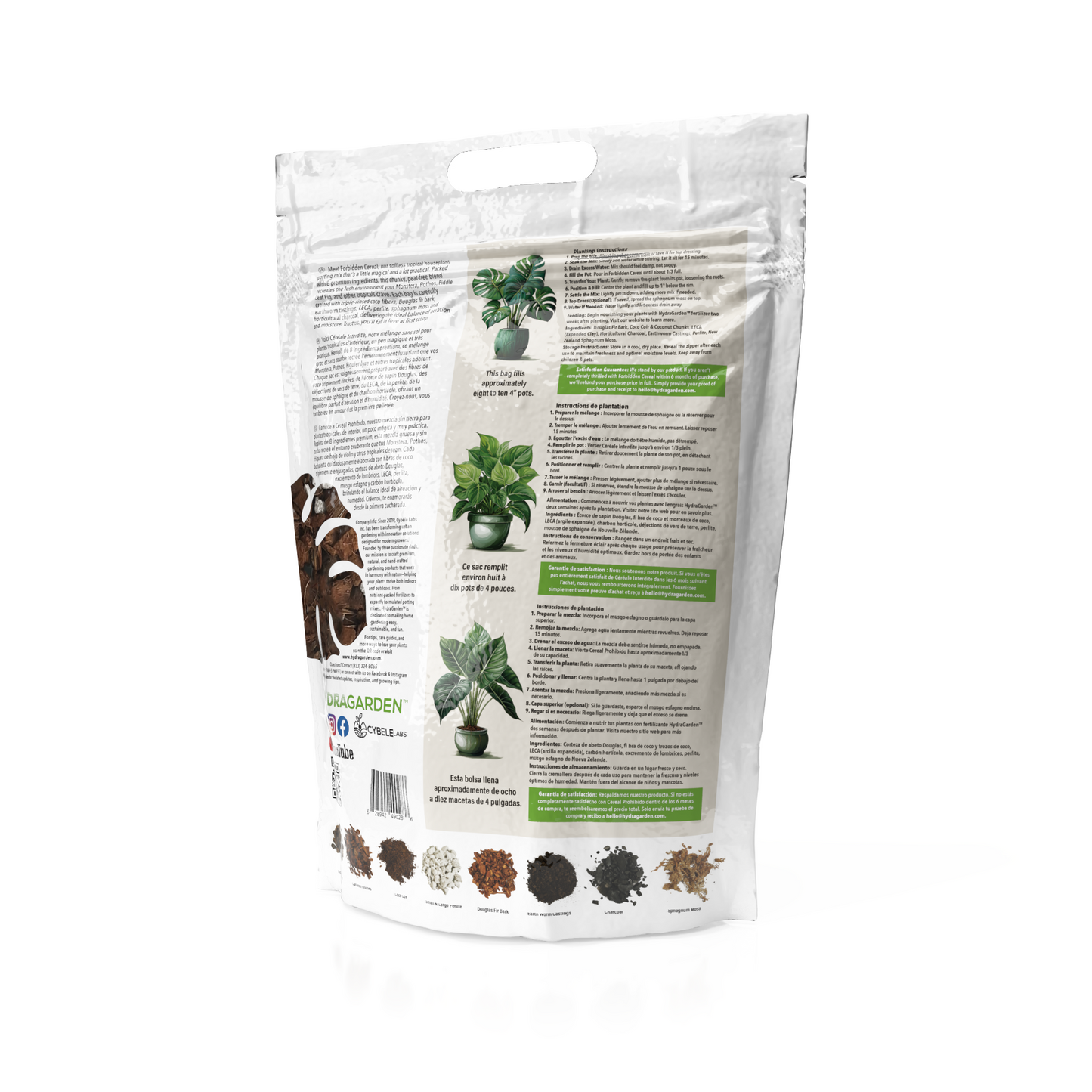
Forbidden Cereal Soilless Houseplant Potting Mix is a soilless houseplant potting mix for aroid tropical houseplants, built to make watering more forgiving in containers. It’s a peat-free and soil-free blend that works as a soilless potting mix when you want a structured, airy root zone for indoor and outdoor potted plants.
This extra chunky mix is designed to help stop overwatering problems while restoring plant growth. The open texture is made to keep air moving through the pot, which supports healthier roots and helps prevent root rot. When roots stay active, plants are better positioned to push steady growth instead of stalling after repeated wet cycles.
You get a clean, purposeful feature set that fits modern houseplant care. It’s fertilizer free and pH neutral, so the medium stays focused on structure rather than acting like a pre-charged soil. It’s also described as pest free, which matters when you’re potting up indoors and want a cleaner experience from bag to pot. For plant spaces shared with pets, it’s listed as pet friendly and non toxic.
The “8 premium organic ingredients” are selected for both airflow and moisture balance. The blend includes hand-picked, heat-treated Douglas fir bark (orchid bark), a mix of fine and coarse perlite, triple-rinsed coco coir and fibers, coco chips, horticultural charcoal (biochar), nutrient-rich worm castings, and leca expanded clay balls, with separated New Zealand sphagnum moss layered on top. It’s made in small batches to help keep the ingredient distribution even throughout the bag.
Forbidden Cereal Soilless Houseplant Potting Mix is positioned as a versatile option for indoor and outdoor potted plants, including popular tropicals like monstera, pothos, philodendron, anthurium, alocasia, hoya, and orchids. It’s a good fit for growers who want a pest free potting mix with a peat-free and soil-free blend, plus an extra chunky mix texture that supports root health while keeping plant care straightforward.
This extra chunky mix is designed to help stop overwatering problems while restoring plant growth. The open texture is made to keep air moving through the pot, which supports healthier roots and helps prevent root rot. When roots stay active, plants are better positioned to push steady growth instead of stalling after repeated wet cycles.
You get a clean, purposeful feature set that fits modern houseplant care. It’s fertilizer free and pH neutral, so the medium stays focused on structure rather than acting like a pre-charged soil. It’s also described as pest free, which matters when you’re potting up indoors and want a cleaner experience from bag to pot. For plant spaces shared with pets, it’s listed as pet friendly and non toxic.
The “8 premium organic ingredients” are selected for both airflow and moisture balance. The blend includes hand-picked, heat-treated Douglas fir bark (orchid bark), a mix of fine and coarse perlite, triple-rinsed coco coir and fibers, coco chips, horticultural charcoal (biochar), nutrient-rich worm castings, and leca expanded clay balls, with separated New Zealand sphagnum moss layered on top. It’s made in small batches to help keep the ingredient distribution even throughout the bag.
Forbidden Cereal Soilless Houseplant Potting Mix is positioned as a versatile option for indoor and outdoor potted plants, including popular tropicals like monstera, pothos, philodendron, anthurium, alocasia, hoya, and orchids. It’s a good fit for growers who want a pest free potting mix with a peat-free and soil-free blend, plus an extra chunky mix texture that supports root health while keeping plant care straightforward.
Product benefits
Less Overwatering Risk; Breathable Root Zone; Air Circulation; Root Development; Plant Health; Air-Water Balance; Sustainable Medium; pH Neutral; Indoor; Outdoor; Flowering Stage; Vegetative Stage; Soilless.
Derived from
Douglas Fir Bark; Coconut Coir; Coconut Chunks; LECA (Expanded Clay); Horticultural Charcoal; Earthworm Castings; Perlite; New Zealand Sphagnum Moss.
Frequently Asked Questions
Frequently Asked Questions
What does Douglas fir bark do in a potting mix?
Why is coconut coir important for plant growth?
Are coconut chunks good for plant roots in containers?
Are earthworm castings a fertilizer or more of a soil conditioner?
Why is perlite important for plant growth, and what makes it different from other mix ingredients?
What does LECA actually do for plant roots?
Does charcoal help plants grow better in containers?
Why is New Zealand sphagnum moss so effective for rooting and moisture control?
Frequently purchased together
-
Growth Technology Complete Focus - 1 Litre
Regular price $32.14Regular price -
Growth Technology Flower Focus - 1 Litre
Regular price $32.14Regular price -
Growth Technology Foliage Focus - 1 Litre
Regular price $32.14Regular price -
Growth Technology GT Silica - 1 Litre
Regular price $31.16Regular price
Reviews are submitted by verified customers after purchase. This section shows a summary of product feedback rather than the full individual review list.