Frequently purchased together
-
Square Nursery Pots 2.75 Inch - Clear
Regular price $0.55Regular price -
Square Nursery Pots 2.75 Inch - Pink
Regular price $0.55Regular price -
 HOT ITEM
Transparent Nursery Pot - 3 Inch
Regular price $0.89Regular price -
Growth Technology Succulent Focus - 250 ML
Regular price $18.50Regular price


Reviews are submitted by verified customers after purchase. This section shows a summary of product feedback rather than the full individual review list.

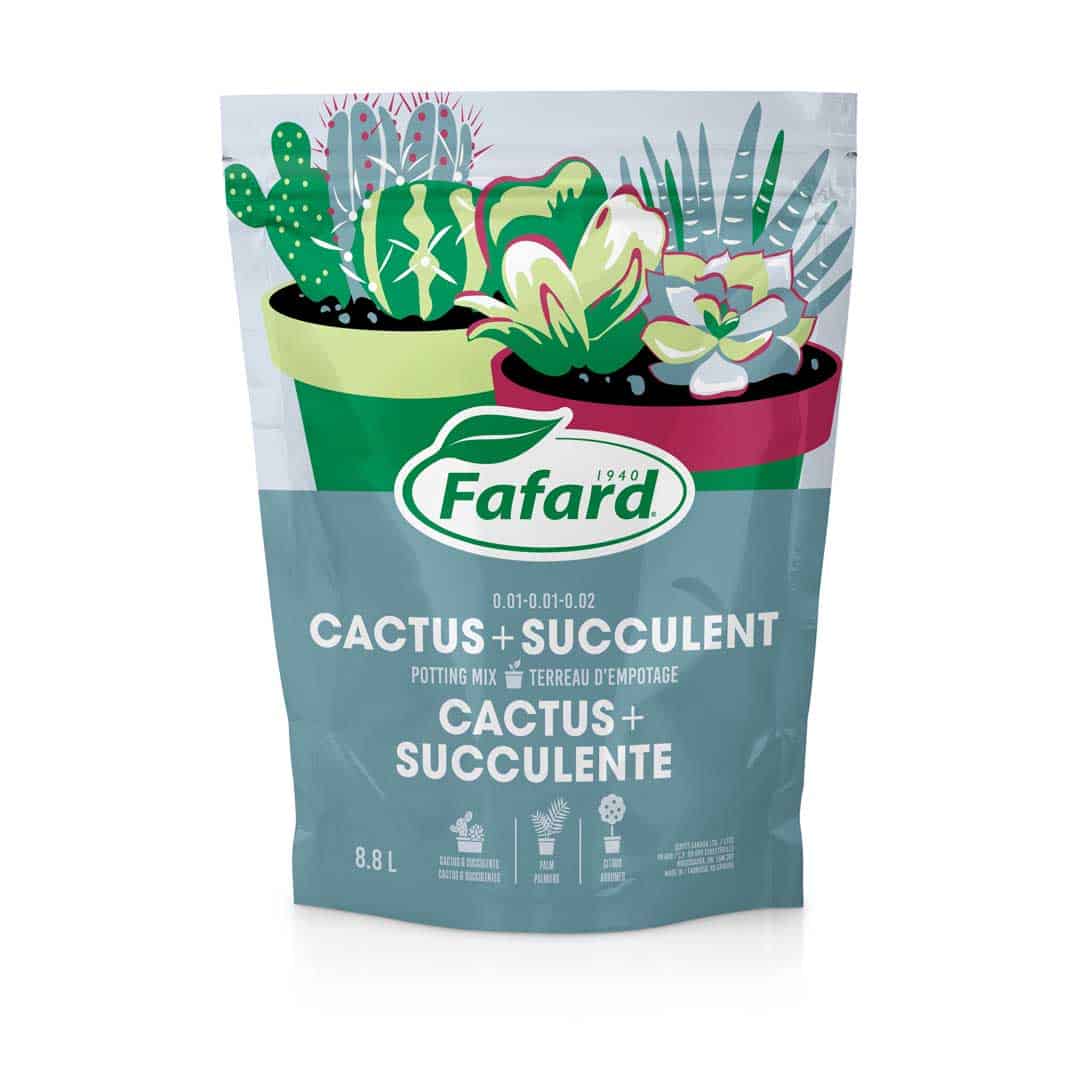
Fafard Cactus + Succulent Potting Mix - 8.8 Litres
Regular price
$14.77
Regular price
Sale price
$14.77
Shipping calculated at checkout.
Store Availability
Newmarket, Ontario (Head Office)
1175 Stellar Drive, Unit #5
Newmarket, ON L3Y 7B8
- Mon10:00am–6:00pm
- Tue10:00am–6:00pm
- Wed10:00am–6:00pm
- Thu10:00am–6:00pm
- Fri10:00am–6:00pm
- Sat10:00am–4:00pm
- SunClosed


Barrie, Ontario
106 Saunders Road, Unit #2A
Barrie, ON L4N 9A8
- Mon10:00am–5:00pm
- Tue10:00am–5:00pm
- Wed10:00am–5:00pm
- Thu10:00am–5:00pm
- Fri10:00am–5:00pm
- Sat10:00am–3:00pm
- SunClosed
Winnipeg, Manitoba
915 McLeod Avenue, Unit #4
Winnipeg, MB R2G 0Y4
- Mon10:00am–6:00pm
- Tue10:00am–6:00pm
- Wed10:00am–6:00pm
- Thu10:00am–6:00pm
- Fri10:00am–6:00pm
- Sat11:00am–3:00pm
- SunClosed
Estimated Delivery Date
Order Within
—
Province
Est. Delivery
—
Quantity
Qualifies for Free Shipping Promotion
Sign in required
Back-in-stock notification
Select the store locations where you’d like to pick up this item, or choose Shipping to have it delivered.
Email notifications are turned off
Turn on email marketing to receive back-in-stock notifications.
Open account profile
Special order request
Select the store where you’d prefer to pick up your special order. To choose a different store, unselect your current choice first.
Description
Description
Description
Fafard Cactus + Succulent Potting Mix is a cactus and succulent potting mix made for fast drainage and steady moisture in containers. This potting mix is a container planting mix for drought-adapted plants that need water to move through the root zone quickly.
Built around fast water drainage, this blend helps prevent soggy conditions while still supporting an ideal moisture level for plants that prefer a drier rhythm. Sphagnum peat moss helps retain and release water as needed, so roots aren’t left completely dry between waterings. Perlite and sand improve drainage and aeration, creating a lighter, more open structure that helps promote vigorous root growth and healthier root development over time.
This mix is specially formulated for desert plants such as cacti and succulents, and it also fits a range of popular indoor plant types the same way. It’s a practical option for collections that include snake plant, dracaena, ZZ plant, and hoya, plus palms and citrus grown in pots. The texture is designed to support plants that dislike lingering moisture, making it easier to keep conditions consistent across mixed planters and single-specimen containers.
For a compact facts layer, Fafard Cactus + Succulent Potting Mix lists an NPK of 0.01-0.01-0.01 and includes a light fertilizer starter charge derived from ammonium nitrate, potassium sulphate, and phosphate sources. It’s suited for indoor container setups and seed starting where a fast-draining potting mix is the priority. This is a good fit for growers who want a straightforward cactus and succulent potting mix that supports drainage, balanced moisture, and strong root establishment without overcomplicating the setup.
Built around fast water drainage, this blend helps prevent soggy conditions while still supporting an ideal moisture level for plants that prefer a drier rhythm. Sphagnum peat moss helps retain and release water as needed, so roots aren’t left completely dry between waterings. Perlite and sand improve drainage and aeration, creating a lighter, more open structure that helps promote vigorous root growth and healthier root development over time.
This mix is specially formulated for desert plants such as cacti and succulents, and it also fits a range of popular indoor plant types the same way. It’s a practical option for collections that include snake plant, dracaena, ZZ plant, and hoya, plus palms and citrus grown in pots. The texture is designed to support plants that dislike lingering moisture, making it easier to keep conditions consistent across mixed planters and single-specimen containers.
For a compact facts layer, Fafard Cactus + Succulent Potting Mix lists an NPK of 0.01-0.01-0.01 and includes a light fertilizer starter charge derived from ammonium nitrate, potassium sulphate, and phosphate sources. It’s suited for indoor container setups and seed starting where a fast-draining potting mix is the priority. This is a good fit for growers who want a straightforward cactus and succulent potting mix that supports drainage, balanced moisture, and strong root establishment without overcomplicating the setup.
Product benefits
Drainage Support; Less Overwatering Risk; Watering Balance; Moisture Retention; Better Aeration; Root Development; Wide Plant Use; Starter Nutrition; Indoor; Outdoor; Flowering Stage; Vegetative Stage; Soilless.
Guaranteed analysis
Total Nitrogen (N): 0.01%; Available Phosphoric Acid (P2O5): 0.01%; Soluble Potash (K2O): 0.01%; Calcium (Ca): 0.001%; Sulfur (S): 0.005%; Linseed Oil: 0.003%; Polyol: 0.002%; Diphenylmethanediisocyanate: 0.003%.
Derived from
Canadian Sphagnum Peat Moss; Perlite; Sand.
Guaranteed Minimum Analysis
Guaranteed Minimum Analysis
| Total Nitrogen (N) | 0.01% |
|---|---|
| Available Phosphoric Acid (P2O5) | 0.01% |
| Soluble Potash (K2O) | 0.01% |
| Calcium (Ca) | 0.001% |
| Sulfur (S) | 0.005% |
| Linseed Oil | 0.003% |
| Polyol | 0.002% |
| Diphenylmethanediisocyanate | 0.003% |
Derived From
Derived From
Frequently Asked Questions
Frequently Asked Questions
Why is total nitrogen (N) important for plant growth, and what makes it different from other nutrients?
What does available phosphoric acid (P₂O₅) do for plants, and how is it different from available phosphate?
Why is soluble potash (K2O) important for plants?
Why is calcium important for plant growth?
Why is sulfur (S) important for plant growth?
Why is linseed oil important in cactus and succulent potting mix?
Why are polyols important in succulent and cactus potting mixes?
Why is diphenylmethanediisocyanate important in cactus and succulent soil mixes?
Why do growers use Canadian sphagnum peat moss in potting mixes?
Why is perlite important for plant growth, and what makes it different from other mix ingredients?
Does sand always improve drainage for plants?
Frequently purchased together
-
Square Nursery Pots 2.75 Inch - Clear
Regular price $0.55Regular price -
Square Nursery Pots 2.75 Inch - Pink
Regular price $0.55Regular price -
HOT ITEM
Transparent Nursery Pot - 3 Inch
Regular price $0.89Regular price -
Growth Technology Succulent Focus - 250 ML
Regular price $18.50Regular price
Reviews are submitted by verified customers after purchase. This section shows a summary of product feedback rather than the full individual review list.