


Newmarket, Ontario (Head Office)
1175 Stellar Drive, Unit #5
Newmarket, ON L3Y 7B8
- Mon10:00am–6:00pm
- Tue10:00am–6:00pm
- Wed10:00am–6:00pm
- Thu10:00am–6:00pm
- Fri10:00am–6:00pm
- Sat10:00am–4:00pm
- SunClosed


Out of stock at your chosen pickup location? We'll automatically transfer inventory from another location so it's ready at your selected pickup location. (Ontario Only)
Couldn't load pickup availability
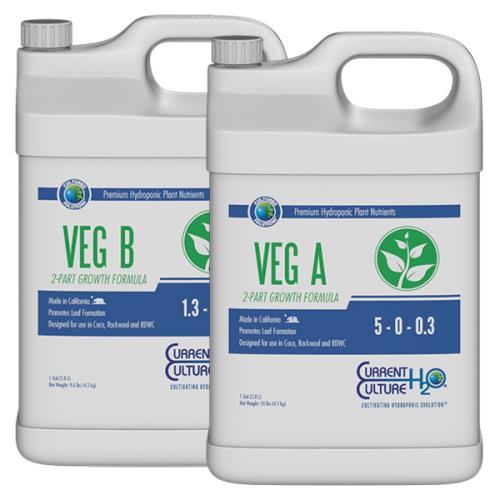
Current Culture H2O Cultured Solutions Veg A and Veg B is a 2-part liquid hydroponic vegetative nutrient for macro and micronutrients in vegetative growth. This 2-part base nutrient is built to keep vegetative nutrition complete and consistent, with a clean mineral profile that suits high-demand growth without extra complexity.
Veg A and Veg B are each formulated in a pH stable, chelated form, bringing macro and micro nutrients together in solution for high performance hydroponics. The goal is straightforward: deliver the minerals plants need in ideal ratios so the nutrient solution supports optimal uptake. If you’re building a dependable vegetative program, this liquid hydroponic nutrient keeps the focus on steady, balanced vegetative performance rather than chasing constant adjustments.
Because chelation is part of the design, the formula includes chelated micronutrients to help keep key trace elements available in solution. That matters most when plants are moving fast and you want a vegetative nutrient that stays consistent from batch to batch, supporting strong vegetative growth and uniform development across a crop. It’s a practical approach for growers who want a simple two-part base fertilizer that stays clean, mineral-forward, and repeatable.
Here’s the compact facts layer: Veg A is 5-0-0.3 and Veg B is 1.3-2-5.9. The mineral inputs include nitrate and phosphate salts such as ammonium calcium nitrate, potassium nitrate, and potassium phosphate, plus magnesium sulfate; micronutrients are supplied in chelated EDTA forms, with trace boron and molybdenum sources included.
Cultured Solutions Veg A and Veg B are suited to drip/drain to waste applications and high performance hydroponics, including recirculating water culture styles such as RDWC, DWC, NFT, and aeroponics, as well as soilless media like rockwool and coco. This is a good fit for growers who want a 2-part liquid hydroponic vegetative nutrient with a pH stable, chelated form and a clean, complete mineral foundation for vegetative growth.
Step-by-step mixing and feeding instructions for Current Culture Veg B - 1 Gallon.
Fill your reservoir or watering container with clean, room-temperature water first. Shake the bottle of Current Culture Veg B - 1 Gallon well before every use. Using the feeding schedule below, measure the recommended dose and add it directly to the water while stirring. Allow the solution to mix fully before adding any other fertilizers, additives, or supplements.
Always add nutrients to water — not the other way around. Mix thoroughly between products to ensure an even, stable nutrient solution.
Vegetative stage — Veg B
Flowering stage — Veg B
Warning – Important Safety Information
This product may cause mild skin irritation and eye irritation. Avoid unnecessary contact with skin, eyes, and clothing. Use only as directed.
General safety precautions
Read and follow all instructions on the product label and any accompanying documentation before use. Keep out of reach of children and pets. Do not ingest. Avoid breathing vapours, mist, or dust that may be generated during handling or use.
Wear appropriate personal protective equipment (PPE), such as protective gloves, long sleeves, long pants and closed-toe footwear. When there is a risk of splashing or airborne particles, use safety glasses or other suitable eye and face protection.
First aid – skin contact
IF ON SKIN OR HAIR: Remove contaminated clothing immediately. Rinse skin with clean water for several minutes, then wash with mild soap and water. If irritation or redness develops and persists, seek medical attention. Wash contaminated clothing before reuse.
First aid – eye contact
IF IN EYES: Rinse cautiously with clean water for several minutes, keeping eyelids open. Remove contact lenses if present and easy to do. Continue rinsing. If irritation persists, obtain medical advice.
First aid – ingestion and inhalation
IF SWALLOWED: Rinse mouth thoroughly with water. Do not induce vomiting unless instructed by a medical professional. Seek medical attention if you feel unwell.
IF INHALED: Move the person to fresh air and keep them comfortable for breathing. If coughing, breathing difficulty, dizziness or other symptoms occur, seek medical assistance.
Storage and handling
Store this product in its original closed container, in a cool, dry and well-ventilated area. Protect from extreme temperatures and direct sunlight. Keep container tightly sealed when not in use.
Avoid release to drains, natural waterways or outdoor soil. Dispose of unused product and empty containers in accordance with local regulations and the directions on the label.
Important: If medical advice is needed, keep the product label or container available. Always follow the specific instructions and safety recommendations provided by the manufacturer. This safety notice is intended as general guidance and does not replace official label directions or documentation.
| Nitrate Nitrogen (N) | 1.3% |
|---|---|
| Available Phosphate (P2O5) | 2.0% |
| Soluble Potash (K2O) | 5.9% |
| Water Soluble Magnesium (Mg) | 1.0% |
| Sulfur (S) | 1.3% |
1175 Stellar Drive, Unit #5
Newmarket, ON L3Y 7B8
106 Saunders Road, Unit #2A
Barrie, ON L4N 9A8
719 Krosno Boulevard
Pickering, ON L1W 1G4
915 McLeod Avenue, Unit #4
Winnipeg, MB R2G 0Y4