

Frequently purchased together
-
Athena Nutrients Blended Line CaMg - 1 Gallon
Regular price $52.99Regular price -
Athena Nutrients Blended Line PK - 1 Gallon
Regular price $52.50Regular price -
Athena Nutrients Pro Fade - 1 Gallon
Regular price $53.17Regular price


Reviews are submitted by verified customers after purchase. This section shows a summary of product feedback rather than the full individual review list.

Athena Nutrients Pro Line Core - 10 Lb
Regular price
$131.88
Regular price
Sale price
$131.88
Shipping calculated at checkout.
Store Availability
Newmarket, Ontario (Head Office)
1175 Stellar Drive, Unit #5
Newmarket, ON L3Y 7B8
- Mon10:00am–6:00pm
- Tue10:00am–6:00pm
- Wed10:00am–6:00pm
- Thu10:00am–6:00pm
- Fri10:00am–6:00pm
- Sat10:00am–4:00pm
- SunClosed


Barrie, Ontario
106 Saunders Road, Unit #2A
Barrie, ON L4N 9A8
- Mon10:00am–5:00pm
- Tue10:00am–5:00pm
- Wed10:00am–5:00pm
- Thu10:00am–5:00pm
- Fri10:00am–5:00pm
- Sat10:00am–3:00pm
- SunClosed
Winnipeg, Manitoba
915 McLeod Avenue, Unit #4
Winnipeg, MB R2G 0Y4
- Mon10:00am–6:00pm
- Tue10:00am–6:00pm
- Wed10:00am–6:00pm
- Thu10:00am–6:00pm
- Fri10:00am–6:00pm
- Sat11:00am–3:00pm
- SunClosed
Estimated Delivery Date
Order Within
—
Province
Est. Delivery
—
Quantity
Not Eligible for Free Shipping
Sign in required
Back-in-stock notification
Select the store locations where you’d like to pick up this item, or choose Shipping to have it delivered.
Email notifications are turned off
Turn on email marketing to receive back-in-stock notifications.
Open account profile
Special order request
Select the store where you’d prefer to pick up your special order. To choose a different store, unselect your current choice first.
Manufacturer Recommended Products


Description
Description
Description
Athena Nutrients Pro Line Bloom, Grow, Core is a dry soluble fertilizer trio designed to cover vegetative growth and flowering with clean, mineral-only nutrition for professional irrigation programs. This soluble mineral fertilizer set is built around clear roles: a soluble base fertilizer for baseline nutrition, a soluble vegetative fertilizer for early development, and a soluble flowering fertilizer for productive bloom.
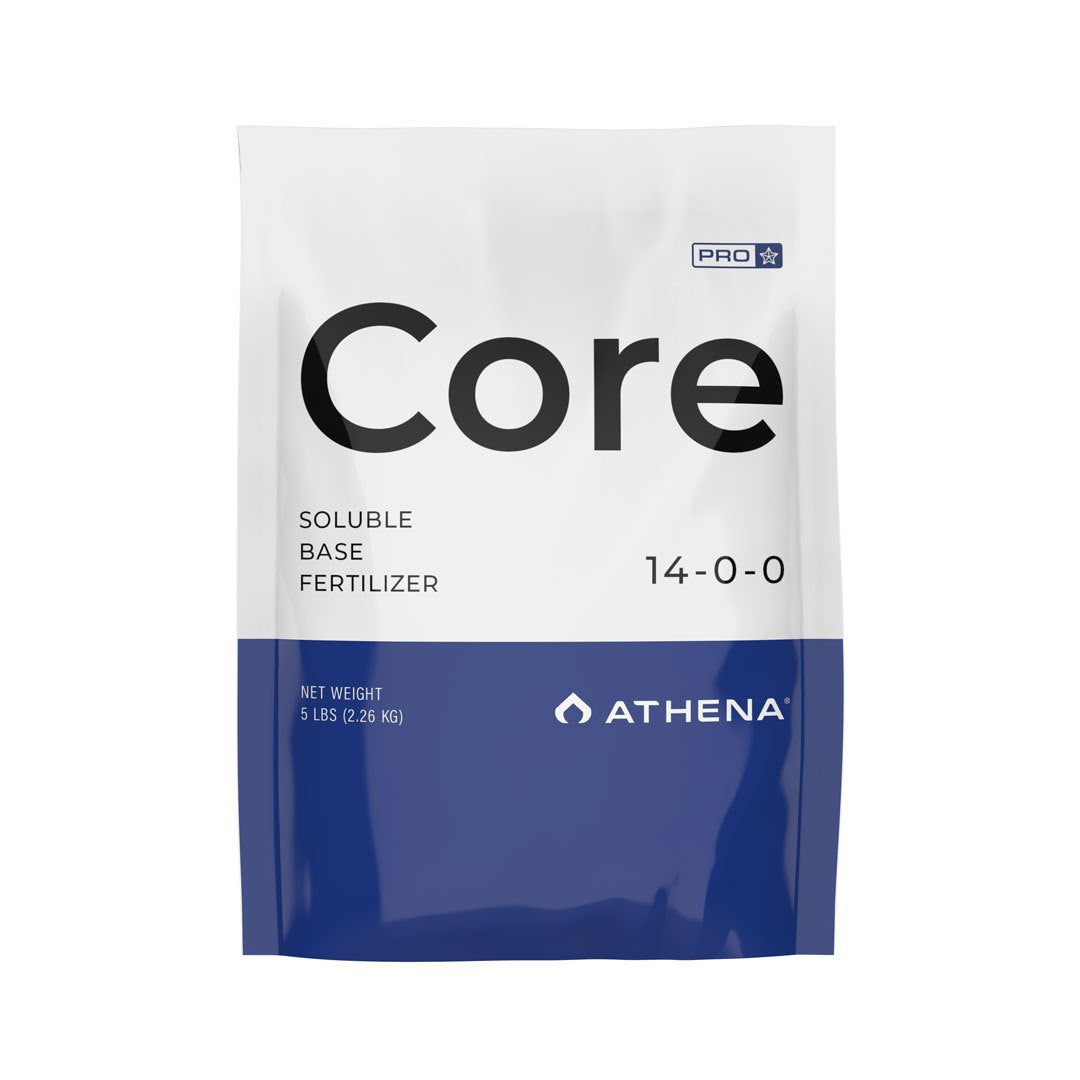
Pro Core is the foundation piece, built to provide baseline nutrition across all stages of plant growth with readily available nitrogen, calcium, and essential microelements. That combination supports core plant functions like chlorophyll and amino acid formation, structural development, and the enzyme activity tied to photosynthesis. When you want a dependable nutrient backbone that stays consistent from start to finish, Pro Core keeps the focus on steady fundamentals rather than extras.
Pro Grow is focused on the vegetative growth stage, where well-rounded nutrition supports strong roots and lush foliage. It’s described as a soluble fertilizer blend formulated for commercial cultivators to streamline irrigation, with balanced NPK and essential microelements as part of the Pro Line approach. Athena also calls out a formulation choice: Pro Grow contains essential nitrogen for vegetative growth while containing no urea or ammoniacal nitrogen, keeping the nitrogen profile straightforward for professional programs.
Pro Bloom is built for flowering plants that demand higher phosphorus and potassium to increase flower bulk and support high metabolic activity. It’s positioned as an ideal flowering fertilizer blend that contributes macro- and micro-elements, including sulfur that Athena associates with increasing flavors. For growers who want a clean bloom-phase profile, Pro Bloom stays centered on flowering nutrition and sulfur-supported finish character, without leaning on separate boosters.
Across the line, the practical differentiator is cleanliness: each product is a fully soluble dry fertilizer with no particulates or sediment, designed to keep the formulation uniform and easy to handle in large-scale routines. The Pro Line positioning emphasizes a complete formula built to reduce deficiency chasing, with mineral-only inputs and a streamlined approach meant for professional fertigation environments.
The compact facts layer is clear on packaging: Pro Core is 14-0-0, Pro Grow is 2-8-20, and Pro Bloom is 0-12-24. Key inputs across the trio include calcium nitrate and a microelement chelate package in Core (iron, manganese, copper, and zinc chelates plus boric acid and sodium molybdate), and phosphate, sulfate, and magnesium sources in Grow and Bloom, with Grow also including potassium nitrate. This set is a good fit for professional growers who want a dry soluble fertilizer program with clean dissolution, essential microelements, and phase-specific support for vegetative growth and flowering.
Pro Core is the foundation piece, built to provide baseline nutrition across all stages of plant growth with readily available nitrogen, calcium, and essential microelements. That combination supports core plant functions like chlorophyll and amino acid formation, structural development, and the enzyme activity tied to photosynthesis. When you want a dependable nutrient backbone that stays consistent from start to finish, Pro Core keeps the focus on steady fundamentals rather than extras.
Pro Grow is focused on the vegetative growth stage, where well-rounded nutrition supports strong roots and lush foliage. It’s described as a soluble fertilizer blend formulated for commercial cultivators to streamline irrigation, with balanced NPK and essential microelements as part of the Pro Line approach. Athena also calls out a formulation choice: Pro Grow contains essential nitrogen for vegetative growth while containing no urea or ammoniacal nitrogen, keeping the nitrogen profile straightforward for professional programs.
Pro Bloom is built for flowering plants that demand higher phosphorus and potassium to increase flower bulk and support high metabolic activity. It’s positioned as an ideal flowering fertilizer blend that contributes macro- and micro-elements, including sulfur that Athena associates with increasing flavors. For growers who want a clean bloom-phase profile, Pro Bloom stays centered on flowering nutrition and sulfur-supported finish character, without leaning on separate boosters.
Across the line, the practical differentiator is cleanliness: each product is a fully soluble dry fertilizer with no particulates or sediment, designed to keep the formulation uniform and easy to handle in large-scale routines. The Pro Line positioning emphasizes a complete formula built to reduce deficiency chasing, with mineral-only inputs and a streamlined approach meant for professional fertigation environments.
The compact facts layer is clear on packaging: Pro Core is 14-0-0, Pro Grow is 2-8-20, and Pro Bloom is 0-12-24. Key inputs across the trio include calcium nitrate and a microelement chelate package in Core (iron, manganese, copper, and zinc chelates plus boric acid and sodium molybdate), and phosphate, sulfate, and magnesium sources in Grow and Bloom, with Grow also including potassium nitrate. This set is a good fit for professional growers who want a dry soluble fertilizer program with clean dissolution, essential microelements, and phase-specific support for vegetative growth and flowering.
Product benefits
Vegetative Stage; Flowering Stage; Indoor; Outdoor; Regular Watering; Watering Systems; Hydroponics; Coco Coir Safe; Soil; Soilless; Baseline Nutrition; All-Stage Support; Micronutrient Support; Photosynthesis Support; Chlorophyll Support; Fully Water Soluble; Dripper Friendly; Consistent Results.
Guaranteed analysis
Total Nitrogen (N): 14.0%; Calcium (Ca): 17.0%; Boron (B): 0.015%; Chelated Copper (Cu): 0.01%; Chelated Iron (Fe): 0.1%; Chelated Manganese (Mn): 0.04%; Molybdenum (Mo): 0.01%; Chelated Zinc (Zn): 0.013%.
Derived from
Calcium Nitrate; Iron EDTA; Manganese EDTA; Copper EDTA; Zinc EDTA; Boric Acid; Sodium Molybdate.
Warnings & Safety
Warnings & Safety
Important – Safety Information
General Safety Precautions
First Aid – Skin Contact
First Aid – Eye Contact
First Aid – Ingestion
First aid – Inhalation
Storage And Handling
Important – Medical
Guaranteed Minimum Analysis
Guaranteed Minimum Analysis
| Total Nitrogen (N) | 14.0% |
|---|---|
| Calcium (Ca) | 17.0% |
| Boron (B) | 0.015% |
| Chelated Copper (Cu) | 0.01% |
| Chelated Iron (Fe) | 0.1% |
| Chelated Manganese (Mn) | 0.04% |
| Molybdenum (Mo) | 0.01% |
| Chelated Zinc (Zn) | 0.013% |
Frequently Asked Questions
Frequently Asked Questions
Why is total nitrogen (N) important for plant growth, and what makes it different from other nutrients?
Why is calcium important for plant growth?
Why is boron (B) essential for strong plant development, and what makes it different from other micronutrients?
Why is chelated copper (Cu) important for plant growth, and what makes it unique from other micronutrients?
Why is chelated iron important for plants, and what makes it different from other iron sources?
Why is chelated manganese (Mn) important for plant growth?
Why is molybdenum (Mo) important for plant growth?
Why is chelated zinc (Zn) important for plants?
Why do growers use calcium nitrate instead of other calcium sources?
Why is copper EDTA used in plant nutrition instead of plain copper?
What makes boric acid important for plants compared to other micronutrients?
What makes iron EDTA effective for fixing pale new leaves?
What makes manganese EDTA different from other manganese sources?
What makes zinc EDTA better for preventing zinc lockout?
What does sodium molybdate do for plants?
Safety & Technical Documents
Safety & Technical Documents
Frequently purchased together
-
Athena Nutrients Blended Line CaMg - 1 Gallon
Regular price $52.99Regular price -
Athena Nutrients Blended Line PK - 1 Gallon
Regular price $52.50Regular price -
Athena Nutrients Pro Fade - 1 Gallon
Regular price $53.17Regular price
Reviews are submitted by verified customers after purchase. This section shows a summary of product feedback rather than the full individual review list.

Nutrient Feed Chart
Vegetative — Week 1
-
Pro Core—
-
Pro Grow—
-
Pro Bloom—
-
Cleanse—
Flowering — Week 1
-
Pro Core—
-
Pro Grow—
-
Pro Bloom—
-
Cleanse—
Vegetative — Week 1
-
Pro Core—
-
Pro Grow—
-
Pro Bloom—
-
Fade—
-
Cleanse—
Flowering — Week 1
-
Pro Core—
-
Pro Grow—
-
Pro Bloom—
-
Fade—
-
Cleanse—